
Alabama Power Fined for Air Emissions Exceedance at Plant Barry
Alabama Power will pay a $35,000 fine after exceeding hydrochloric acid emission limits at its Plant Barry power plant in north Mobile County.
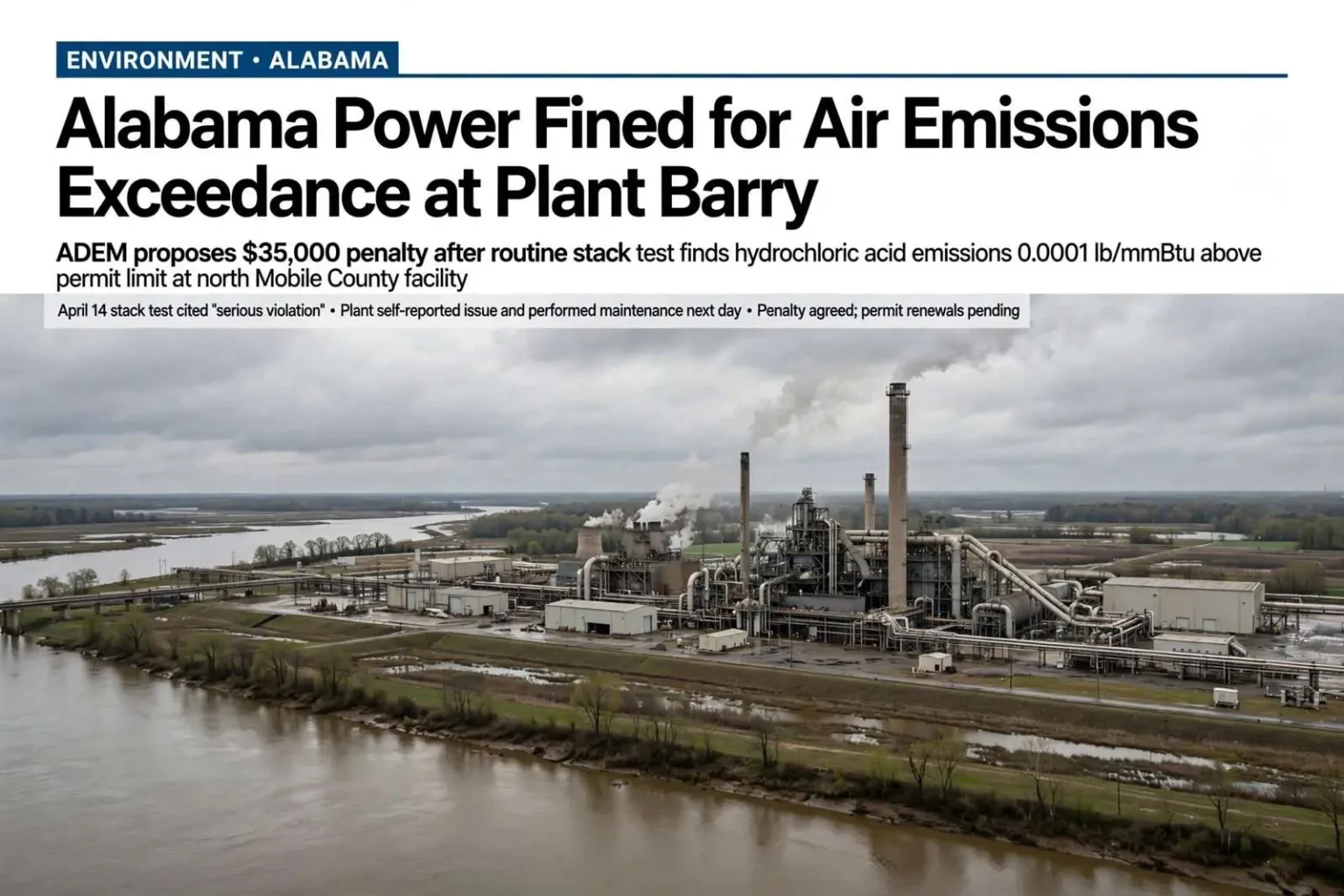
The Alabama Department of Environmental Management has proposed a $35,000 fine against Alabama Power after the utility exceeded allowable hydrochloric acid emissions at its Plant Barry plant in north Mobile County.
In a notice issued Friday, ADEM said routine testing on April 14 measured hydrochloric acid emissions at 0.0021 pounds per million British thermal units — about 0.0001 pounds above the utility’s air permit limit. The department called the exceedance a “serious violation” but said it was “not aware of any irreparable harm to the environment” and noted Alabama Power self-reported the issue and performed maintenance the next day.
Alabama Power attributed the event to a sudden introduction of moisture into its dry sorbent injection system, which caused unusual plugging of the injection lances. “The violation was self-reported and, according to the order, was addressed and did not cause an impact to the environment,” said spokesperson Elizabeth Weatherford Thomas.
The company has agreed to pay the $35,000 penalty. It is also seeking renewal of its air permit and two water permits at Plant Barry.
What the Exceedance Means
Hydrochloric acid emissions fall into the category of acid gases that power plants are required to control under their air permits, which in turn are built on federal air toxics standards for electric generating units. When coal is burned, chlorine present in the fuel combines in the combustion process to form hydrogen chloride, which exits the plant through the stack unless it is captured by pollution control equipment. Permit limits are set at levels designed to keep those emissions within the ranges federal regulators have determined to be protective, and a routine stack test that reads above the permitted ceiling — even by a small margin — is treated by the state as a violation.
The margin in this case was narrow. A reading of 0.0021 pounds per million British thermal units sat just beyond the permitted ceiling, a difference measured in the fourth decimal place. Yet ADEM’s characterization of the exceedance as a serious violation reflects how the regulatory framework works: permit limits are bright lines, and a test result above the line triggers enforcement regardless of how close the number is to the threshold or whether any measurable harm resulted.
The problem originated, according to the company’s account, in the equipment installed to keep such emissions in check. Dry sorbent injection systems work by blowing a powdered alkaline material directly into the exhaust stream, where it chemically binds with acid gases before they reach the stack. The system depends on a steady, unobstructed flow of sorbent through a network of injection lances. When moisture entered that system, the powder clumped and the lances plugged, reducing the system’s effectiveness and allowing emissions to climb past the permitted level during the April 14 test.
Company crews performed maintenance the day after the test, and the utility’s account of the episode, as reflected in the order, indicates the condition was corrected promptly after it was identified.
Plant Barry’s Place in North Mobile County
Plant Barry sits along the Mobile River in the northern reaches of Mobile County, near the community of Bucks, and has operated for decades as one of the anchors of the regional power grid. The site has long been among the largest generating facilities in the state, and over the years it has been the focus of repeated environmental attention as its generation mix and pollution controls have evolved. Its location on the river places it upstream of Mobile Bay, making its water permits — two of which the company now seeks to renew — a matter of ongoing interest to conservation groups that monitor the bay’s health.
The facility’s air emissions are governed by a permit that spells out ceilings for a range of pollutants, with compliance verified through periodic stack testing. Those tests, like the one conducted April 14, are the mechanism by which regulators confirm that the controls a plant has committed to install and maintain are actually performing as promised. When a test shows a result above the permitted ceiling, the state issues a notice of violation and may propose a penalty, which is the process now playing out in this case.
The Utility’s Response
Alabama Power has agreed to pay the $35,000 penalty, and the company’s public posture has emphasized both the self-reporting and the quick repair. “The violation was self-reported and, according to the order, was addressed and did not cause an impact to the environment,” Weatherford Thomas said. From the utility’s perspective, the sequence — a narrow exceedance caught by scheduled testing, reported to the state, and corrected within a day — represents the compliance system working as designed.
State regulators, for their part, acknowledged in the order that they were not aware of any irreparable harm to the environment. Even so, the proposed fine signals that ADEM treats an exceedance of an acid gas limit as a matter requiring a monetary consequence, in line with its approach to comparable violations at industrial facilities across the state.
Environmental Advocates Raise Monitoring Questions
Environmental advocates say a single quarterly test may understate actual emissions. Their concern is arithmetic: a stack test captures a snapshot of performance over a limited period, while a plant operates around the clock for months between tests. If the control equipment performs well during the test window but slips at other times — as the plugged injection lances here suggest can happen — the official record may not reflect what the community actually experienced.
Mobile Baykeeper Program Manager Cade Kistler noted that Toxic Release Inventory data showed the plant released about 30,000 pounds of hydrochloric acid through stack emissions last year, and called for more frequent monitoring and reporting requirements. The Toxic Release Inventory is an EPA program under which industrial facilities report their annual releases of listed chemicals, giving the public a year-by-year accounting that advocates argue provides a fuller picture than periodic compliance tests alone.
Kistler’s organization has historically pushed for tighter scrutiny of the industries clustered along the Mobile River and Mobile Bay, where power generation, paper production, and chemical manufacturing all operate in close proximity. The group’s position on Plant Barry follows that pattern: more data, reported more often, with the public able to see it.
The Permit Renewals Ahead
Against that backdrop, Alabama Power’s pending permit renewals at Plant Barry carry added weight. The company is seeking renewal of its air permit and two water permits at the site, processes that allow the public and advocacy organizations to review the terms under which the plant will operate going forward. Air permit renewals set the emission ceilings for the years ahead, while water permits govern what the facility may discharge into the river system that feeds Mobile Bay.
The proposed fine and the permit renewals are separate matters, but they intersect in practice. Advocates say the April exceedance illustrates why permit terms, monitoring requirements, and enforcement all deserve close attention during renewal proceedings. A utility seeking renewed permits, they argue, should expect questions about how reliably its pollution controls performed in the current permit term.
For ADEM, the case will close with the payment of the agreed penalty unless further issues surface. The department’s enforcement orders typically document the violation, the amount of the penalty, and any corrective actions, and the company’s agreement to pay resolves the matter administratively. The order’s language — serious violation, no known irreparable harm — captures the split assessment that frequently characterizes cases of this kind: a genuine breach of a legal limit, handled through the standard enforcement channel, with no finding of lasting environmental damage.
What It Means for Nearby Residents
For residents of north Mobile County, the episode is a reminder of the scale of the industrial operations that share their landscape. Plants of this size burn fuel at enormous rates, and even emission limits expressed in fractions of a pound per million British thermal units translate into tons of material moving through stacks over a year. Hydrochloric acid gas at low concentrations is a respiratory irritant, and communities near large combustion sources have a long-standing interest in whether the controls on those sources hold steady.
The regulatory structure is built to answer that question through permits, tests, and enforcement, and this case moved through that structure as intended: a test found a problem, the company reported it, the state proposed a penalty, and the equipment was repaired. The open question — the one advocates will continue to press — is whether quarterly testing gives regulators and residents a true picture of day-to-day performance, or only a favorable glimpse of it.
With the penalty agreed and the injection system repaired, attention now shifts to the permit renewals, where the terms of future monitoring will be set. Those proceedings will determine whether the reporting framework that produced this case — a single test, four months apart, backed by annual inventory reporting — remains the standard at Plant Barry, or whether the record of the past year persuades regulators to require a closer look more often.
The Bigger Regulatory Picture
The Plant Barry case arrives amid broader attention to acid gas controls at power plants across the Southeast. Controls like dry sorbent injection became widespread as federal standards tightened, and their performance depends heavily on maintenance routines and the consistency of the sorbent supply. Moisture intrusion of the kind Alabama Power described is a recognized failure mode for such systems, since the powdered sorbent is hygroscopic and clumps when it gets damp, choking the lances designed to disperse it evenly into the exhaust stream.
How utilities handle those failures matters to the enforcement record. A self-report accompanied by prompt maintenance generally weighs in the company’s favor when the state calculates a penalty, as it appears to have done here, where the proposed $35,000 amount reflects a violation with a narrow measured exceedance, a quick correction, and no finding of environmental harm. Larger penalties have historically followed cases where exceedances went undetected or unreported, or where tests showed wide departures from permitted levels.
For now, the sequence of events is settled: a routine April 14 test, a narrow exceedance, a next-day repair, a proposed fine, and an agreement to pay. The remaining open threads are the plant’s air and water permit renewals, where the public will have the opportunity to weigh in on the terms that will govern the facility in the years ahead. Those who follow Plant Barry closely — from ADEM’s permitting staff to the bay advocates who track its emissions — will be watching whether the monitoring provisions in the renewed permits reflect the lessons of the past year, or preserve the status quo that produced it.


