Alabama Power Restores Electricity to About 1,500 Theodore Customers After Equipment Failure
Alabama Power restored electricity to about 1,500 Theodore customers on August 5, 2020, after an equipment failure caused an afternoon outage in the area.
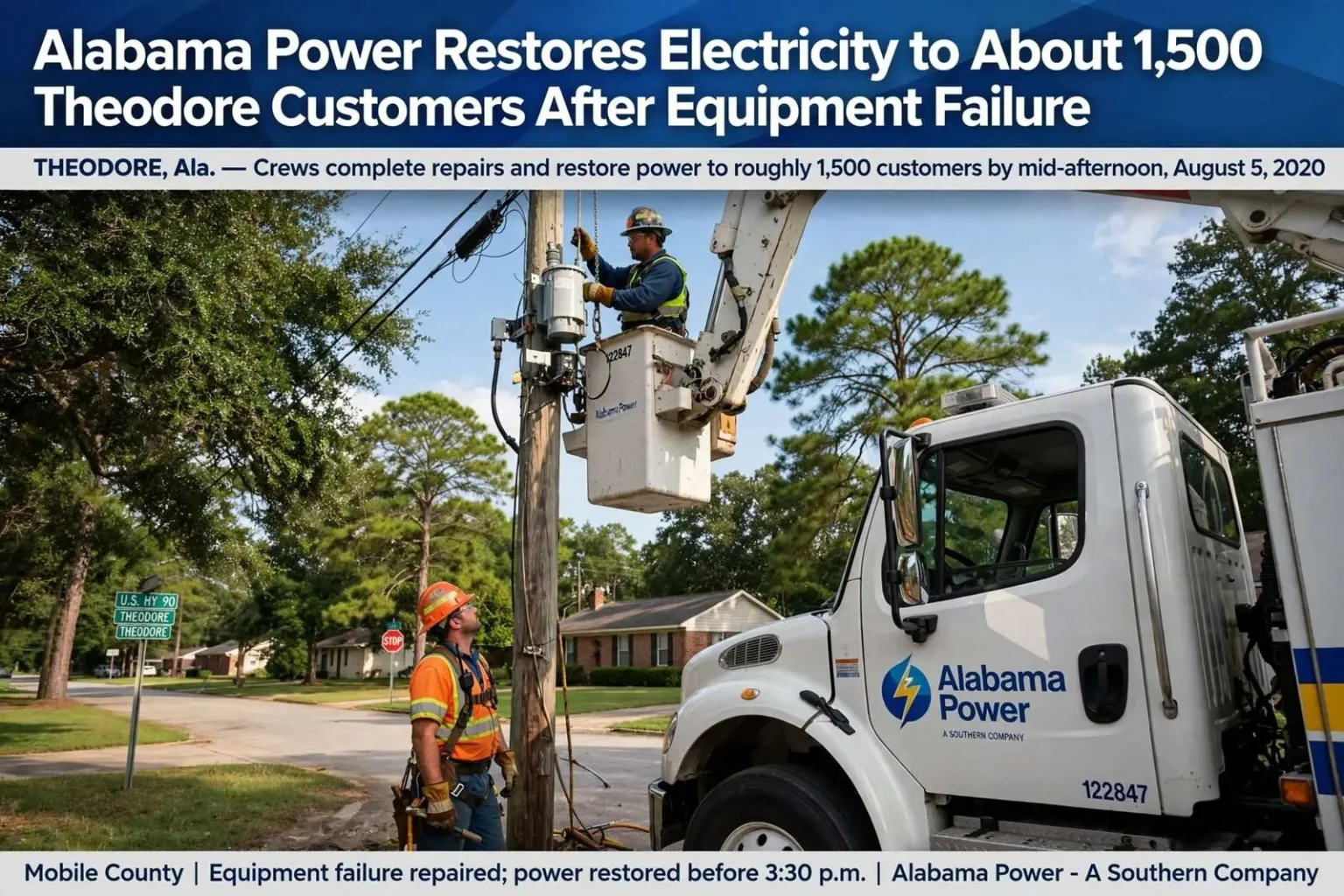
THEODORE, Ala. — Alabama Power crews restored electricity to roughly 1,500 customers in the Theodore area of Mobile County on the afternoon of August 5, 2020, after an equipment failure knocked out service. The outage, though brief by the standards of Gulf Coast storm restoration, darkened homes and businesses across a slice of the community south of Mobile for several hours on a summer afternoon.
The utility announced shortly before noon that line crews were responding to the outage and expected most affected customers to be back on by about 3:30 p.m. In a mid-afternoon update, the company confirmed that power had been restored to customers in the area, closing out an incident that had occupied crews for the better part of a workday.
A fast response
Theodore, located just south of Mobile along U.S. Highway 90, is one of the larger communities in Mobile County served by Alabama Power’s Mobile division. Equipment failures such as failed transformers or damaged switching gear are among the most common causes of localized outages, and utilities typically prioritize them because repairs can be made at a single point rather than across miles of line.
That is precisely why the Theodore outage moved quickly. When a failure is concentrated — a transformer at a substation, a piece of switching equipment on a distribution feeder — crews know roughly where to go from the moment the outage appears on the grid’s monitoring systems, and a restoration depends on the repair itself rather than a hunt for the cause. Line technicians isolated the fault, replaced or bypassed the failed equipment, and re-energized the feeder well ahead of the schedule the company had given the public, with the mid-afternoon confirmation arriving close to the 3:30 p.m. estimate made before noon.
The company thanked customers for their patience while crews worked to bring the neighborhood back online safely.
How Alabama Power handles outages
Alabama Power, a subsidiary of Southern Company, serves hundreds of thousands of customers across the state through division offices, and its Mobile division covers the counties of the southwest corner, including all of Mobile County. Outage response runs on a priority system: life-threatening situations and large feeder failures first, then smaller clusters, then single-home outages. A mid-day outage affecting 1,500 customers ranks as a significant single event, large enough to draw the public announcement the company made but small enough that one crew assignment could carry it.
Customers tracked the progress the same way most do now — through the utility’s online outage map and automated alerts, which report estimated restoration times and update them as crews work. Those estimates are calculations, not promises, based on the type of equipment involved, the crew count assigned and historical repair times, which is why the Theodore estimate held as steady as it did: the utility had identified a single-point equipment failure, and single-point failures are the most predictable category of restoration the company handles.
Why equipment fails on summer afternoons
Early August in south Alabama is the most punishing stretch of the year on the grid. Air conditioners run at full load through the afternoon, pushing distribution equipment to its rated limits, and the heat degrades the components themselves — transformer insulation, switches, connectors that expand and contract with temperature swings. Failures cluster in exactly these conditions, and a mid-day August outage in Theodore fit the pattern utilities see statewide every summer.
When a transformer or switchgear fails under load, the protective devices on the feeder — reclosers and fuses — operate to isolate the fault, which is what protects the rest of the line from damage and keeps the outage footprint contained to the affected area. That protection worked as designed in this case: about 1,500 customers lost power rather than the far larger number who would have been dark had the fault propagated, and crews could work on a de-energized section in relative safety.
What Theodore residents can expect
For the affected neighborhood, an afternoon outage on a weekday carries costs beyond the inconvenience. Perishable food in refrigerators holds for roughly four hours if doors stay closed — a threshold the Theodore restoration beat. Home-based businesses, medical equipment users and shops along the Highway 90 corridor all feel a mid-day interruption acutely, which is why the utility’s before-noon announcement and steady updates mattered: knowing the window, families and business owners could plan around it rather than wait blind.
Customers who depend on powered medical equipment are generally encouraged to register with their utility so their addresses are flagged for priority restoration awareness, and to have a backup plan — a charged phone, a battery backup, a relative’s address within driving distance — for exactly these events. The Theodore outage ended well within tolerance, but its lesson is the one Gulf Coast residents relearn with every storm season: the grid is strong, but it is not immune, and an hour’s preparation covers a day’s disruption.
The bigger picture for Mobile County
Outages like the August 5 event sit at the routine end of a spectrum whose other end includes hurricanes. Alabama Power’s Mobile division has rebuilt its system repeatedly in the two decades since Hurricane Ivan and Hurricane Katrina, hardening lines, trimming rights-of-way and installing smarter grid equipment that pinpoints faults faster. Those investments show up in numbers like the ones from Theodore — a 1,500-customer outage located, repaired and restored in a single afternoon, with accurate public estimates issued before lunch.
The company’s closing thanks to customers was the customary sign-off on a clean restoration. For the residents of Theodore, the lights were back on by mid-afternoon, the cause was a single point of failed equipment, and the incident closed as a routine summer workday for the crews who fixed it — a small demonstration of how the region’s power system is built to absorb failure without turning it into an emergency.
Inside a restoration crew’s afternoon
The work that restored Theodore’s power follows a sequence that repeats across Alabama Power’s territory dozens of times a week. First, the system operator in the control center confirms the faulted section and de-energizes it, because no crew touches a line until it is grounded and proven dead. Then the line technicians arrive with the equipment — a bucket truck, a replacement transformer or switch, splicing gear and grounds — and the physical repair begins: locating the failed component, cutting it out of the circuit, installing and testing the new equipment, and only then calling the control room to close the switches back in.
Re-energizing is its own step, not an afterthought. Crews watch for the inrush when a feeder picks up hundreds of air conditioners at once, and they stagger the restoration across sections when the load demands it. The final act is verification — confirming from the system’s side that customers are back on and from the field that the equipment is holding. The mid-afternoon update that announced the Theodore restoration complete is the end of that checklist, and its timing close to the estimate reflects a repair that unfolded exactly as the utility’s model said it would.
What neighbors saw on the street
For residents of the affected area, the visible side of the restoration is a bucket truck on the shoulder and technicians in arc-rated gear working through an August afternoon. The utility asks the public to keep clear of crews, to treat every downed line as energized, and to report outages rather than assume the company already knows — though on a feeder affecting 1,500 customers, the outage map registered the event before the calls came in.
Businesses along Highway 90 and the surrounding residential streets handled the interruption the way south Alabama establishments do: generators where they had them, doors propped for airflow where they did not, and a shared neighborhood awareness of which houses on the block had someone on oxygen or a medical device. The hours without power passed without reported incidents, and by the time the company posted its all-clear, the neighborhood’s afternoon had resumed as if the grid had never blinked.
The value of a quick, clear announcement
The Theodore event is also a small case study in outage communication. A before-noon announcement that named the cause in general terms, gave an estimated restoration window and committed to updates let customers plan their afternoon — schools, offices and shops could make arrangements rather than sit in uncertainty. Utilities that communicate slowly pay for it in call volume and in public frustration that far outlasts the outage itself; Alabama Power’s handling of the incident kept the community informed on a schedule that the crews then met.
Two updates, a clear estimate, and a restoration inside the promised window — for a mid-summer equipment failure affecting 1,500 customers, that is the standard working model. The Theodore outage of August 5, 2020, entered the record as what it was: a single failed component, a crew that knew its job, and a community back online by mid-afternoon.