Alabama public schools to stay closed; at-home learning begins April 6
Alabama closed public schools for the rest of the year because of COVID-19, shifting to at-home learning beginning April 6.
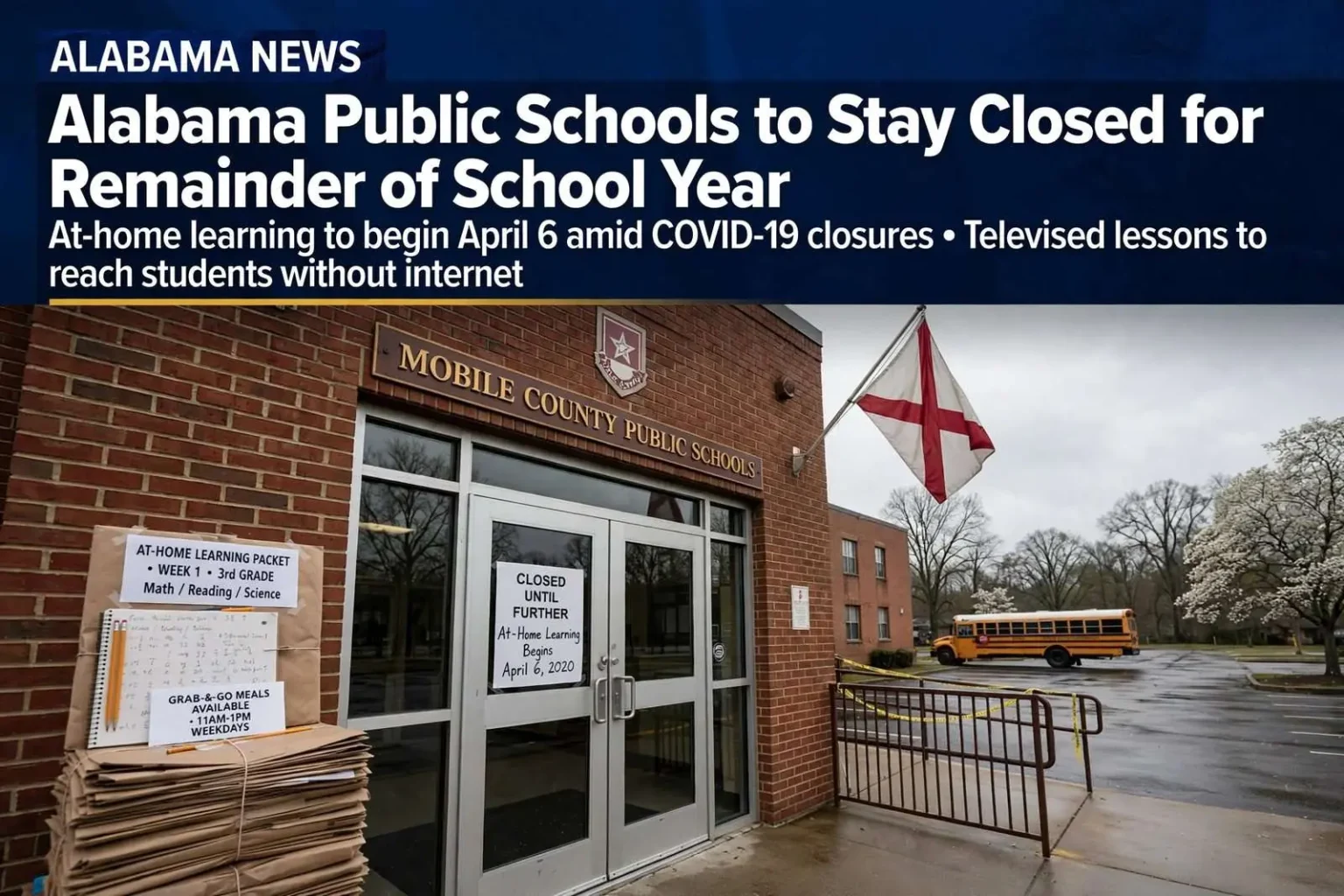
Alabama’s public schools will remain closed for the rest of the school year, and students will begin receiving lessons at home starting April 6, state officials announced. Gov. Kay Ivey and State Superintendent of Education Eric Mackey said rising COVID-19 cases left them little choice but to extend the closure first ordered in March. It is the first time Alabama has shut this many schools for this long.
The announcement ended weeks of uncertainty for families and educators across the state. Since the initial closure order in March, districts had been preparing for a range of possibilities, from a quick return after spring break to an extended shutdown, and the decision made clear that the 2019-2020 school year would conclude without students returning to classrooms. More than 130 school systems serving roughly 720,000 students were affected, making it the most sweeping interruption to public education in Alabama’s modern history.
Mackey said the Alabama State Department of Education will work with each school system to tailor a plan that fits its community. Some districts already have online platforms; others will use take-home packets, and Alabama Public Television will broadcast lessons during the day to reach homes without reliable internet. The multi-track approach reflects the state’s digital divide, where broadband access varies dramatically between metropolitan areas and rural counties.
The television component emerged as one of the plan’s most practical elements. Alabama Public Television, the state’s public broadcasting network, reaches virtually every county through its transmitters, and its daytime lineup was converted to instructional programming so that students without computers or home internet could keep learning through a television set. Educators described it as a return to an older technology solving a new problem, and other states watching Alabama’s rollout adopted similar arrangements with their own public broadcasters.
Local impact in Mobile County
Mobile County Schools Superintendent Chresal Threadgill told teachers and parents that the week of the announcement would still be treated as spring break and urged them to limit contact with students. When local at-home plans launch April 6, the goal is to keep children learning until classrooms can reopen.
Mobile County’s system, the largest in Alabama, faced particular logistical challenges in building its remote learning program. The district spans urban Mobile, suburban communities and rural stretches of the county, and its students’ access to devices and internet varies as widely as the geography. District staff spent the intervening weeks assembling paper packets, coordinating device loans and setting up online classrooms, work that continued even as Threadgill asked teachers to protect the remains of the break.
Grading and credit questions loomed over the transition. State guidance directed districts to hold students harmless for circumstances beyond their control, and systems developed policies for completing coursework, calculating final grades and promoting students without standardized test results that were canceled along with the school year. Seniors presented the most delicate case, with districts required to ensure that the Class of 2020 could meet graduation requirements despite the lost months of in-person instruction.
All spring high school sports and extracurricular activities are canceled statewide. The announcement by the Alabama High School Athletic Association and state officials ended seasons in progress across baseball, softball, soccer, track and field, golf and tennis, cutting short playoff runs and senior seasons across every classification. Band competitions, theater productions, awards banquets and scholarship signing ceremonies went with them, losses that educators acknowledged would be felt well beyond the standings.
For many families, athletics and activities are also the structure around which the school year is organized, and the cancellation rippled through communities where Friday night games and spring tournaments anchor social calendars. School booster clubs lost fundraising events, senior athletes lost final seasons they had trained for over four years, and coaches across the state had to deliver the news to rosters that had been together since the fall.
Mackey said he hopes graduation ceremonies for the Class of 2020 can be held later in the summer once public health limits are lifted. The prospect of postponed ceremonies, rather than canceled ones, became a lifeline for districts planning alternatives, and some systems began discussing outdoor celebrations, drive-through diploma presentations and other contingencies in case traditional commencement remained impossible by summer.
The shutdown’s impact on school operations extended well beyond instruction. School buildings across Alabama serve as feeding sites, and districts mobilized buses and cafeteria staff to distribute free meals to students who rely on school breakfasts and lunches, Mobile County among the systems running grab-and-go distribution sites. Custodial and transportation staff shifted to new duties, and central offices became command centers for coordinating everything from meal routes to device checkout.
Teachers faced the steepest learning curve of all. Veterans of decades in classrooms suddenly found themselves building lessons for delivery through video calls, learning management systems and paper packets, often while managing their own children’s learning at home. The state department offered training resources, and districts leaned on their instructional technology coaches to bring faculties up to speed in a matter of days rather than the months such transitions normally take.
Child care and economic effects compounded the educational ones. The closures sent working parents scrambling for supervision, and the loss of school-based jobs, bus routes and contracting hit local economies already reeling from business shutdowns. State leaders acknowledged that keeping children learning was only one dimension of what schools had been providing; for many communities, the daily routine of school was itself a form of stability that vanished overnight.
What April 6 promised, then, was less a replacement for school than a bridge across the gap, built differently in every district according to its resources. Students from Huntsville to Mobile logged into unfamiliar platforms or picked up packets from empty parking lots, and a state that had never attempted anything on this scale improvised its way forward. Whether the experiment would carry students successfully to summer, and whether graduation could indeed be salvaged, remained the open question in every superintendent’s office as the state’s classrooms went quiet.
The equity concerns ran deeper than devices. Educators noted that students with disabilities depend on individualized services, therapies and routines that cannot be delivered through a packet or a broadcast, and districts worked to adapt individualized education plans to remote conditions. English language learners, homeless students and children in unstable housing situations all faced additional barriers, and school social workers and counselors shifted to remote outreach to keep families connected to the services schools normally provide in person.
The pandemic also arrived during the spring testing and accountability season, and Alabama had already secured federal waivers allowing it to skip the annual assessments that feed the state’s report cards. That spared schools the immediate accountability consequences of a disrupted year, but it also left officials without the data they normally use to measure learning, and researchers warned that the effects of the lost instructional time would show up for years in achievement patterns that districts would have to track themselves.
Alabama was not alone in the shutdown, of course. Every state in the nation eventually closed its schools that spring, affecting tens of millions of students, and states traded notes on remote learning models as the weeks went on. Alabama’s decision to keep classrooms closed for the remainder of the year put it among the states that acted earliest and most definitively, a choice officials defended by pointing to the state’s relatively strained rural health care capacity and the trajectory of the outbreak.
For high school seniors, the announcement transformed the final weeks of a thirteen-year career into something none of them had imagined. Proms, senior trips, scholarship days and the ordinary rituals of the last semester all disappeared with the closure order, and teachers found themselves writing farewell messages to students they would not see again in person. Some districts organized virtual senior nights and online celebrations, but educators acknowledged that nothing fully substituted for the shared experience of a final semester together.
The state’s plan also anticipated a long tail beyond spring. Officials cautioned that reopening in the fall would depend on public health conditions and might involve distancing measures, altered schedules or hybrid arrangements, and districts were told to begin planning for multiple scenarios. The April 6 launch of at-home learning was framed not as a temporary stopgap but as the beginning of a longer period in which Alabama’s schools would operate in ways no generation of educators had experienced.
In Mobile County, the district’s communications became a daily lifeline for tens of thousands of families navigating the new arrangements, with updates on meal sites, packet distribution and online resources delivered through text alerts and social media. Threadgill’s message to teachers and parents emphasized patience, urging everyone to give the distance-learning model time to find its footing. District leaders also flagged attendance tracking as a challenge, since counting students who are learning from kitchens and living rooms required new definitions of what it means to be present.
By the time the at-home plans went live on April 6, the statewide machinery was in motion: packets in backpacks and at pickup tables, teachers logged into new platforms, and Alabama Public Television carrying lessons into living rooms from the Tennessee Valley to the Gulf Coast. The school year would finish in a form no one had planned, but the state’s intention was fixed, that learning would continue even with every classroom door closed.