Alabama ranks second worst state to live in, U.S. News says
U.S. News & World Report ranked Alabama the second-worst state to live in, ahead of only Louisiana, citing education and health care.
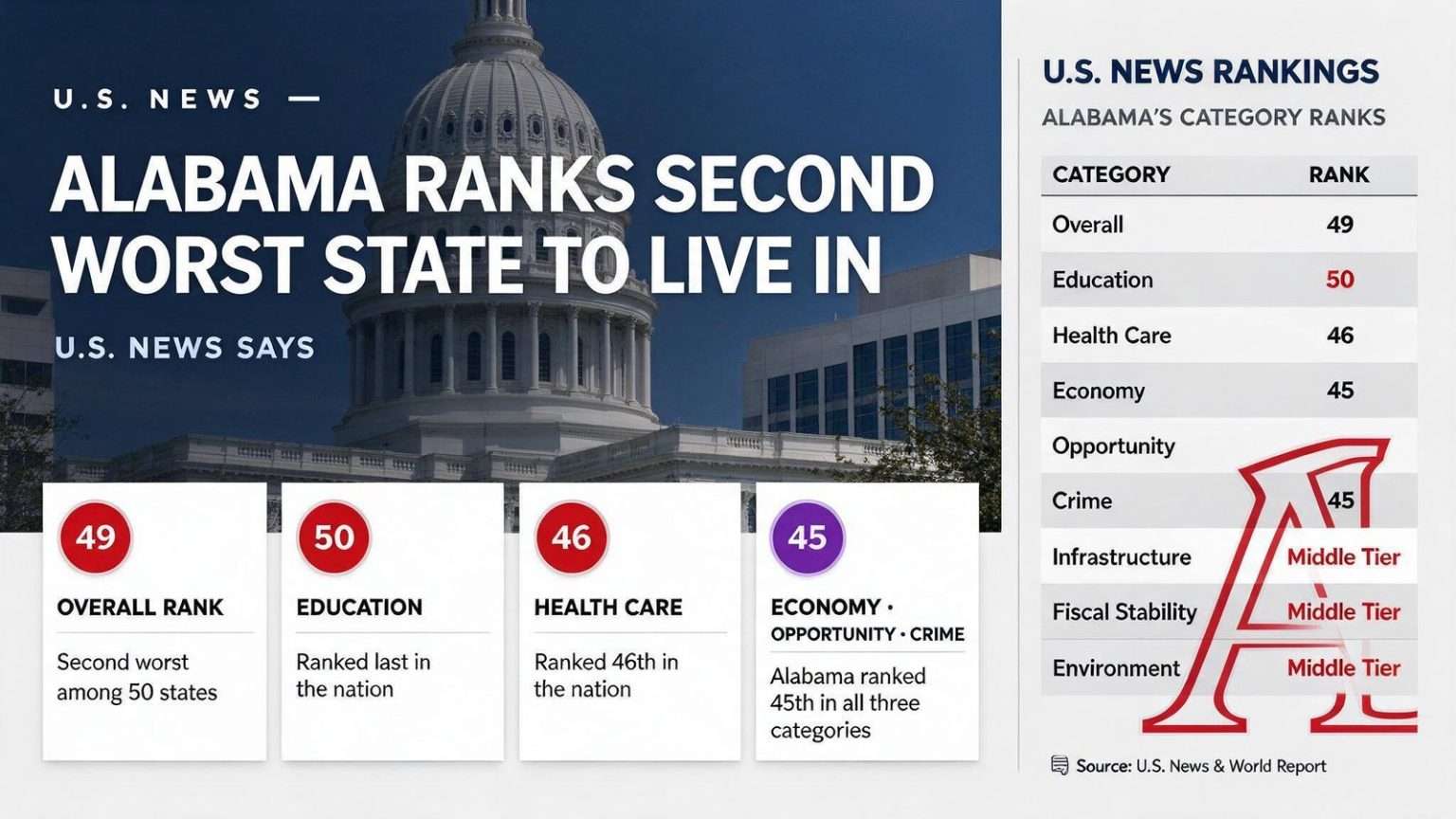
Alabama ranks as the second-worst state in the nation to live in, according to new rankings from U.S. News & World Report. The only state that fared worse was Louisiana, the publication found, leaving Alabama 49th among the 50 states in the overall assessment.
U.S. News weighed eight categories in building the rankings, placing the most weight on health care and education — factors its surveys show matter most to residents when they evaluate where they live. Alabama’s numbers in those two cornerstone categories dragged down its overall position: the state ranked last in the nation in education and 46th in health care.
The state also landed at 45th in economy, 45th in opportunity, and 45th in crime, according to the report. The survey additionally examined infrastructure, fiscal stability, and the environment, completing the eight-category framework the publication uses to compare states on the conditions that shape daily life.
The rankings are built from a mix of federal data — statistics on everything from health insurance coverage and hospital quality to test scores, income, crime rates, and road conditions — combined with survey responses about what residents value. Because the methodology emphasizes health care and education above all else, states that struggle in those areas face an uphill climb in the overall standings regardless of strengths elsewhere.
Education: The 50th-Place Finish
Alabama’s last-place ranking in education reflects long-documented challenges in its public schools. The state has spent years near the bottom of national measures of student achievement, including standardized test results in reading and math that trail most other states across grade levels.
Funding has been a persistent issue. Alabama’s school system relies heavily on the state’s Foundation Program, supplemented by local taxes that vary dramatically by district — wealthier suburban systems can raise far more per student than rural or urban systems with weaker tax bases. The state’s use of sales taxes for school funding also makes education budgets unusually vulnerable to economic downturns, a vulnerability demonstrated by the repeated proration, or mid-year budget cuts, that hit Alabama schools during recessions.
State leaders have periodically launched reform efforts in response to such rankings, including accountability programs, charter school legislation, and interventions in struggling districts. Results, however, have been slow to move the needle on the national measures that feed rankings like U.S. News’s.
The education ranking carries consequences beyond pride. Companies weighing locations for new plants and offices routinely cite workforce quality and educational attainment among their top considerations, meaning the state’s position on such lists factors directly into economic development pitches.
Health Care: 46th and the Rural Hospital Crisis
Alabama’s 46th-place health care ranking mirrors problems that health policy researchers have documented for years: high rates of chronic disease, elevated infant mortality, large uninsured populations in the coverage gap, and a shrinking network of rural hospitals.
Rural hospital closures have been the most visible symptom. Across the state’s Black Belt and other rural regions, hospitals operating on thin margins have closed or cut services, leaving residents to travel long distances for emergency care and maternity services. Health officials have repeatedly tied the closures to the state’s decision against expanding Medicaid, which would have extended coverage to more low-income adults and stabilized hospital finances with federal dollars.
The state’s health outcomes compound the access problem. Alabama has ranked among the highest states in obesity and diabetes rates, and its infant mortality rate has been among the worst in the nation — statistics that weigh heavily in composite health rankings of the kind U.S. News produces.
For residents, the numbers translate into everyday realities: fewer doctors per capita in many counties, longer drives for specialists, and higher rates of preventable illness. Public health leaders have argued that closing the gaps requires both coverage expansion and recruitment of providers to underserved areas, efforts that have moved slowly.
Economy, Opportunity, and Crime: Three 45s
Alabama’s three-way tie at 45th — in economy, opportunity, and crime — paints a consistent picture of a state where wages, mobility, and public safety all lag national norms.
The economy category weighs factors including job growth, business formation, and income levels. Alabama’s median household income has long run well below the national median, and while the state has landed major manufacturing investments — automotive plants in Vance, Montgomery, and Lincoln among them — the gains have been uneven, with pockets of the state, particularly in the Black Belt, seeing little of the growth.
The opportunity category takes in poverty rates, housing affordability, and measures of economic mobility. Alabama’s poverty rate has consistently exceeded the national average, and the state’s food insecurity and infant mortality figures feed into how Opportunity metrics treat conditions for children and families.
The crime ranking reflects both violent and property crime rates as reported to federal authorities. Alabama’s rates have run above national medians on several measures, and rural counties with thin sheriff’s departments have struggled with drug-related crime, a problem law enforcement leaders have linked to the state’s addiction and mental health treatment shortfalls.
The Categories Where Alabama Scored Better
The U.S. News framework also measures infrastructure, fiscal stability, and the environment — areas where Alabama’s numbers were comparatively less damaging to its overall score, even if none of them lifted the state near the top.
Infrastructure rankings consider bridges, roads, and energy reliability. Alabama’s rural roads and bridges have drawn criticism in national infrastructure report cards, but the state’s relatively low congestion outside its major metros helped its numbers compared with gridlocked states elsewhere.
Fiscal stability measures state budget management, pension health, and reserve funds. Alabama has historically balanced its budgets as required and kept its debt loads moderate by national standards, though its chronic General Fund shortfalls — the budget that pays for Medicaid, prisons, and state police — have forced repeated rounds of cuts and patchwork revenue fixes.
The environment category weighs air and water quality along with measures of climate exposure. Alabama’s abundant water resources and forestland helped its standing here, though industrial and agricultural runoff issues in some waterways have drawn attention from environmental groups.
How the Rankings Work
U.S. News & World Report’s Best States project ranks all 50 states across eight categories, assigning weights that reflect both policy priorities and what its survey respondents say matters to them. Health care and education carry the heaviest weights because the publication’s polling found they top the list of what residents care about in their state’s performance.
Each category is built from multiple sub-measures drawn from federal sources — Census data, health statistics, education assessments, crime reports, and economic series — so a state’s rank in a category reflects a bundle of indicators rather than any single number.
Because the same methodology applies to every state, the rankings invite year-to-year and state-to-state comparisons. Louisiana’s position below Alabama meant that both Gulf South states finished at the bottom of the national list, a pairing that drew attention in both states’ capitals.
State officials have historically responded to such rankings in one of two ways: disputing the methodology, or using the results as ammunition for reform arguments. In Alabama, education and health care advocates have consistently cited national rankings like these when pressing for expanded funding, Medicaid changes, and school improvement programs.
What the Rankings Mean for Alabamians
Composite rankings are blunt instruments — they average away regional variation and can’t capture the quality of life in any particular town or neighborhood. Mobile, Huntsville, Birmingham, and Auburn each present economic and cultural strengths that a state-level ranking smooths over.
Still, the underlying data points are real, and each connects to decisions made in Montgomery. The education ranking reflects per-student funding levels, teacher pay relative to neighboring states, and the achievement gaps tied to poverty. The health care ranking reflects coverage policy and the distribution of providers. The economy and opportunity rankings reflect tax structure, workforce development, and the reach of industrial recruitment.
For local readers, the practical takeaway is where Alabama’s weaknesses cluster: in the two heaviest-weighted categories, education and health care. Improvements there would do the most to move the state’s overall position, and they are also the areas with the most direct effect on residents’ lives — the quality of a child’s classroom and the distance to the nearest emergency room.
The report’s placement of Alabama ahead of only Louisiana will renew familiar debates, but its component rankings offer a more useful map: last in education, 46th in health care, and 45th in economy, opportunity, and crime mark the priorities, while infrastructure, fiscal stability, and environment show the state nearer the middle of the national pack.
As with all such national rankings, the value lies less in the number itself than in the details underneath — the areas where the state can measure its progress against the rest of the country, one category at a time.