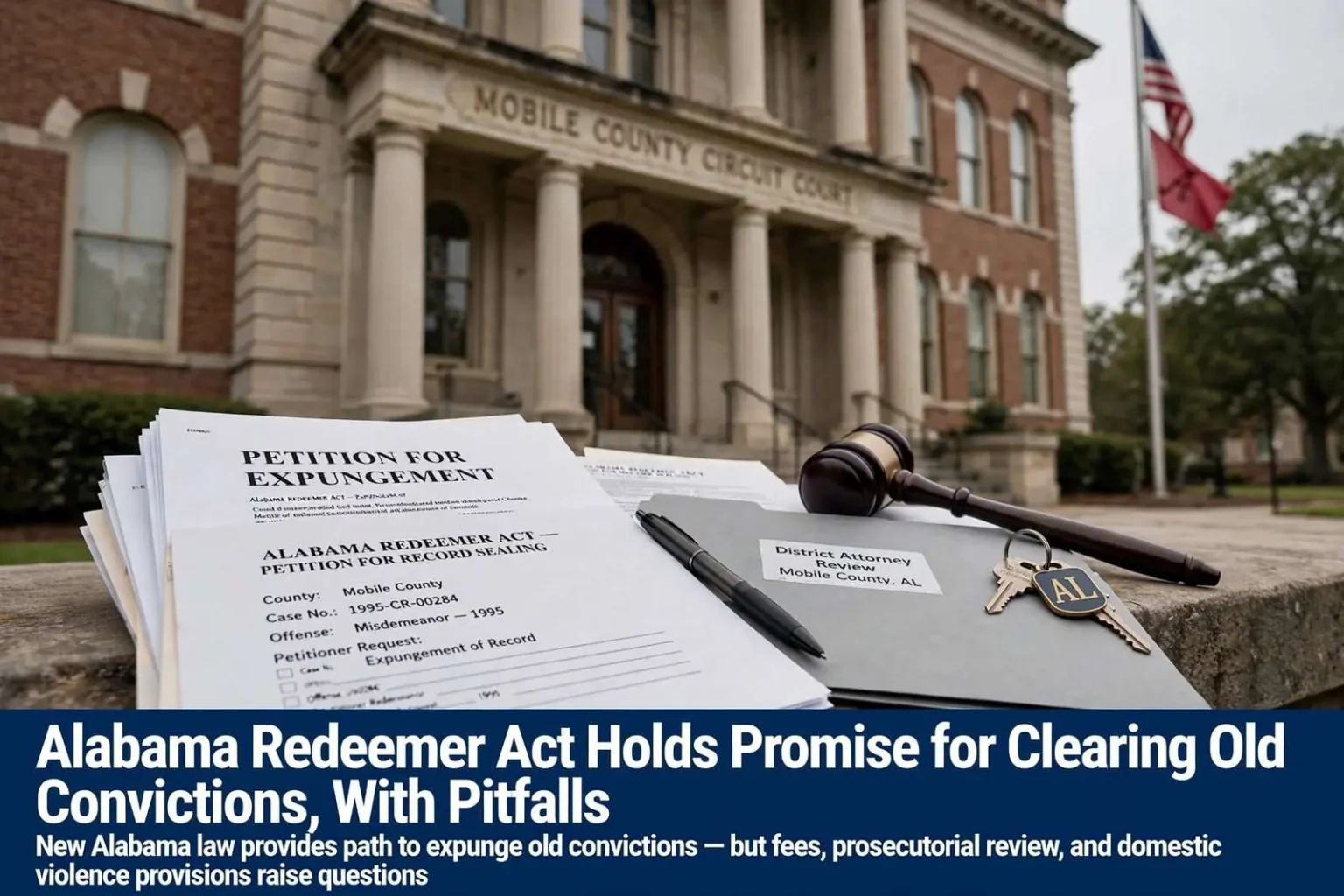
Starting in July 2021, Alabamians carrying certain old criminal convictions can ask the courts to wipe the slate clean under the state’s new Redeemer Act — a law that advocates call overdue and some prosecutors view with caution. The measure gives people whose records have haunted them for years a formal mechanism to seek relief, while leaving prosecutors and judges squarely in the process.
Alabama long ranked among the states where a criminal record followed a person most persistently. Before the Redeemer Act, the state’s expungement framework was narrow, and most convictions — even minor ones from decades past — remained visible to employers, landlords and licensing boards through commercial background check services. The new law widened that door for a defined set of offenses and built a petition process that runs through the court where the conviction occurred.
The act creates a process for people convicted of certain crimes to petition for expungement, on the theory that those who have paid their debt to society shouldn’t be shut out of jobs decades later. The logic that advocates cite is straightforward: an arrest or conviction from twenty or thirty years ago tells an employer little about the person standing in front of them today, yet it shows up on nearly every background check and can quietly disqualify a candidate before an interview ever happens.
Mobile County District Attorney Ashley Rich said the law builds a check into that process: district attorneys can review petitions and make a recommendation to a judge, who makes the final call. That structure was central to winning prosecutorial buy-in, since it ensures the office that handled the original case sees each petition before the record is sealed.
“I think it can help in some cases — that’s why DAs can give a recommendation to a judge and it’s ultimately up to a judge to make this decision,” Rich said.
Under the act’s framework, the petitioner files in the circuit court of the county where the conviction occurred, the district attorney’s office reviews the petition and the underlying case, and a hearing can follow before a judge enters an order. Expungement under the law does not physically destroy records but seals them from public view, meaning the person can lawfully answer questions about the record as though it did not exist in most contexts.
Prosecutors’ reservations: Rich flagged one provision that concerns her — third-degree domestic violence convictions, which are misdemeanors in Alabama, could qualify for expungement. Keeping those convictions on the books matters, she argued, because prior offenses can carry heavier consequences if someone reoffends.
“It’s important we have domestic violence convictions held on the books — if they commit another domestic violence offense, that conviction can be held against them,” Rich said.
In her view, each petition deserves an individual look at the facts and circumstances rather than a blanket approval. That case-by-case posture is what prosecutors across Alabama have emphasized as the act took effect: expungement as a reward for demonstrated rehabilitation, rather than an automatic scrubbing of the record after a waiting period.
Third-degree domestic violence, the provision Rich singled out, covers misdemeanor-level offenses such as assault or harassment committed against a family or household member. In Alabama’s sentencing structure, a prior conviction for domestic violence can elevate the charge and the potential punishment when a new offense occurs, which is the practical reason prosecutors want those convictions preserved even when a petitioner has otherwise stayed out of trouble. Victim advocates have raised parallel concerns, noting that a pattern of escalating abuse is often visible only when the record of earlier incidents remains intact.
The cost of a clean slate: the process isn’t cheap. Applicants must pay a $500 fee, and most will likely need a lawyer to navigate the paperwork properly — hurdles that critics say could put relief out of reach for many of the people the law was written to help.
The filing fee goes to the court system, but the larger expense for most petitioners is legal representation. Gathering certified copies of old judgments, confirming eligibility for each conviction on a record, drafting petitions and appearing at hearings are tasks that benefit from an attorney’s familiarity with the process, and legal aid organizations that might otherwise absorb such cases have limited capacity across the state’s counties.
For people like those with decades-old misdemeanor convictions that keep resurfacing in background checks, though, the act offers something Alabama’s system previously didn’t: a formal route to a second chance. Whether that route proves to be a wide road or a narrow path will depend on how many people can afford to walk it — and on how prosecutors and judges weigh the petitions that come before them.
Why old records carry such weight
The market for background checks has transformed how a conviction functions in daily life. What was once a courthouse file that a curious employer would never see is now a database entry that commercial screening companies retrieve within seconds, and industries from healthcare to transportation to education run checks on nearly every hire. Studies of employment discrimination against people with records have shaped the argument for expungement laws nationally, and states across the country have moved in recent years to automate or expand record-clearing for old, minor offenses.
Alabama’s Redeemer Act arrived in that context. Its supporters in the Legislature pitched it as both a workforce measure and a justice measure: clearing qualifying records puts people back into the labor pool for jobs they can hold, and it ends the indefinite punishment that a decades-old misdemeanor imposes on someone who has long since changed their life. The law’s name itself — Redeemer — signaled the redemption framing its sponsors intended.
The District Attorney’s Office role in Mobile County illustrates the scale involved. The office reviews petitions arising from prosecutions dating back decades, and each requires a look at the original case file, the petitioner’s subsequent history and the views of any victims involved. Prosecutors say the review distinguishes between the petitioner who completed probation in 1995 and has been employed ever since and the petitioner whose record shows continued contact with the courts — a difference that is invisible to a background check company but obvious in a case file.
Judges retain the final decision in every case, and expungement orders are entered only after the court is satisfied that the petitioner meets the law’s requirements for the offense in question. That judicial check, layered on top of the prosecutorial review, was the compromise structure that let the bill move through the Legislature with law enforcement’s grudging acceptance rather than its opposition.
What petitioners should know
Not every conviction qualifies, and the details matter. The act draws lines by offense type and outcome, and a petitioner’s record has to be read against those lines before anything is filed. Defense attorneys who handle expungement work recommend obtaining a complete criminal history first, since applicants are frequently surprised by what is actually on their record — including arrests from other counties that complicate where and how petitions are filed.
The waiting requirements are part of the design as well. The law contemplates that relief comes after a demonstrated period of lawful living, not immediately upon completion of a sentence. For petitioners, that means the timeline from deciding to seek expungement to actually holding a clean record can stretch across many months, particularly in urban counties where dockets are crowded and hearings must be scheduled.
For employers and landlords, the law changes what appears on the checks they run. Once a record is expunged, screening companies are expected to stop reporting it, and the petitioner is released from disclosure obligations in most circumstances. Advocates advise people who obtain expungement to follow up with the major background check companies, because stale data can linger in commercial databases even after the court order issues.
In Mobile County, the practical effect of Rich’s stance is that petitioners should expect scrutiny rather than rubber stamps. Cases involving violence — particularly domestic violence — will draw recommendations against relief more often than drug possession or minor property offenses from long ago. Petitioners with strong work histories, family responsibilities and long stretches without new charges present the profile that the review process was designed to reward. Prosecutors also weigh input from victims and witnesses tied to the original case, which can shape a recommendation in ways the petitioner never anticipated when filing.
The $500 fee, the attorney costs and the procedural complexity remain the law’s biggest critics’ focus, and proposals to streamline or subsidize the process have surfaced in the years since the act took effect. For now, the Redeemer Act stands as Alabama’s most significant expansion of record relief in decades — a second chance with a price tag, and one that prosecutors intend to supervise closely.