Alabama rolls out new marriage forms next week
Alabama will require new marriage forms beginning Aug. 29, replacing marriage licenses with a notarized form filed with a probate judge.
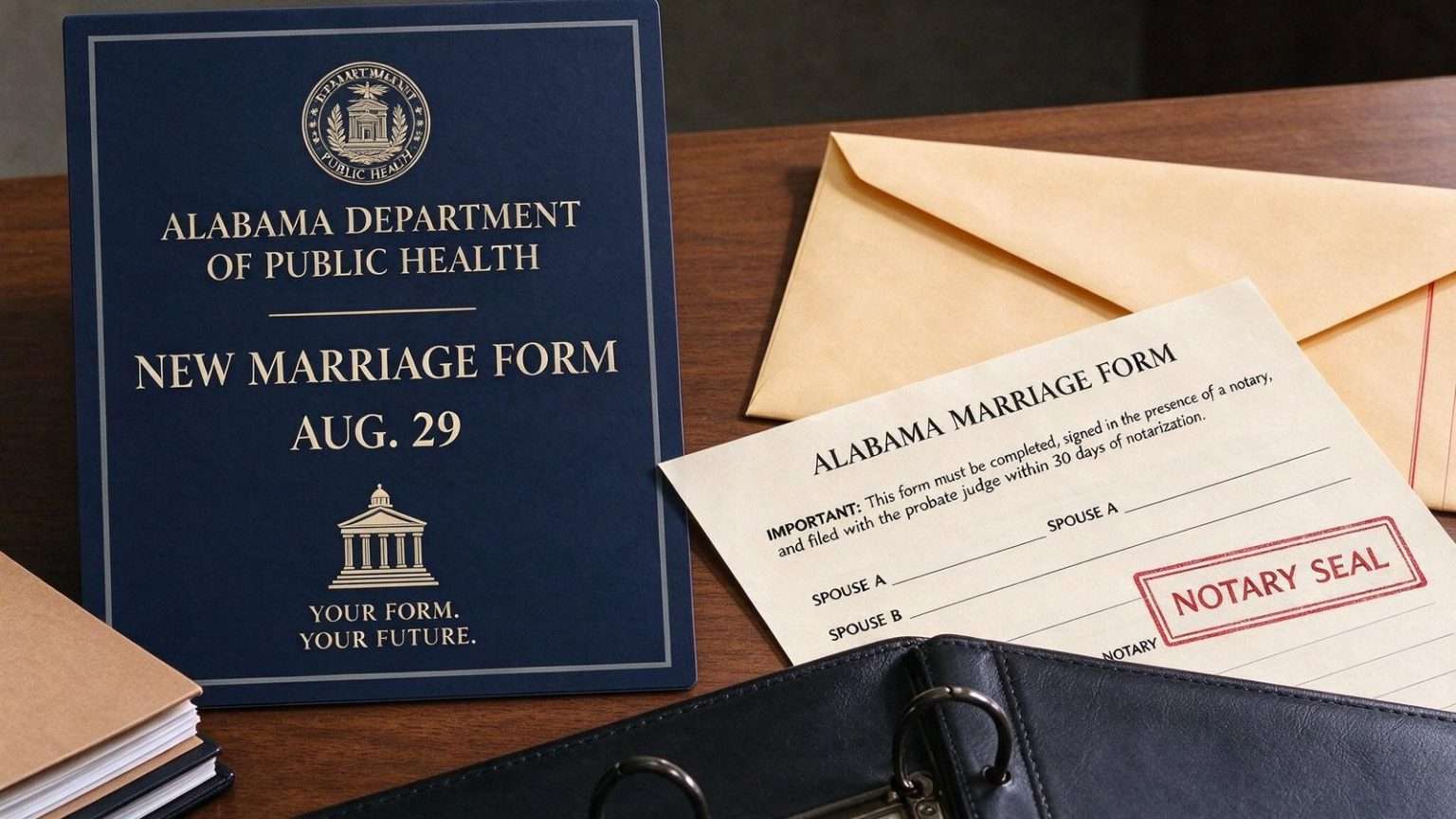
MONTGOMERY, Ala. — Alabama will require new forms for couples getting married beginning Aug. 29, according to guidance issued by the Alabama Department of Public Health. The change fundamentally restructures how marriage works in the state: instead of obtaining a marriage license, couples will fill out a new form, have it notarized and then submit it to a probate judge within 30 days. A wedding ceremony is no longer required, though couples may still choose to have one.
Under the new procedure, the marriage record becomes a contract executed by the couple themselves rather than a license issued by the state. Both spouses complete the standardized state form, sign it in the presence of a notary, and deliver the executed document to the probate office in the county where either lives. The probate judge’s role shifts from gatekeeper to registrar — reviewing the form for completeness and recording it, rather than deciding whether to issue a license. Once recorded, the marriage is legally effective, with no ceremony required to make it official.
The Alabama Legislature voted this year to change the marriage process, passing the legislation that directs the Department of Public Health to create the standardized form and spells out the new filing requirements. The revised procedure was designed to accommodate probate judges who had objected to issuing marriage licenses, a conflict that had left some Alabama couples unable to marry in their home counties and had produced a patchwork of practice across the state’s 67 probate offices.
Why Alabama changed its marriage law
The road to the new system ran through a decade of legal and political conflict. Following federal court rulings on same-sex marriage, a number of Alabama probate judges — elected officials in each county who historically handled license issuance — stopped issuing any marriage licenses at all, citing religious objections to their role in authorizing marriages. Because some judges continued issuing licenses and others did not, couples’ ability to marry came to depend on which county they lived in, a situation critics called a lottery and defenders framed as an accommodation of conscience.
The Legislature’s response was to remove the judges from the licensing decision entirely. By converting marriage into a contract recorded by the probate office rather than a license the office grants, the law eliminated the act to which the objecting judges had refused to lend their names. Judges no longer authorize anyone’s marriage; they simply record a form, the same ministerial function they perform for deeds and other documents. The design was deliberately structured to let every probate office return to providing marriage services statewide without requiring any judge to perform or authorize a ceremony.
How the new process works step by step
The mechanics center on a form created by the Alabama Department of Public Health. Couples obtain the form, which requires standard identifying information and declarations from both spouses, and complete it together. Both parties then sign the document in front of a notary public, whose stamp verifies their identities and signatures. The couple — or someone acting on their behalf — must deliver the notarized form to the probate judge within 30 days, where it is reviewed and recorded. That recording is what makes the marriage official under Alabama law.
Several practical details distinguish the system from the old license regime. There is no waiting period tied to a license, no expiration date racing couples to the altar, and no ceremony requirement — a couple who signs, notarizes and files the form is married whether or not they ever hold a wedding. Fees are set by state law rather than left to county variation, and the same standardized form applies in every county, ending the differences between probate offices. Couples who want a ceremony remain free to have one, whether religious or civil, but the ceremony carries no legal weight; the filed form is the marriage.
Notaries become a new fixture in the process. Alabama’s notary population — bank employees, attorneys, insurance agents and others commissioned to witness signatures — now serves as the verification step that probate clerks once performed, confirming that both parties signed voluntarily and in person. Couples without easy access to a notary can typically find one at banks, shipping stores and law offices for a nominal fee, and probate offices are expected to direct residents to notarial resources as questions arise.
What it means for couples and counties
For Alabama couples, the change simplifies paperwork but shifts responsibility onto the spouses themselves. Under the old system, a license application initiated the process and a returned certificate completed it; under the new one, the couple must ensure the form is accurate, properly notarized and filed on time. An incomplete form or a missed 30-day deadline can leave a marriage’s status in question, so couples are advised to read the instructions carefully and file promptly. Probate offices across the state, from Mobile to Madison County, have updated their websites and counters with the new requirements ahead of the Aug. 29 effective date.
For probate judges, the law resolves an uncomfortable position in which they had been asked to choose between their offices’ traditional functions and their personal convictions. The recording function that remains is one judges of every disposition performed for decades with documents of all kinds. Whether the new arrangement satisfies everyone — couples who found their counties closed to them, judges who sought accommodation, and lawmakers who wanted marriage services uniform statewide — will be tested as the form goes into use, but its design is a distinctly Alabama compromise: marriage as a private contract, recorded by the state, with ceremony optional and conscience accommodated.
Alabama’s distinctive place in marriage law
The new system makes Alabama the only state to adopt a purely contract-based marriage process, a structure with deep historical roots. Marriage in English and early American law was understood as a civil contract long before states built licensing bureaucracies around it, and Alabama’s reform effectively returned to that older model with modern verification tools. Other states that grappled with license objections — Utah’s dormant-license approach and a handful of county-level workarounds elsewhere — kept the licensing framework intact; Alabama discarded it outright.
That distinction matters for couples from other states. A marriage recorded under Alabama’s new form is recognized everywhere in the United States under the Full Faith and Credit framework, just as a licensed marriage would be. Visitors who marry in Alabama while passing through — a notary and a probate office are all that is required — return home with a valid marriage, and Alabamians who move retain all the legal consequences of marriage wherever they go. The form itself, once recorded, becomes the authoritative marriage record that couples, agencies and courts rely on.
The state’s probate courts retain a connection to marriage beyond recording. Questions about the validity of a marriage, disputes over filings and the rare contested case all remain matters for the probate judge, whose office also maintains the permanent record that genealogists, title examiners and attorneys consult. The form’s standardization across all 67 counties actually improves that record-keeping: where the old system’s certificates varied county by county, the new form is identical statewide, filed in a uniform way.
The Legislature’s path to passage
The bill’s journey through the Alabama Legislature reflected the subject’s sensitivity. Lawmakers from both parties had watched the license controversy drag on for years, with some counties issuing licenses and others refusing, and with federal litigation and public protests punctuating the interim. Proposals circulated in multiple sessions before the compromise structure — no license, no ceremony requirement, a notarized form filed with the probate judge — emerged as the version that could pass. The design appealed to legislators who wanted marriage services restored in every county, to those who wanted judges’ consciences respected, and to those who simply wanted the state out of the ceremony business altogether.
Supporters of the final bill described it as a rare win-win in a contentious area: couples regain uniform access to marriage in all 67 counties, objecting judges lose the act they found objectionable, and the state’s form-based process removes the discretionary step that had produced the inconsistency. Critics questioned whether eliminating the ceremony requirement and the license’s traditional role diminished the institution, and some probate judges expressed uncertainty about the administrative details of the new filing process. The Department of Public Health’s guidance, issued ahead of the Aug. 29 effective date, was intended to answer those operational questions with uniform instructions for every probate office.
Practical guidance for couples
Couples planning to marry in Alabama after Aug. 29 should prepare for a process that looks more like executing a legal document than applying for a permit. The essentials: obtain the state form, complete it accurately, sign before a notary with both parties present, and file with the probate judge in the county where either spouse lives within 30 days of notarization. Photo identification is required for the notarization, and couples should verify their probate office’s filing hours and any local procedures for submitting the form.
A few common pitfalls deserve attention. Waiting until the end of the 30-day window to file risks a missed deadline that complicates the marriage’s effective date. Incomplete forms — missing signatures, unsigned declarations, errors in identifying information — will be rejected by the probate office and require resubmission, restarting the clock. Couples who plan ceremonies should understand that the ceremony has no legal effect and that the marriage is official only when the form is recorded; insurers, employers and agencies will ask for the recorded form as proof. Finally, couples should keep a copy of the filed form for their records, since certified copies of the marriage record are obtained through the probate office after recording.
The change does not affect the substantive rights and obligations of marriage — property, inheritance, tax treatment and family-law protections all remain as they were. What changes is the doorway: Alabama couples now marry by contract, recorded by a judge who makes no judgment at all, in a process the Legislature designed to end years of county-by-county conflict. As of Aug. 29, the form is the license that no longer exists, the notary is the gatekeeper who no longer stands in the way, and the wedding — for the first time in state law — is entirely up to the couple.