Alabama Supreme Court Orders Escambia County Commissioners Dismissed From Lawsuit Over Handling of a Body
In a 9-0 decision, the Alabama Supreme Court ruled that Escambia County commissioners cannot be held liable for the actions of a county medical examiner who was immune under state law. The family's claims against D.W. McMillan Memorial Hospital remain pending.
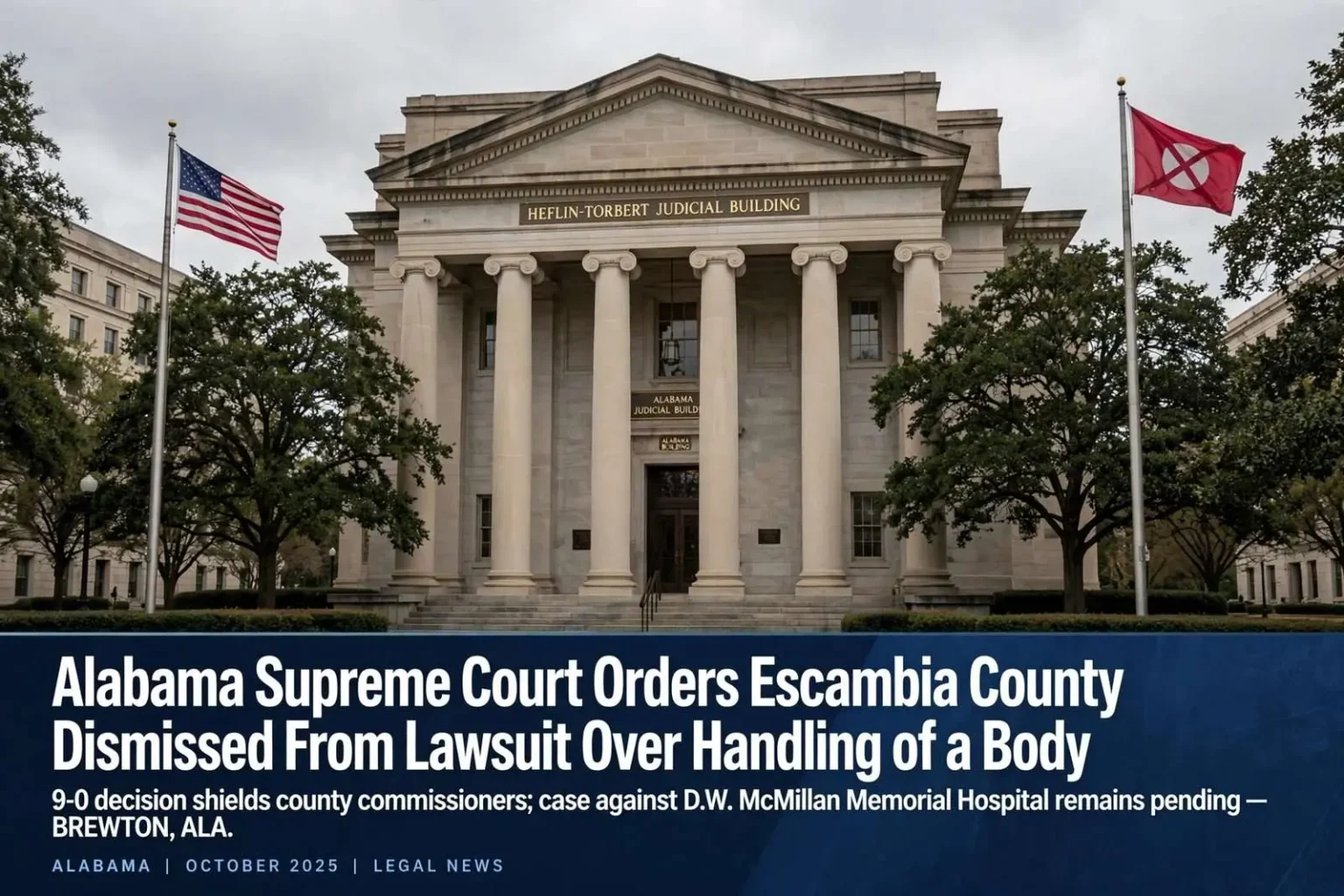
BREWTON, Ala. — The Alabama Supreme Court has ordered the dismissal of Escambia County commissioners from a lawsuit filed by a family over how their relative’s body was handled at the county morgue, ruling unanimously that the commissioners cannot be held liable for the actions of a medical examiner who was himself immune under state law.
The 9-0 decision, issued Friday, resolves only the claims against the county. The family’s case against D.W. McMillan Memorial Hospital, where the county morgue is located, remains pending in trial court.
The underlying allegations
Grady Floyd Sr. died May 31, 2023, at age 61. An Army veteran who enjoyed working on old cars and trucks, he was remembered in his obituary as “a very out spoken man, to know him is to love him.”
Floyd’s son, daughter and brother filed suit in 2024, alleging that the county medical examiner allowed Floyd’s body to decompose to the point that no autopsy could be performed and the family could not hold an open-casket service. The medical examiner, Dr. J. Daniel Raulerson, died before the lawsuit was filed.
According to the Supreme Court’s opinion, the family alleged that Raulerson took possession of Floyd’s remains to transport them to the Alabama Department of Forensic Sciences for an autopsy and told the family the body would be released within two days for burial.
“Thereafter, however, according to the plaintiffs, Dr. Raulerson ‘essentially dumped the body at the morgue’ and left town,” the opinion states.
The suit alleges that when Raulerson returned — reportedly on June 6, 2023 — Floyd’s body was in such an advanced state of decomposition that no autopsy was performed. The complaint refers to the morgue’s purported lack of “requisite refrigeration” and alleges the body “was not properly stored.” Without an autopsy, the family said, they were deprived of learning the cause of Floyd’s “sudden and untimely” death.
The funeral home told them the body was too decomposed for embalming, and the family said Raulerson gave permission for the remains to be cremated. The family sued for negligence, wantonness and the tort of outrage, seeking compensatory and punitive damages.
The county’s position
The commissioners denied the allegations and claimed legal immunity. An attorney for the commissioners pushed back on the characterization in the complaint.
“We are not in a position to comment at this time, other than to say that we strongly disagree with that characterization as alleged by the Plaintiffs,” attorney Chris Williams said in an email.
How the case reached the Supreme Court
The Escambia County Circuit Court held a hearing in August 2025 and subsequently denied the commissioners’ motion to dismiss. The commissioners appealed that ruling.
Writing for the court, Associate Justice Greg Shaw concluded that the medical examiner was immune from the claims under state law, and that immunity extended upward to the county defendants who were alleged to be his principals.
“In sum, because, under [the state law] Dr. Raulerson would be immune from civil liability for his actions as medical examiner, the County defendants, as his alleged principals, may not be held liable for those same actions,” Shaw wrote. The other eight justices concurred.
What remains
The ruling does not address whether the underlying allegations are true — only whether the county commissioners can be sued over them. D.W. McMillan Memorial Hospital, which remains a defendant, has denied any wrongdoing.
The doctrine at the center of the decision is a familiar one in Alabama litigation involving county officials: when an individual officer is statutorily immune, claims against the governing body that appointed or oversaw that officer generally cannot proceed on the same set of facts. For families in similar circumstances, that structure narrows considerably who can be held accountable in court.