
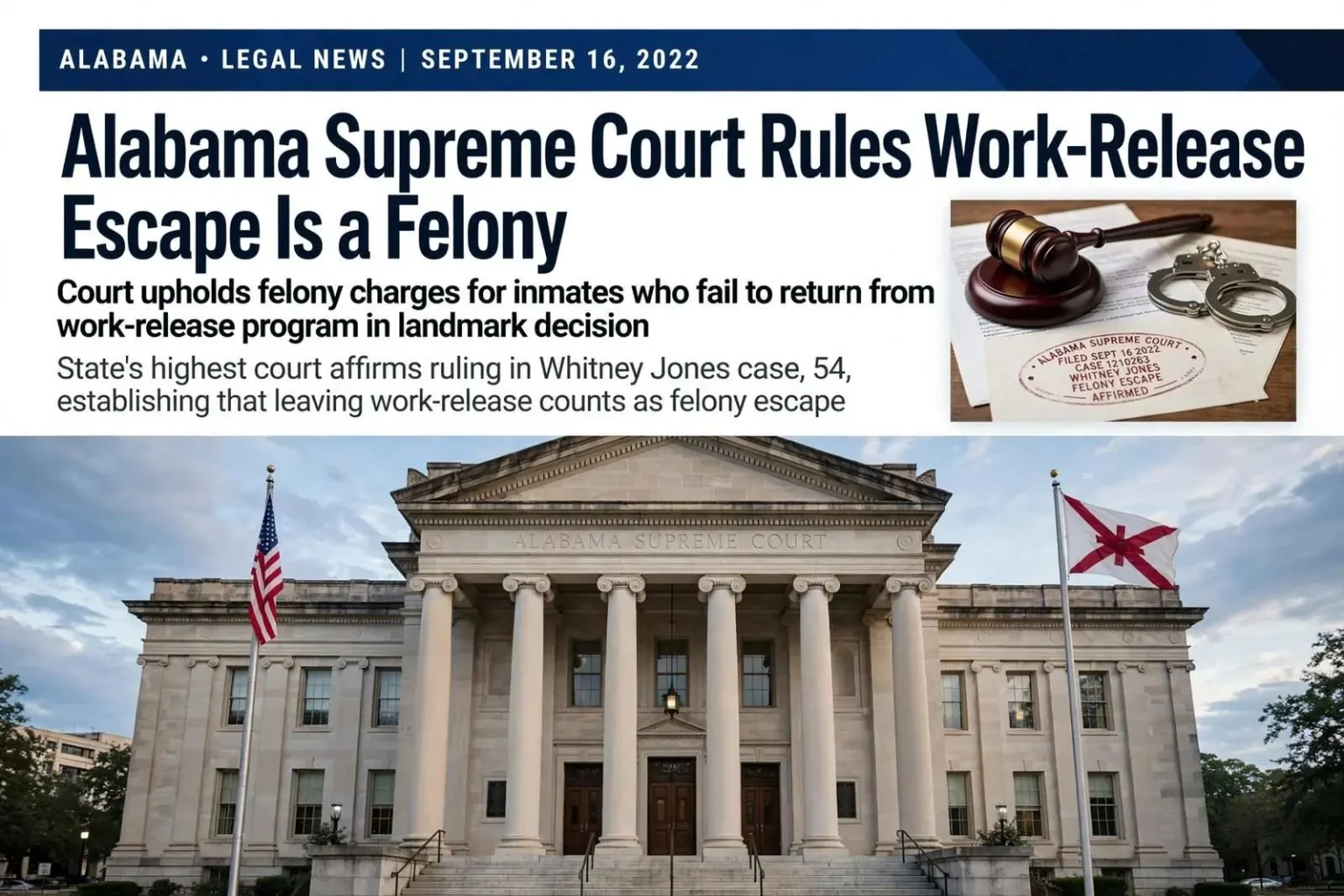
The Alabama Supreme Court has upheld felony escape charges against inmates who fail to return from work-release programs, setting a significant legal precedent for how the state handles such cases. The ruling came in the case of Whitney Jones, 54, a Mobile County inmate who participated in the Mobile Metro Jail’s work-release program in January 2018. Jones and another inmate did not return to the work-release barracks, according to the Alabama Attorney General’s office.
The decision resolves a question that had lingered in Alabama criminal law for years: whether walking away from a work-release assignment counts as a misdemeanor escape or a felony. By answering it definitively, the state’s highest court closed an argument that defense attorneys had raised repeatedly, and it aligned the treatment of work-release absconders with those who escape from secure confinement.
The Case Behind the Ruling
Jones had originally been arrested in 2017 on charges of receiving stolen property and attempting to elude after she and another suspect led police on a seven-mile chase. She was charged with second-degree escape in October 2018 and subsequently convicted. Her path through the system — from the initial arrests, through incarceration with work-release eligibility, to the escape charge — illustrates how quickly a program intended as a privilege can become the basis for new criminal liability when its rules are broken.
At trial and on appeal, Jones argued that she could only have been guilty of a misdemeanor due to a provision in Alabama’s work-release escape statute. The Alabama Supreme Court rejected that argument, firmly establishing for the first time that the state’s felony escape statutes apply not only to escapes from correctional facilities but also to escapes from work-release programs. The court’s reading treated the work-release barracks and program supervision as part of the correctional system itself, so a failure to return carries the same legal weight as an escape from behind a wall.
Work-release programs operate on a simple premise: inmates who qualify are permitted to leave confinement during the day for employment, education or treatment, then return at night. In return for that freedom, participation depends entirely on compliance. Alabama’s prison system and county jails, including the Mobile Metro Jail, use work release to reduce overcrowding, allow inmates to pay restitution and child support, and build the job history that eases reentry after a sentence ends.
The Attorney General’s Response
Attorney General Steve Marshall praised the decision, noting that it provides law enforcement and prosecutors with stronger tools to ensure the safety and effectiveness of work-release and community corrections programs. “Escaping from a work release or community corrections program is a felony under Alabama law and it will be treated as such from this point forward,” Marshall said. “Community corrections and work-release programs are intended to provide a second opportunity for less serious offenders. Those who escape from these programs have forfeited that opportunity and will now be held fully accountable for their actions.”
Marshall’s office has a long institutional stake in escape prosecutions. The Attorney General’s Criminal Appeals Division, which handled the Jones case, represents the state whenever criminal convictions are challenged in Alabama’s appellate courts, and it frequently steps in when a statute’s interpretation is contested. The division’s success in Jones preserved not only one conviction but the framework under which every future work-release escape will be charged.
Prosecutors across the state had contended with the ambiguity the ruling eliminated. A misdemeanor classification limited the consequences for absconding and, in practice, weakened the deterrent value of the program’s rules. With the felony interpretation confirmed, a failure to return from a work detail now carries exposure to state prison time, rather than a county jail term — a difference participants understand when weighing whether to walk away.
Why Work Release Matters in Alabama
Work-release and community corrections programs occupy a central place in Alabama’s corrections landscape. The state’s prisons have operated for years above their design capacity, and county jails face similar pressures. Programs that let eligible inmates work at outside jobs serve several purposes at once: they relieve bed space, generate income that inmates can use for restitution and family support, and teach the habits of regular employment that reduce the likelihood of reoffending after release.
Those benefits, however, depend on participation being conditional. An inmate who fails to return creates immediate public safety concerns — the person is unaccounted for, may be desperate, and has demonstrated a willingness to break program rules. The felony classification gives sheriffs and prosecutors the leverage to respond proportionately and to signal to the broader inmate population that the privilege is genuinely revocable.
The Mobile Metro Jail’s work-release program, like similar programs in Jefferson, Madison and other counties, places participants in jobs with local employers while they remain in the custody of the sheriff. Participants typically pay a portion of their wages toward room and board, court costs and victim restitution. Program administrators screen candidates for disciplinary history and offense type, generally excluding those convicted of violent or sexual offenses.
The Court’s Reasoning and Its Reach
Both the Alabama Court of Criminal Appeals and the Alabama Supreme Court affirmed Jones’ felony conviction in a decision issued on September 16, 2022. The intermediate court had upheld the conviction first, and the Supreme Court’s acceptance and affirmance removed any remaining doubt. Because both appellate levels agreed, the interpretation is now settled law that trial judges can apply without awaiting further guidance.
The statutory question turned on how to read Alabama’s escape provisions alongside the work-release statute. Jones’ argument relied on a provision addressing work-release escapes that she contended capped the offense at a misdemeanor. The Supreme Court disagreed, reading the felony escape statutes to encompass program absconders. Courts in other states have reached similar conclusions, treating walkaways from minimum-security and community-based programs as escapes because the participants remain in legal custody throughout.
Defense attorneys had also raised proportionality arguments — that a person trusted to hold a day job should not face the same charge as someone scaling a prison fence. The courts’ answer was that custody is custody: the legal relationship between inmate and state exists whether the physical setting is a cell or a barracks, and breaching it is the offense. The reasoning extends to community corrections programs, day-reporting centers and any arrangement in which the participant remains in custody while living outside a secure facility.
What It Means Going Forward
For Alabama’s sheriffs and community corrections directors, the ruling is a practical tool. Programs can now state plainly in orientation that absconding is a felony, and participants facing that clear consequence have a strong incentive to raise problems — a lost job, a transportation issue, a family emergency — with program staff rather than simply not coming back. Administrators note that most walkaways begin as small problems that snowball, and a clear legal consequence gives staff a chance to intervene early.
The decision also brings Alabama’s approach in line with the national mainstream. Most states treat escape from work release as a felony, and federal law similarly treats failure to return from a halfway house or community confinement as escape. The alignment matters for inmates transferred between systems and for prosecutors coordinating with federal authorities.
For the courts, Jones closes a chapter that began with a seven-mile police chase in 2017 and ended with a precedent applying to every work-release participant in Alabama’s 67 counties. The Attorney General’s office framed the outcome in plain terms: the second chance remains available to those who follow the rules, and those who walk away from it will answer to a felony charge.
Escape Law in Alabama: The Broader Picture
Alabama’s escape statutes have developed through a series of appellate decisions that repeatedly defined how custody works. Courts have held that an inmate is in custody wherever the state’s authority over him extends — inside a cell, on a work detail, at a medical appointment or in a barracks — and that breaking that authority is the offense of escape regardless of how little resistance is involved. The Jones decision extends that settled logic to work release, removing the last grey area for program participants.
Second-degree escape, the charge Jones faced, generally applies to inmates in custody for felony charges or convictions, while first-degree escape involves force, violence or a weapon. The distinction matters at sentencing: felony escape convictions add prison time on top of the underlying sentence and can affect parole eligibility, classification and future program eligibility across the entire corrections system.
County sheriffs have pressed for clarity on this question for years. When a work-release participant fails to return, deputies must decide quickly how to charge, how hard to publicize the search and what resources to commit. A settled felony interpretation makes those decisions straightforward and ensures that the person located in the next county faces the same charge he would have faced in Mobile — no matter which district attorney’s office handles the case.
A Message to Program Participants
The practical lesson of the ruling is aimed squarely at the thousands of Alabamians who pass through work-release and community corrections programs each year. These programs represent a negotiated middle ground in criminal justice: the state trades some physical control for the rehabilitative benefits of employment and structure, and the participant trades some freedom for an obligation to comply. The Supreme Court’s decision confirms that violating that bargain is treated seriously everywhere in the state.
Program administrators encourage participants who encounter difficulties to speak with case managers before making a decision they cannot undo. A missed shift, a family crisis or a transportation problem is almost always resolvable within program rules; a failure to return converts a solvable problem into a new felony conviction. With the law now unambiguous, that message will be delivered in every program orientation across Alabama — and backed, prosecutors say, by the full weight of the state’s escape statutes.


