University of South Alabama Dauphin Island
Alabama Tagging Program Tracks Surprising Journeys of Trout and Redfish Through Mobile Bay
A tagging program run by CCA Alabama and University of South Alabama researchers is revealing new details about how speckled trout and redfish move through Mobile Bay, including one redfish tracked all the way to Louisiana.
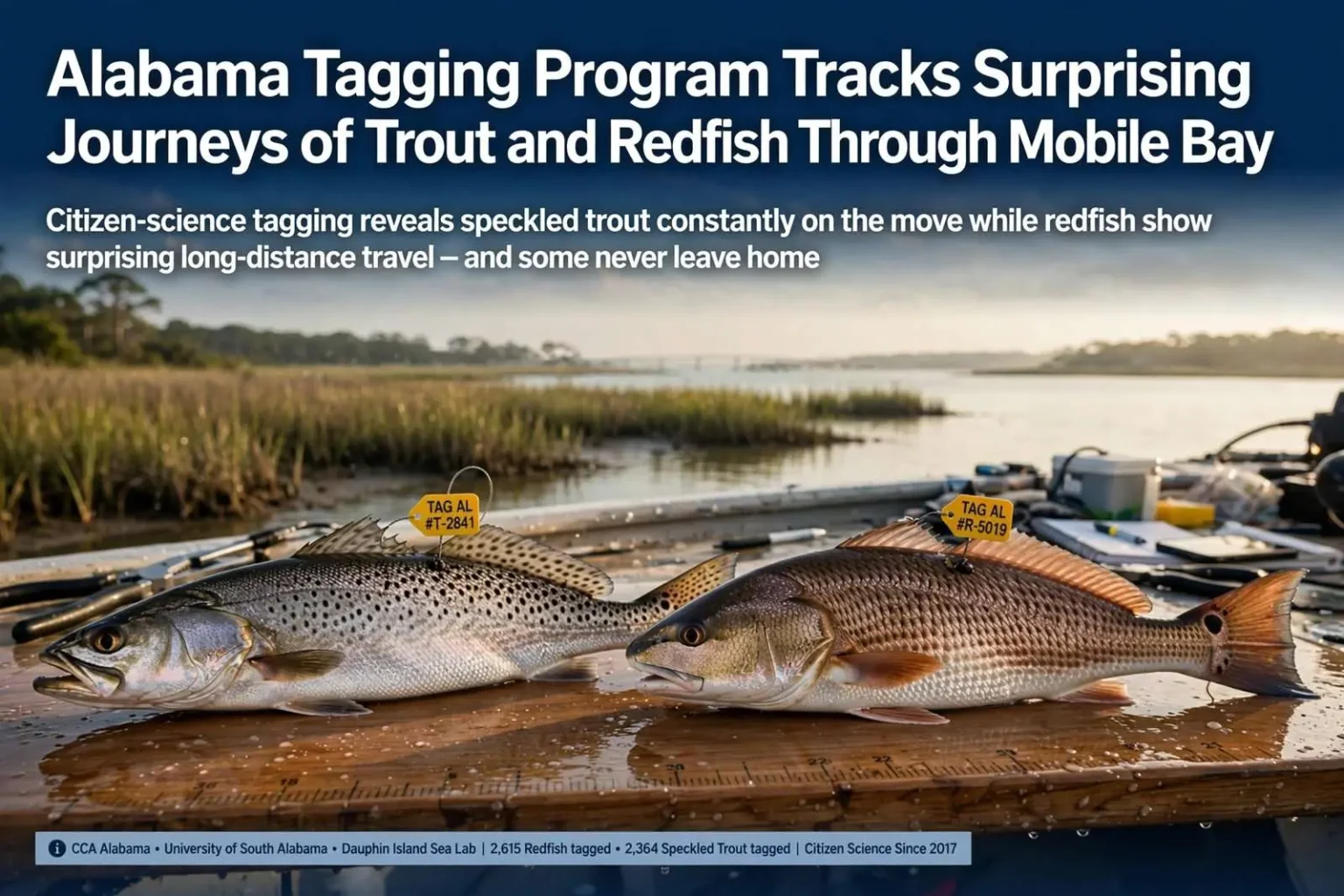
A fish-tagging program built around Mobile Bay's most popular inshore species is giving Alabama anglers and researchers an increasingly detailed picture of how speckled trout and redfish move, grow and survive along the Gulf Coast. The TAG Alabama program, launched in 2017 by the Coastal Conservation Association (CCA) Alabama, has now tagged thousands of fish, and the data is starting to reveal patterns that surprise even the scientists studying them. The program is a partnership between CCA Alabama and the University of South Alabama's School of Marine Sciences, working alongside researchers at the Dauphin Island Sea Lab.
Volunteer anglers who are CCA members tag legal-sized trout and redfish they catch, then anyone who later recatches one of those fish can report the recapture for a reward. The recapture reports, filed through a smartphone app, a dedicated website or a toll-free phone line, are what allow researchers to reconstruct where individual fish have traveled and how long they lived between being tagged and caught again.
After a year without in-person events because of COVID-19 restrictions, CCA Alabama recently resumed its tagging seminars, holding sessions in Birmingham and Daphne to teach anglers how to tag fish properly so the fish are not injured and the tags stay secured. CCA Alabama's executive director and a University of South Alabama graduate student who studies inshore species at the Dauphin Island Sea Lab's Fisheries Ecology Lab led the instruction, walking participants through safe handling techniques and sharing the latest findings from years of tagging data. The data so far shows a clear behavioral split between the two species.
Trout and Redfish Show Different Movement Patterns
Speckled trout tend to be constant travelers, moving frequently even within familiar territory, while redfish behavior is far less predictable. One redfish tagged near Dauphin Island turned up near Pensacola about 30 days later. Another, tagged near an island in the Mobile River, was recaptured 130 days later in Lake Pontchartrain, Louisiana — a journey of well over 100 miles. Yet a third redfish was recaptured three separate times in the exact same spot by the same angler, first in 2017 and twice more in 2018, showing that some fish barely move at all.
That contradiction echoes earlier acoustic tracking work on red drum in Dog River and Fowl River, where researchers worried that a fish signal staying on the same receiver for long stretches might mean the tagged fish had died. Instead, several of those fish were later recaptured within about 100 yards of where they were originally tagged, evidence that they had simply settled into a comfortable spot with enough food to thrive.
Speckled trout, researchers say, behave almost the opposite way — anglers may catch them in the same general areas year after year, but the fish themselves are constantly on the move within that range. This year, TAG Alabama introduced a new bull redfish tag specifically for larger fish. Redfish longer than 26 inches are generally classified as bull reds, though researchers say they would prefer anglers focus on tagging fish 30 inches and larger.
As more of those tags get distributed and recaptured, scientists hope to learn whether large bull reds are heading offshore to spawn, as expected, or moving up into the Mobile-Tensaw Delta instead. CCA Alabama has also approved funding for a related University of South Alabama study using acoustic and satellite tags to track bull redfish offshore. Participation in the program has grown steadily since it began. TAG Alabama has now tagged 2,615 redfish, with 424 of those recaptured, for a recapture rate of about 16 percent.
For speckled trout, 2,364 fish have been tagged and 206 recaptured, a rate of roughly 8.7 percent. Both figures far outpace typical results from larger regional tagging programs, which usually see recapture rates in the range of 4 to 5 percent. Researchers credit better-trained anglers, a result of the seminars, for keeping tags secured properly and reducing the chances a tagged fish loses its marker before it can be caught again. Redfish in particular tend to stay in the same general areas, which combined with heavy fishing pressure in those spots, helps drive up their recapture numbers.
A Citizen Science Model for Tracking Fish
Organizers describe the program as a model of citizen science, arguing that involving everyday anglers directly in data collection makes the research both more efficient and more far-reaching than what a small team of scientists could accomplish alone. Anyone participating can report tagging or recapture information through the Fishing Chaos app, through a dedicated university website best accessed on a computer, or by calling a toll-free hotline. To protect angler privacy, the app blurs the exact location where a tagged fish is recaptured.
Only legal-sized fish are eligible for tagging — a minimum of 15 inches for speckled trout and 16 inches for redfish — and when a tagged fish is recaptured, email reports go out to both the original angler who tagged it and the angler who caught it again. A related effort is now extending similar tracking methods to Southern flounder, a species that has declined significantly in Alabama waters over the past decade.
Tracking Extends to Southern Flounder
The Alabama Marine Resources Division has provided funding for the Dauphin Island Sea Lab's Fisheries Ecology Lab to capture and tag the fish using acoustic transmitters and a network of receivers that blanket Mobile Bay, logging data whenever a tagged flounder swims within range. In 2019, the state raised the minimum size limit for flounder to 14 inches and set a bag limit of five fish per angler, and the harvest of flounder is now prohibited throughout November to protect fish migrating offshore to spawn.
Researchers tag flounder in the fall in the upper reaches of Mobile Bay, catching them on hook and line before inserting acoustic tags and collecting otoliths, or ear bones, for age data, along with reproductive samples. Southern flounder females grow considerably larger than males, which rarely exceed about 13 inches and spend most of their lives offshore. The tagging effort has expanded each year — 67 flounder were tagged in 2019, including several fish weighing six and seven pounds and one 10-pounder, and 70 were tagged in 2020, with a goal of reaching 100 fish this year.
Early data suggests roughly 30 percent of tagged flounder eventually leave Mobile Bay, though researchers say it will take several more years of tracking to fully understand the offshore migration pattern. One of the more striking discoveries from the flounder work is a homing instinct reminiscent of salmon. Large flounder tend to leave their home rivers in late fall and return to those same exact rivers roughly six months later. Scientists say it remains unclear exactly how the fish navigate back so precisely, whether through water chemistry, magnetic sensing or some other mechanism not yet understood.
State fisheries officials say programs like TAG Alabama and the flounder tagging effort provide critical data that shapes management decisions for these popular sport fish. Inshore tagging programs offer insight into seasonal movement patterns as well as catch-effort data that would otherwise be difficult to gather, and officials note that the more anglers who participate and the more fish that get tagged, the more valuable the resulting information becomes for setting size limits, bag limits and seasonal protections designed to keep Alabama's inshore fisheries healthy for years to come.