Alabama Task Force 1, With Mobile Rescue Specialists, Continues Swift Water Response in Texas
Alabama Task Force 1, an eight-person swift water rescue team that includes Mobile Fire-Rescue specialists, is continuing search and rescue work in flood-hit parts of Texas.
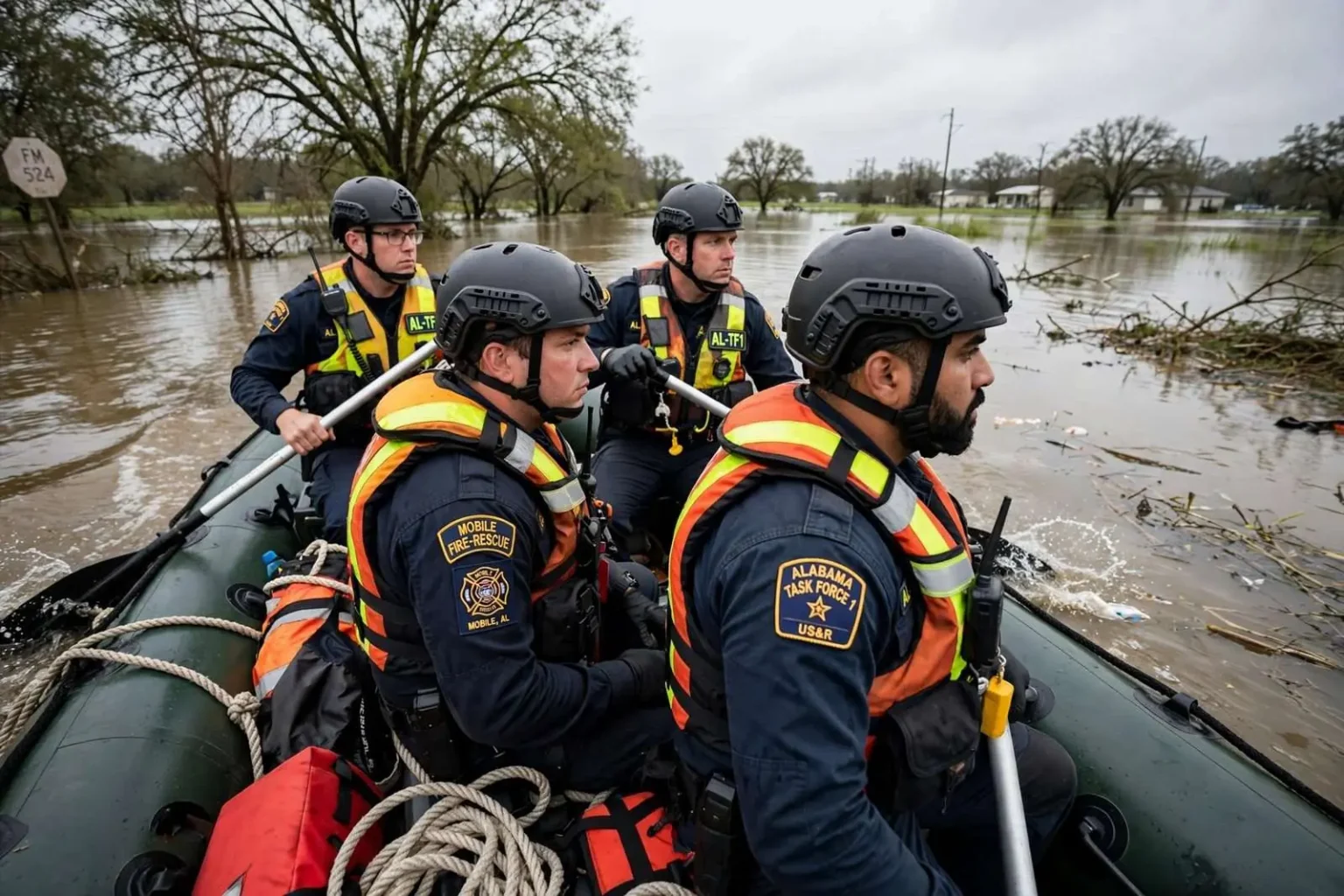
An Alabama swift water rescue team that includes specialists from the Mobile Fire-Rescue Department is continuing its work in Texas communities hit hard by recent flooding. Alabama Task Force 1, an eight-person urban search and rescue team, posted an update on its Facebook page over the weekend detailing its ongoing operations in the region. The deployment put Gulf Coast rescue specialists to work hundreds of miles from home, doing the kind of water rescue work that Mobile-area crews train for along their own flood-prone coastline.
According to the update, the team spent the previous 24 hours working near Dilly, Texas, one of the areas affected by the flooding. The assignment illustrates how flood response works across a wide region: crews are shifted from community to community as water rises and falls, with task force members staged where they can reach the next hard-hit area quickly. The 24-hour operational tempo described in the update is typical of swift water deployments, where rescues happen around the clock as conditions change.
The Mobile Connection
The task force draws its urban search and rescue specialists from departments across the state, including Mobile Fire-Rescue, giving South Alabama a direct stake in the mission playing out hundreds of miles away. For the Mobile firefighters on the team, the deployment draws on skills honed for their own region — a port city ringed by bayous, tidal rivers and hurricane surge that makes swift water rescue a core capability rather than an occasional specialty.
Swift water rescue teams like AL-TF1 are typically deployed to assist local authorities when flooding overwhelms the resources of the communities involved. The mutual-aid structure works both ways: the host state requests assistance through emergency management channels, and specialized teams arrive with boats, rescue gear and trained personnel that rural counties cannot maintain on their own. For a small community like Dilly, the arrival of a trained task force means experienced boat crews operating under an incident structure that local volunteer departments rarely have at hand during a major flood.
The team’s update did not include a timeline for when its work in Texas will wrap up, though further updates are expected as conditions on the ground develop. Deployments of this kind typically end when local authorities determine that the remaining rescue workload can be handled by their own personnel, and task force leaders make that call in coordination with the state officials directing the response.
Mission Complete: The Trip Home
Update: Alabama Task Force 1’s swift water rescue specialists, including the Mobile Fire-Rescue Department members embedded with the team, have wrapped up their mission in Texas and are headed home. According to officials, the team left Texas and spent the night in Lake Charles, Louisiana, before continuing on toward Mobile, where they were expected to arrive Thursday afternoon after roughly a week assisting with flood response efforts in the southern part of the state. The overnight stop in Lake Charles, a routine practice that keeps drivers rested on the long return leg along the Gulf Coast corridor, put the team a single day’s drive from home.
Roughly a week is a typical length for a swift water deployment of this kind. Teams on out-of-state missions operate on a cycle of travel, in-processing with the local incident command, sustained rescue operations and demobilization, with the final days often spent standing by as floodwaters recede and local departments resume control. The Thursday-afternoon arrival gave the Mobile members of the team a quick turnaround back to their regular duties with the department.
How Swift Water Deployments Work
Modern swift water response is built on the same incident-management structure that governs other major emergency operations. When flooding overwhelms a region, requests for assistance flow from local governments to state emergency management, and specialized teams are matched to the need. An eight-person configuration like Alabama Task Force 1’s is a compact, fast-moving package — boat operators, rescue swimmers, a team leader and support personnel — capable of operating independently or plugging into a larger effort. Larger task forces bring hundreds of members and days of self-sufficiency; a swift water element of this size is built for speed and focused water rescues.
The work itself varies with the flood. Crews move residents from flooded neighborhoods, check on stranded motorists, evacuate people from homes surrounded by rising water and support local departments with boat operations until roads reopen. Members of the team coming from Mobile Fire-Rescue do the same work during hurricane season along the Alabama coast, where storm surge and flash flooding in low-lying neighborhoods are recurring threats. That regional experience is a large part of what makes Gulf Coast rescuers valuable on out-of-state deployments.
Why It Matters Back Home
For South Alabama residents, the deployment is a reminder of the connection between their local fire departments and a national network of mutual aid. Mobile firefighters who serve in Texas this week may be the ones rescued by visiting crews the next time a hurricane floods the Mobile Bay area, and the experience each deployment builds — reading moving water, handling boats in debris-filled currents, coordinating with unfamiliar agencies — returns home with them when the mission ends.
The task force’s updates, posted to its Facebook page as the mission progressed, gave followers in Mobile and across Alabama a window into that work: 24-hour operations near Dilly, a week in the flooded communities of southern Texas and the long drive home through Lake Charles. The team was expected back in Mobile on Thursday afternoon, closing out a deployment that took eight of the region’s rescue specialists roughly a thousand miles from home and brought them back a week later.
The Task Force Structure in Alabama
Alabama Task Force 1 operates within the framework the state maintains for urban search and rescue, drawing personnel from fire departments that maintain the specialized certifications the mission requires. The multi-department model is deliberate: no single agency could release enough trained specialists to staff a deployable team, so task force rosters are built from volunteers across the state who train together and deploy together when the call comes. Mobile Fire-Rescue’s participation reflects its size and its water-focused mission, alongside contributions from departments in other parts of Alabama.
The eight-person swift water configuration is a subset of that larger capability. Its members carry the rescue swimmer, boat operations and incident-communications certifications that allow the element to work independently under a host agency’s command. Equipment travels with the team — rescue boats, rope systems, personal flotation gear and the radios that tie the element into local dispatch — so that the group can begin work shortly after arriving rather than waiting on borrowed gear.
The Flood Environment in Southern Texas
The flooding that pulled the team across the state line followed a pattern familiar along the Gulf Coast: slow-moving storm systems dropping enormous rainfall on terrain that drains through creeks and rivers prone to flash rises. Communities like Dilly and the surrounding countryside face the double hazard of rapidly rising water on small streams and prolonged inundation along the larger rivers downstream. Rescue crews in that environment spend as much time reading the water as navigating it, watching for debris flows, submerged hazards and currents strong enough to swamp a boat.
That work also depends on local knowledge. Task force members pair with residents, game wardens and volunteer firefighters who know which roads flood first and where people are likely to be stranded. The mutual respect between visiting specialists and local responders is one of the quiet byproducts of deployments like this one — the task force brings technical rescue capability, and the community brings the maps in their heads that no GPS can replace.
The Return to Regular Duties
When the team crossed back into Alabama on the final leg of its trip home, its members returned to the departments that had released them for the mission. Fire departments that lend personnel to state task forces absorb the absence — covering shifts, adjusting schedules and relying on the remaining roster while their specialists are away. The arrangement works because deployments are finite and because the departments see a return on the investment: members come back with advanced training exercised under real conditions, relationships with counterpart agencies across the region and experience leading small teams through complex operations.
For Mobile Fire-Rescue, whose members have deployed with the task force to floods and hurricanes across the Southeast, the Texas mission was the latest in a series of out-of-state assignments. Each one tests the same capabilities the department needs at home during hurricane season, when surge and inland flooding can put entire neighborhoods under water in hours. The specialists expected back in Mobile on Thursday afternoon brought that experience with them — and the knowledge that the next call could just as easily be local.