
Alabama Waterfowl Stamp Art Contest Opens: Artists Have Until Feb. 15 to Enter
Alabama artists can enter the 2016 waterfowl stamp art contest through Feb. 15; the winning painting appears on the 2017-18 state duck stamp.
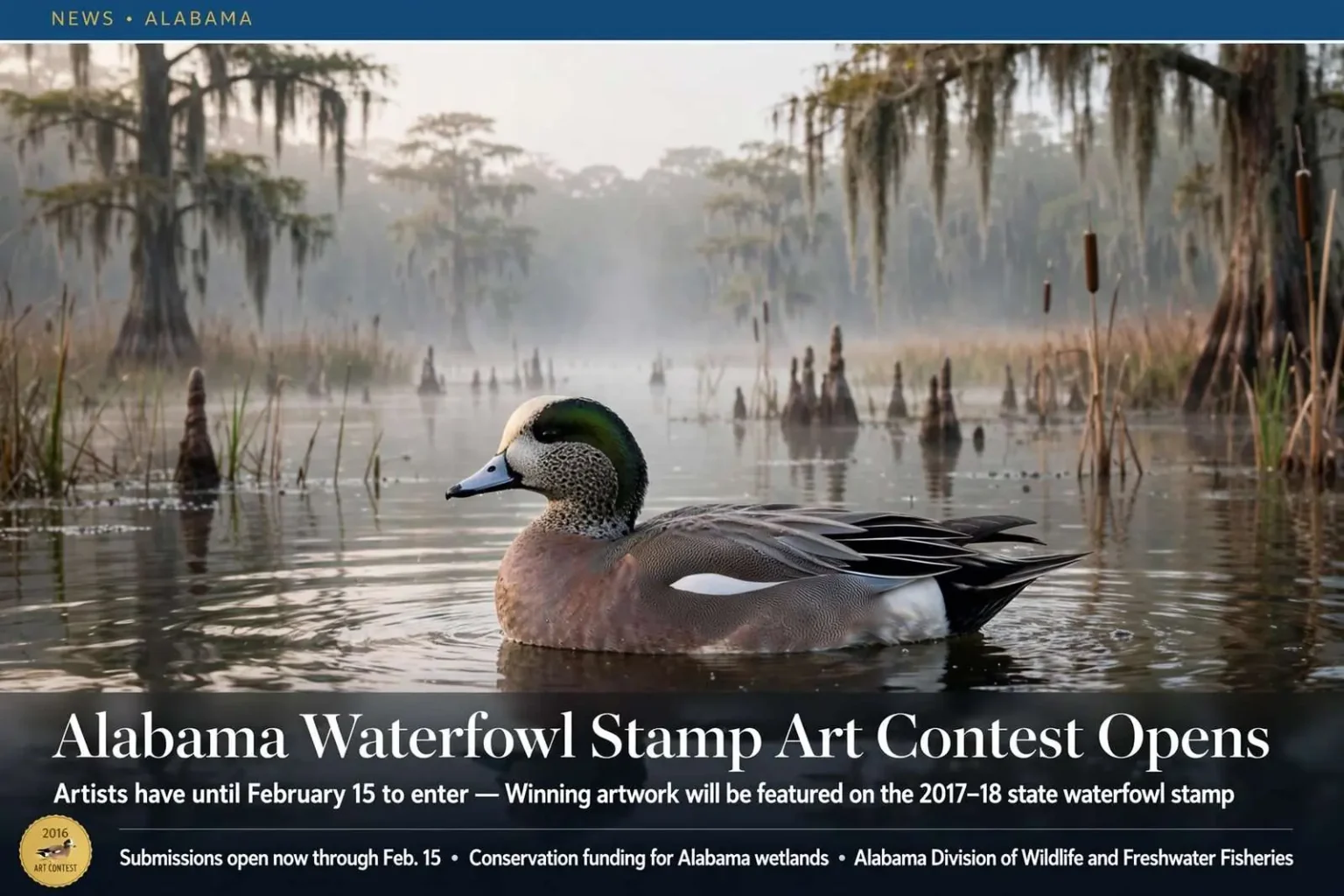
Just as Alabama’s duck and goose seasons wind down, a new competition is taking aim at the state’s wildlife artists. Entries for the 2016 Alabama Waterfowl Stamp art contest are being accepted through Feb. 15, and the winning piece will grace the 2017-18 state stamp — the validation hunters must carry alongside their federal stamp when pursuing migratory waterfowl in Alabama. For the artists who enter, the contest is one of the most visible honors in the state’s outdoor world: the winning painting will be reproduced on thousands of stamps, collected by hunters and philatelists alike, and archived in the long line of Alabama duck stamp art that stretches back generations.
The timing is deliberate. By early February, Alabama’s waterfowl seasons are closing and hunters are turning their attention to next year, making winter the natural moment to look ahead to the stamps they will carry in the seasons to come. The contest also gives the state’s community of wildlife artists a reliable annual stage, one that has helped launch and sustain careers in outdoor art across the Southeast.
The contest is open to Alabama residents only, and the stakes reach beyond bragging rights. “Like the Federal Waterfowl Stamp, revenues from the sale of Alabama stamps are used to purchase, establish or improve migratory waterfowl habitat,” said Chris Smith, contest coordinator for the Alabama Division of Wildlife and Freshwater Fisheries. That funding model — conservation paid for by the hunters who use the resource — is the direct descendant of the federal duck stamp program Congress created in 1934, which has since raised hundreds of millions of dollars for wetland acquisition across the country and remains one of the most successful conservation funding mechanisms in American history.
Jim Denney of Alexander City took last year’s crown with a painting of an American wigeon that appears on stamps for the current 2016-17 season. Denney’s win continued a pattern familiar in state duck stamp competitions, where artists often spend months on a single entry, studying reference photos, mounted specimens and live birds to capture plumage precisely. Alexander City, on the edge of Lake Martin, sits in the east-central part of the state where waterfowl habitat and wildlife art both have deep roots.
The American wigeon itself is a fitting subject for Alabama’s stamp. The dabbling duck is a regular winter visitor to the state’s flooded timber, oxbow lakes, coastal marshes and managed impoundments, arriving each fall from prairie breeding grounds to the north. Hunters and birders alike recognize the species by the white patch on the drake’s crown, and its presence in Alabama’s wetlands each winter is one of the seasonal markers the stamp program exists to protect.
How the Judging Works
Every eligible entry goes on public display Feb. 26 at the Richard Beard Building in Montgomery, where judges drawn from the worlds of art, ornithology and wildlife conservation will pick the winner. The public viewing has become part of the contest’s appeal, giving hunters, collectors and art enthusiasts a chance to study the field of entries in person and see the range of approaches Alabama’s artists take to the same assignment. The Richard Beard Building, home to the Department of Conservation and Natural Resources’ administrative offices in the capital, is a fitting venue for a competition whose purpose is as much administration as art.
The Department of Conservation and Natural Resources says judging will emphasize uncluttered design suitable for printing as a stamp, anatomical accuracy and overall artistic rendering. The criteria matter more than casual observers might expect. A stamp is a small, printed object that must read clearly at postage-stamp size, so busy compositions and cluttered backgrounds tend to lose out to simpler, stronger designs. Anatomical accuracy is scrutinized by judges who know waterfowl down to the feather tract, and rendering quality separates paintings that merely resemble a duck from those that bring one to life.
Artists can find entry details through the department’s website under the programs menu. The low-friction entry process reflects the contest’s grassroots character: unlike some state competitions that charge substantial entry fees or restrict mediums, Alabama’s contest is designed to be reachable by any resident artist, from professionals who enter duck stamp competitions across the country to talented amateurs entering for the first time.
Waterfowl hunting in Alabama depends on habitat that is far from guaranteed. The state sits at the southern end of the Mississippi Flyway, one of the four great migration corridors that funnel ducks and geese from Canadian prairies through the American heartland to the Gulf Coast each winter. Along that route, wetlands have been drained, channelized and developed for more than a century, which is why stamp dollars — state and federal — matter. Every acre of flooded timber or coastal marsh purchased with stamp revenue is habitat that will hold birds for future seasons of Alabama hunters.
For residents who hunt the state’s public waters — from the Tennessee River impoundments in the north to the Mobile-Tensaw Delta and the coastal marshes of Baldwin and Mobile counties — the stamp is a small annual purchase with a visible return. The 2017-18 stamp that emerges from this winter’s contest will be carried in wallets and taped to hunting licenses across the state, and the painting behind it will take its place in a gallery of Alabama wildlife art that doubles as a conservation ledger.
BayBears Busy Before Opening Day
In other local sports news, the Mobile BayBears are already reshaping their front office months before first pitch. Concessions director Justin Gunsaulus has been promoted to assistant general manager of food and beverage, and Matt Baranofsky moves up to director of ticket operations after steadying the box office mid-season. The moves reflect a common pattern in minor league baseball, where front-office staff who can manage both the business side and the ballpark experience on a small budget are valued and advanced quickly.
New account executives Jackson Hamilton and Mike Murtha arrive from the Daytona Tortugas, bringing with them experience from another small-market Southern club. In minor league baseball, ticket sales staff are the engine of the business: season plans, group outings and corporate accounts fund the promotions, fireworks nights and family ticket packages that fill the seats on weeknights. Building a sales team with experience at other clubs is a sign that the BayBears are investing in the season-long effort to grow attendance rather than simply opening the gates.
The club opens its 20th Southern League season April 7 at Tennessee before returning to Hank Aaron Stadium on April 14 to host the Biloxi Shuckers. The 2016 season marks two decades of minor league baseball at the ballpark named for Mobile’s most famous son, the Hall of Famer whose childhood on the city’s north side preceded a career that redefined the home run record. The stadium itself, opened in the late 1990s on the city’s west side, has been the anchor of professional baseball in Mobile since it opened.
The opponent for the home opener carries its own storyline. The Biloxi Shuckers were a brand-new member of the Southern League that year, having relocated from Huntsville, Alabama, in 2015 — a move that reshaped the league’s geography and briefly left the Shuckers playing nearly the entire season on the road while their new Gulf Coast ballpark was finished. By the time Mobile’s 2016 home opener arrived, the newest member of the league had become one of its closest geographic rivals, making early-season series between the clubs a convenient Gulf Coast matchup.
A 20th season also invites reflection on the franchise’s place in Mobile’s sports landscape. Minor league baseball has come and gone in Mobile across the 20th century, but the BayBears’ arrival in the late 1990s brought the game back on a modern scale, complete with a purpose-built stadium and a spot in the Southern League, one of the oldest and most storied circuits in the minors. Twenty years of springtimes at The Hank have made the club part of the city’s routine — a place for youth league teams on weekday nights, fireworks in the summer and the first sign of warmer weather each April.
Seasonal game-day staff hiring continues through Jan. 22 for applicants 16 and older, who must apply in person at The Hank weekdays between 9 a.m. and 5 p.m. The in-person requirement is a throwback in an era of online applications, but it fits the job: game-day staff work the gates, the concession stands and the ticket windows, and the club’s hiring process doubles as an early audition for the customer-facing work. For students and part-time job seekers along the Gulf Coast, the annual hiring window is one of the area’s most reliable sources of seasonal work.


