Alabama’s Red Snapper Season Set to Open May 27 for Private Anglers
Alabama's 2022 red snapper season for private anglers opens May 27 and runs extended weekends through the summer, as a charity fishing tournament benefiting United Way chapters in Choctaw, Clarke, Mobile and Washington counties wraps up and a Black Belt turkey photo contest gets underway.
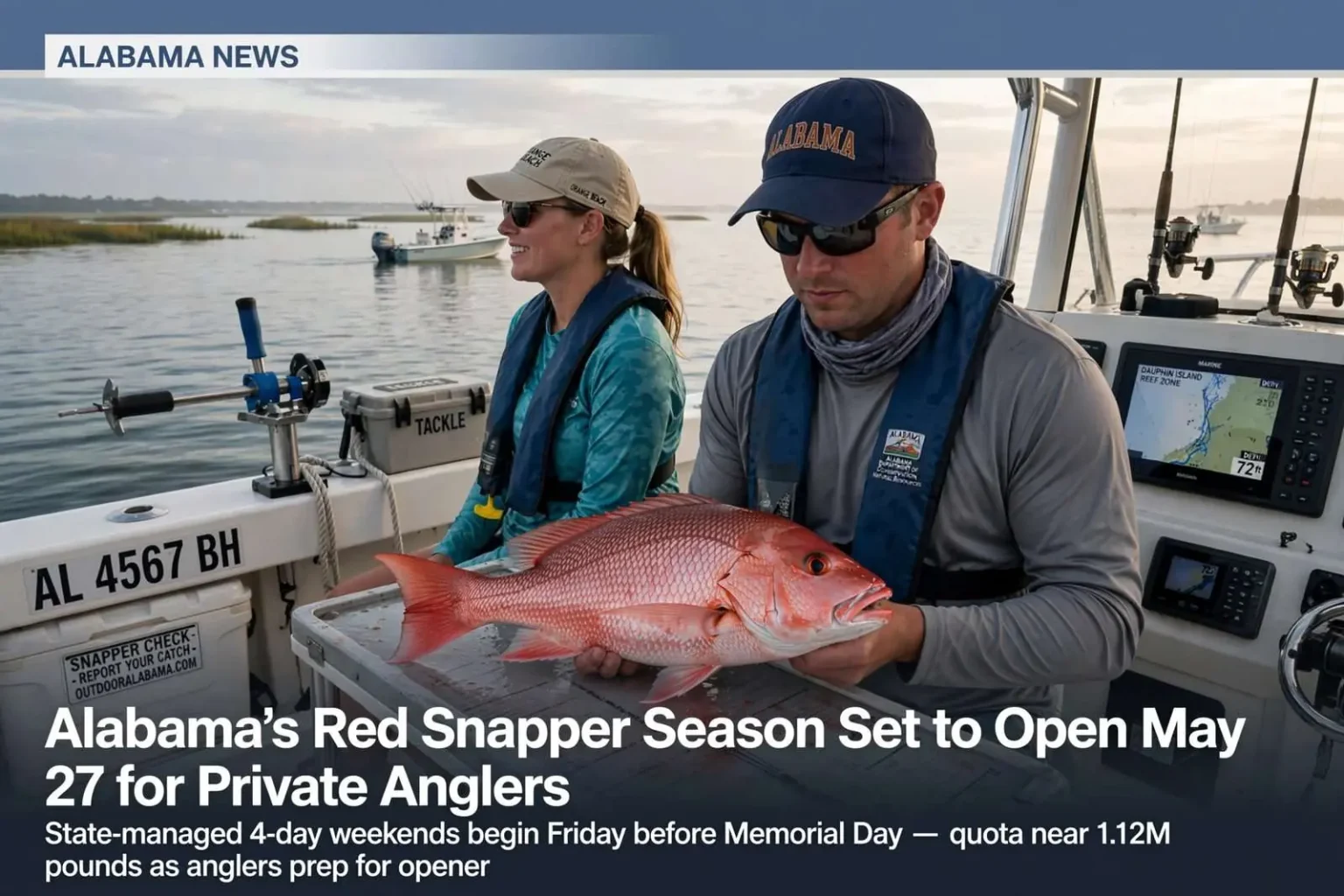
Recreational anglers along the Alabama Gulf Coast will get their first shot at red snapper this year starting Friday, May 27, the Friday before Memorial Day. The season, set by the Alabama Department of Conservation and Natural Resources (ADCNR) Marine Resources Division, will run in extended four-day weekends — Friday through Monday — until the state’s annual harvest quota is projected to be met.
The National Oceanic and Atmospheric Administration (NOAA) Fisheries has not yet finalized this year’s poundage quota, but state officials expect it to land close to last year’s figure.
“We anticipate our quota for this year will be similar to last year’s, which was 1.12 million pounds,” said Scott Bannon, director of the ADCNR Marine Resources Division. “If the fishing effort is ‘normal,’ and the weather is favorable, we’ll fish probably 30 to 40 days, depending on the effort. We encourage people that if the weather is bad, don’t go. Wait until the weather is better.”
The snapper opener is the marquee date on Alabama’s saltwater calendar. Red snapper draw more private boats across the state line and into Gulf waters than any other species, and the weekends surrounding the opener routinely fill launch ramps from Dauphin Island to Orange Beach as anglers chase a fish prized on the table as much as on the line.
Anglers planning to head out over the holiday weekend are reminded to check current regulations before launching, since size limits, bag limits and season length can shift from year to year based on quota projections and fishing effort.
How Alabama’s snapper season works
The Friday-through-Monday schedule applies specifically to anglers fishing from shore, from private recreational vessels, and from state-licensed Alabama commercial party boats that do not hold federal for-hire fishing permits. A separate season for anglers aboard federally permitted for-hire charter vessels will be announced later by NOAA Fisheries.
The split exists because federal law assigns red snapper catch to two distinct channels. Federal for-hire charters operate under federal permits and federal seasons, while private anglers and state-licensed boats fall under state management. Alabama has used its state-season authority to give private anglers longer and more predictable windows than the federal system historically provided, using state-waters expansion and careful quota tracking to stretch the harvest.
Extended weekends are the design principle behind the state calendar. Rather than a continuous season that closes abruptly, the four-day blocks concentrate fishing around the days most anglers can actually take off work, spreading the quota across the summer instead of exhausting it in the first weeks. Weekend openings also align with weather windows — Gulf conditions in late May and June are more reliably fishable than they become during the July and August thunderstorm pattern.
Bannon’s advice to skip bad-weather days reflects the math of quota management. Effort spent on days when half the fleet stays at the dock wastes little quota; effort on days when the entire fleet launches can burn through weeks of the allocation in a single weekend. The state watches landings weekly and can shorten the schedule if the pace runs hot.
Reporting the catch
As in recent years, Alabama will rely on its “Snapper Check” reporting system to track landings from shore, private vessels and state-licensed charter boats throughout the season. Anglers are required to report their catch, and the state posts weekly landing updates at outdooralabama.com so fishermen can gauge how quickly the quota is being reached.
Snapper Check has become central to how Alabama defends its longer seasons. The reporting data lets state biologists show federal managers precisely how many pounds were harvested and when, replacing the extrapolated estimates that once made federal-season calculations conservative. Anglers who report their landings are, in a very real sense, funding next year’s calendar — incomplete reporting forces the state to pad its estimates, which shortens future seasons.
There is also a new requirement for 2022: every vessel fishing for reef fish in federal waters must now have a venting tool or descending device rigged and ready to use. The devices help reduce mortality in fish brought up from deep water by relieving pressure or returning them quickly to depth. Additional details on the requirement are available through the Gulf of Mexico Fishery Management Council.
Descending devices matter because snapper brought up from depths beyond about 100 feet often arrive with distended swim bladders — the condition anglers call barotrauma — that leaves them floating on release. Returning a fish to depth quickly gives it a far better chance of surviving, and fish that survive release do not count against the harvest quota the way dead discards do.
A charity tournament already underway
While red snapper season gears up, a separate fishing event is already underway that benefits local charities. Phins Apparel is hosting the inaugural Phins Fishing Classic, a catch-photo-release tournament running in eight Southern states through May 1 that will benefit more than 240 United Way chapters nationwide.
The tournament is designed to raise both funds and awareness for United Way while connecting anglers directly to their local chapters. Locally, the United Way of Southwest Alabama stands to benefit from anglers who fish in Choctaw, Clarke, Mobile and Washington counties, with net proceeds divided among participating United Way chapters based on how many anglers register in each community.
The registration-based split gives the area’s chapters a direct stake in turnout. Every angler from southwest Alabama who enters directs the tournament’s net proceeds toward the United Way serving Mobile and its neighboring counties, meaning participation — not just entry fees — is what channels money here.
The tournament, powered by the Fishing Chaos app, allows anglers to submit photos of their catch for professional judging through the Fishing Chaos App and Reel Tournament Management system. Organizers are guaranteeing $10,000 in prize packages across six categories of salt and freshwater fish: Black Bass, Crappie, Freshwater Catfish, Redfish, Snook and Speckled Trout.
The catch-photo-release format has become the standard for conservation-minded tournaments because it eliminates the weigh-in entirely. Fish are photographed against a measuring board and released alive, which lets an event cover six species across eight states without hauling live fish to a central site — and without adding mortality to a fishery already under close management.
High school-aged anglers are especially encouraged to enter, since the tournament includes a dedicated High School Black Bass category and qualifies as an NSR reporting event. Open tournament tickets cost $35, or $55 for an entry that includes a tournament T-shirt. Tickets can be purchased through the Fishing Chaos website or app. Anglers with questions about the tournament can email [email protected] or call 251-661-0369.
The Big Gobbler contest
Turkey hunters in the region have their own contest to look forward to as well. The Alabama Black Belt Adventures Association is hosting the 10th annual Big Gobbler Photo Contest, timed to coincide with Alabama’s turkey season and meant to showcase the Black Belt region, an area widely regarded as one of the best turkey hunting destinations in the country, while celebrating both veteran and first-time hunters.
The Black Belt’s reputation for turkey hunting rests on the same soil that made it famous for cotton — the chalky prairie soils and mixed hardwood bottoms that support abundant flocks across a band of counties stretching across central Alabama. Outfitters from around the country book hunts there each spring, and the region’s wild turkey population has made it a destination comparable to its better-known reputation for whitetail deer.
This year’s contest, conducted entirely online, closes May 8, with the winner selected through public voting. Entrants are limited to one submission and must complete the online form in full, including naming everyone pictured in the photo and identifying the Black Belt county where the turkey was harvested. Visitors to the contest site may cast one vote per entry, per day, per IP address.
The contest doubles as marketing for a rural region whose economies depend heavily on hunting tourism. Photographs submitted from across the Black Belt become a showcase the association can point to when promoting the area’s outdoors economy — outfitters, lodging, restaurants and the small-town businesses that spring turkey season supports each March and April.
Between the snapper opener, the charity classic and the gobbler contest, the region’s outdoors calendar is running at full speed. Anglers watching the weather ahead of May 27 will find their openings soon enough; hunters and bass fishermen, meanwhile, have deadlines and photo uploads of their own to keep straight before the month ends.
What the opener looks like on the water
A typical opener weekend on the Alabama coast runs through the artificial reef zones the state has spent decades building. Alabama’s nearshore reef program — more than a thousand reef sites deployed in state waters — concentrates snapper within a short run of the passes, which is the structural reason the state can support such intense private-boat effort. Boats out of Dauphin Island Marina, the Bayou La Batre docks and Orange Beach can reach productive structure in well under an hour, making a snapper trip a half-day proposition for families rather than an offshore expedition.
That accessibility is what makes the quota math urgent. When thousands of private boats can each limit out in a morning close to shore, the state’s 1.12 million pound allocation can move quickly, and the weekly landings updates at outdooralabama.com become required reading for anyone planning a late-season trip. Anglers who wait until the final announced weekend risk finding it canceled; anglers who follow the data know how many Fridays remain.
The venting and descending-device rule adds a small but real gear checklist for 2022. A device rigged and ready means exactly that — attached to a line or readily deployable, not buried in an anchor locker — and marine patrol officers will be checking for it alongside life jackets and flares through the season.
For shore-bound anglers, the state season includes beach and pier fishing as well. Snapper caught from the shore and from public piers count under the same reporting rules, and the four-day weekend format gives pier fishermen the same windows as boat owners — a deliberate equity in the state’s design that keeps the season from belonging exclusively to vessel owners.
The separate federal for-hire season, announced later by NOAA Fisheries, fills in the calendar for customers of the charter fleet. Those trips operate under different rules and a different allocation, so anglers booking a guided snapper trip should confirm with the captain which season the boat is fishing under before planning a date.