
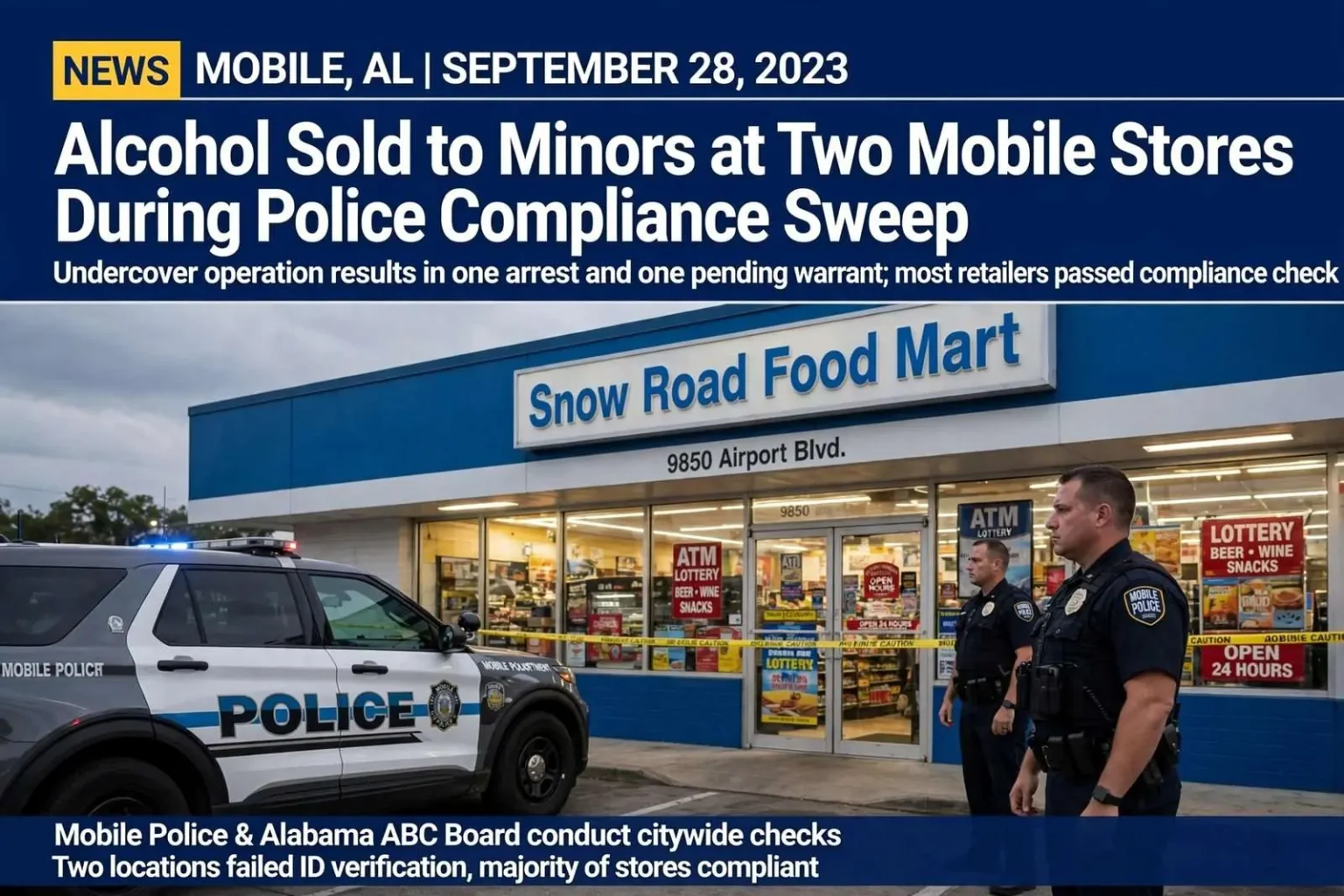
Two Mobile stores sold alcoholic beverages to an underage buyer during a recent compliance operation run by the Mobile Police Department alongside the Alabama Alcoholic Beverage Control Board, according to police. The effort has so far produced one arrest and one outstanding arrest warrant.
Compliance operations of this kind pair undercover enforcement with a plain public purpose: confirming that the businesses licensed to sell alcohol are actually checking identification before the sale. The results, police said, split the city’s retailers into two groups — the overwhelming majority who followed the rules, and the small number who did not.
Clerk arrested after second violation
Police said the sweep took place Thursday, Sept. 28, with a minor working alongside officers visiting businesses across the city. At Snow Road Food Mart, located at 9850 Airport Blvd., the underage buyer was served without being asked for identification. Clerk Hani Al Samet, 34, was arrested and charged with furnishing alcohol to a minor. According to police, that store had now failed a compliance check twice within 90 days.
The mechanics of the operation are standard across Alabama. An underage operative — a volunteer or young officer under the legal drinking age — attempts to purchase alcohol while accompanying officers observe. If the clerk requests identification and refuses the sale, the business passes. If the sale goes through, officers step in immediately, and the clerk who made the sale can face criminal charges on the spot.
The furnishing alcohol to a minor charge carries real consequences in Alabama, including potential jail time and fines for the individual seller. For the business itself, the penalties run on a separate track through the Alabama Alcoholic Beverage Control Board, which holds the license and can levy fines, suspensions or ultimately revocation — a remedy that ends a store’s ability to sell alcohol entirely.
A second failure within 90 days is treated with particular seriousness. Repeat violations signal to both police and the ABC Board that a store’s training and supervision have not corrected the problem after an initial warning, and they weigh heavily in any subsequent license proceedings.
Second location faces pending warrant
A second violation occurred at the Chevron station at 6400 Cottage Hill Road, where a clerk allegedly sold an alcoholic beverage to the underage buyer without requesting proof of age. Police said an arrest warrant for that clerk will be signed at a later date.
The pending warrant means the case remains open: once the warrant is signed and served, the clerk will face the same charge process as the arrested Snow Road clerk. Police noted that the warrant process follows the completion of paperwork and a judge’s review, which is why one store produced an immediate arrest and the other a warrant still to come.
Convenience stores and gas stations occupy a prominent place in these sweeps precisely because of their volume. Beer and wine sales account for a large share of the transactions at many locations, staffed by clerks handling dozens of duties at once, which is why the state’s message to retailers focuses on making the ID check an unbreakable habit rather than a judgment call under pressure.
Most businesses passed
The operation also covered several other retailers, including Springhill Shell on Springhill Avenue, R & P Liquor on Cody Road South, West Mobile Liquor on Schillinger Road South and Airport Liquor on Airport Boulevard. Officers reported that each of those locations complied with ABC Board guidelines by checking identification before completing any sale.
The passing locations span several distinct corners of the city — Springhill Avenue in the midtown area, Cody Road South and Schillinger Road South in West Mobile, and the Airport Boulevard corridor that runs the width of the city — a spread that reflects how compliance teams distribute their visits across neighborhoods rather than concentrating on a single district.
For the stores that passed, the result is more than an absence of charges. Passing a compliance check demonstrates that a business’s age-verification practices work under real conditions, and police departments typically publicize passing results alongside failures to give responsible retailers the credit the law intends for them.
Why the sweeps matter
Compliance sweeps of this kind are a standard enforcement tool across Alabama, pairing local police with state ABC agents to reduce underage access to alcohol. Retailers who fail can face criminal charges for their clerks and repeated violations can bring consequences for the business itself.
The Alabama Alcoholic Beverage Control Board administers the state’s alcohol laws from its Montgomery headquarters, issuing licenses, promulgating rules and running its own enforcement arm alongside local departments. Undercover compliance checks are among the ABC Board’s most frequent joint operations with municipal police, and cities across the state — from Birmingham to Huntsville to the coast — run versions of the same program.
The public-health rationale is straightforward. Underage drinking is associated with elevated risks of injury, impaired driving and long-term alcohol misuse, and surveys consistently show that retail outlets remain one of the places minors attempt to obtain alcohol. Cutting off that supply line requires the two-part strategy the sweeps embody: enough enforcement to catch violators, and enough publicity to deter the rest.
Police departments also stress that the operation’s design protects fairness. The underage operative enters and attempts the purchase exactly as any young customer would, without misrepresenting age if asked, and clerks who follow the law — even an imperfectly trained clerk who hesitates and checks — pass. The sweep measures compliance, not perfection, and the distinction between a pass and a failure is a single question: was identification requested?
What retailers can do
Store owners and managers who want to stay on the right side of the next sweep have a familiar checklist. Train every clerk on acceptable forms of identification and on the calculation of age from a birth date. Post signage reminding customers that ID is required. Refuse sales without hesitation when identification is missing, expired or altered. And document training, because a store that can show a serious training program is in a far stronger position if a violation nevertheless occurs.
Technology helps as well. Some retailers use scanners that read the barcode on a driver’s license and calculate age automatically, removing arithmetic errors from the counter transaction. Others schedule shift huddles before high-traffic periods to reinforce the policy. The cost of these measures is trivial compared with the price of a failed check — a criminal charge for a clerk, an ABC Board action for the store, and the reputational damage that follows a publicized violation.
Mobile’s enforcement landscape
Mobile Police Department runs these checks in coordination with the ABC Board as part of ongoing citywide enforcement rather than as a one-time campaign. The city’s size and its long corridors of commercial strips — Airport Boulevard alone passes dozens of convenience stores and package stores between the downtown area and the western city limits — mean the number of licensed alcohol retailers runs well into the hundreds, and compliance teams rotate coverage across them over the course of a year.
The partnerships extend beyond alcohol as well. Local police, the ABC Board’s agents and community organizations frequently share resources on enforcement campaigns that touch underage access, and results from each sweep feed into decisions about where the next round of visits will focus. Stores with recent failures can expect to see officers return sooner rather than later, a pattern the second Snow Road violation in 90 days illustrates.
Neighborhood context matters to residents watching these operations unfold. The Airport Boulevard corridor, Springhill Avenue and the West Mobile roads where this sweep concentrated carry dense retail development serving surrounding residential neighborhoods, which puts the stores that fail a check in close proximity to the families affected by underage alcohol sales. City officials have long treated retail compliance as a neighborhood safety issue, not merely a licensing question.
The legal consequences in detail
Furnishing alcohol to a minor is a criminal offense in Alabama, and the charge against a clerk follows the standard criminal process: arrest or warrant, booking, an initial appearance, and resolution through plea or trial. Penalties can include fines and confinement, and a conviction becomes part of the seller’s record — a consequence that falls on the individual who made the sale, not only the business.
The store’s exposure runs in parallel. The ABC Board’s administrative process can impose fines scaled to the violation, suspend the store’s privilege to sell alcohol for a period, or, for repeated failures, revoke the license altogether. Because the license is the backbone of any alcohol retailer’s revenue, suspension alone can be an existential blow to a small store, and revocation effectively ends the business model.
There are collateral consequences as well. Sellers’ servers’ training certificates, insurance premiums and wholesale suppliers’ own compliance obligations can all be touched by a store’s violation history, and a publicized failure travels quickly in a city where the police department releases the names and addresses of the businesses involved.
The broader push across Alabama
Alabama’s underage-drinking enforcement infrastructure has grown over the years into a cooperative network spanning state and local agencies. The ABC Board’s enforcement division conducts checks statewide, municipal departments run their own operations with state support, and grant-funded programs have historically supported both enforcement and education campaigns aimed at parents and teens.
The message police hope the Sept. 28 results deliver is symmetrical. To the clerks and store owners who checked identification and refused the sale: the system works in their favor, and their names will not appear in the next press release. To the minority who did not: the next buyer standing at the counter may be working with officers, and the price of skipping the question is arrest, a warrant, and a file at the ABC Board.
Residents who observe what they believe is a store selling alcohol to minors can report the business to the Mobile Police Department or the Alabama Alcoholic Beverage Control Board, and those complaints help determine where future compliance sweeps direct their visits.


