ALDOT Pile Driving Work Set Near Wallace Tunnel for Mobile River Bridge Project
ALDOT crews are conducting pile driving work this week near the Wallace Tunnel as part of ongoing foundation testing for the proposed Mobile River Bridge and Bayway project.
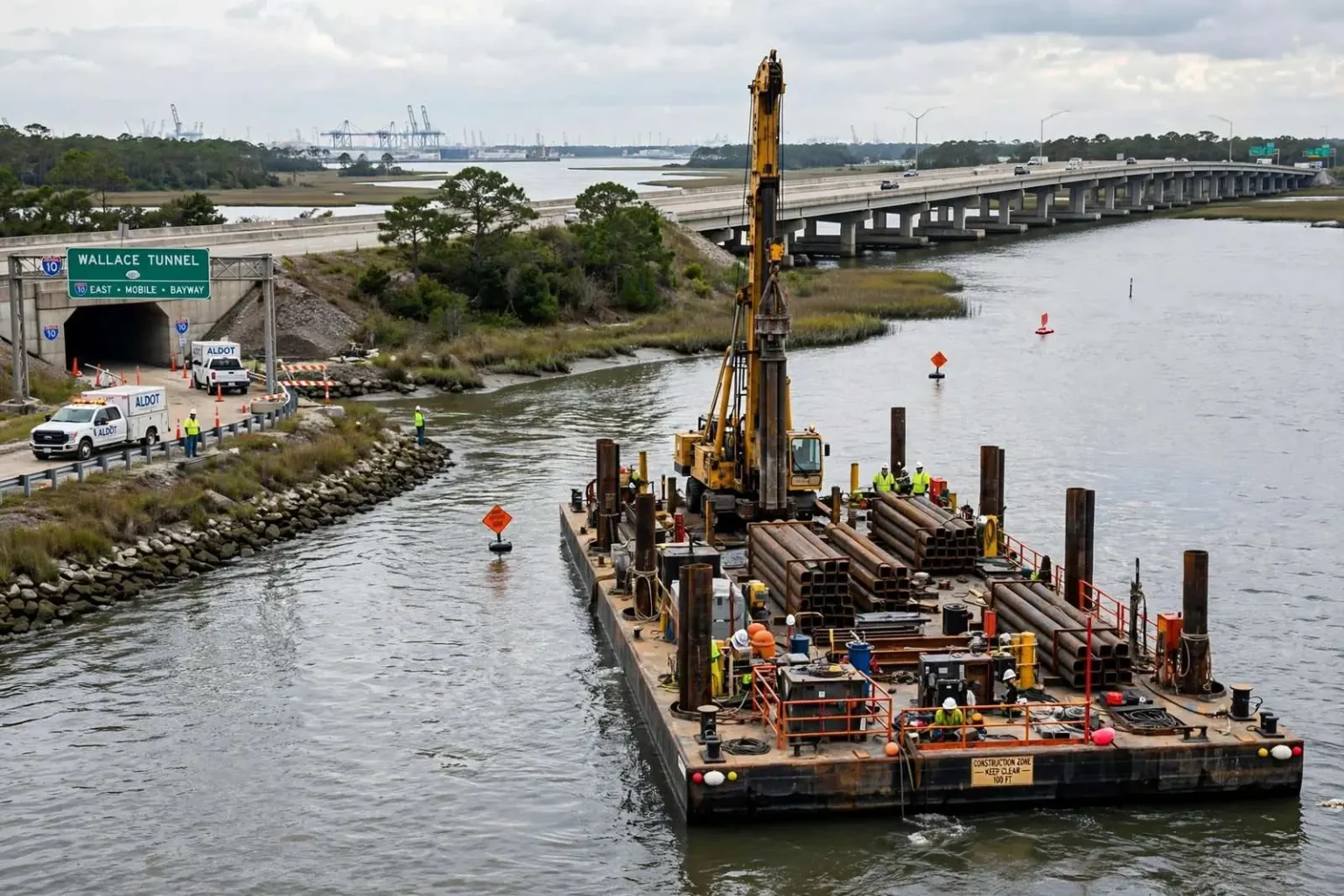
State transportation crews are set to begin pile driving work this week on the north side of the Bayway just east of the Wallace Tunnel entrance, part of ongoing preliminary construction tied to the proposed Mobile River Bridge and Bayway project. The Alabama Department of Transportation says the work is expected to begin as early as Tuesday and continue through the end of the week, running throughout the day.
Officials said the pile driving itself is not expected to disrupt traffic flow on the Bayway, though drivers are being asked to observe posted speed limits and stay alert for crews and equipment working close to the roadway. The work zone sits just beyond the eastern portal of the Wallace Tunnel, one of the busiest stretches of Interstate 10 in southwest Alabama, so drivers moving through the area at highway speed should watch for slowed or merging equipment trucks even where lanes remain open.
The activity is the latest in a series of foundation tests that have been underway since March at three separate sites along the proposed bridge and Bayway corridor. Crews have already driven and constructed varying types and sizes of foundation piling and drilled shafts at the Texas Street Interchange, along the west bank of the Mobile River, and at points along the Bayway itself.
Each site presents its own ground conditions, and that variety is exactly why the testing program was spread across the corridor. Soil near the Mobile River behaves differently from the fill and soft sediments beneath the Bayway, and engineers cannot size foundations for a multi-billion-dollar crossing without first learning what the earth will bear. This week’s work on the north side of the Bayway is the continuation of that data-gathering effort, bringing heavy equipment to the edge of one of the region’s most recognizable landmarks.
According to ALDOT, the tests are designed to give engineering teams additional preliminary geotechnical data before design work moves forward. Teams competing to design, build, finance, operate and maintain the eventual bridge and Bayway project will use the information to refine their proposals.
Knowing more precisely how deep and how large the foundation piling needs to be at each site allows designers to avoid over-building the structure’s foundations, which officials say translates into real cost savings on a project expected to carry a price tag in the billions of dollars. On a structure of this scale, foundation work accounts for a substantial share of total cost, so even modest refinements to piling requirements can move the budget by meaningful amounts.
Testing before the big decisions
The current phase of testing is being carried out by Jordan Pile Driving, Inc., a Mobile-based contractor that was awarded a $3.4 million contract for the work. The contract calls for the testing to wrap up by the end of May. The firm’s crews specialize in exactly the kind of deep foundation work the corridor demands, driving steel piling into soft coastal soils until they reach the load-bearing layers far below the surface.
Geotechnical testing of this kind is standard practice before any major bridge project. Engineers analyze the soil profile at each proposed foundation location, then drive test piles and measure how much resistance they encounter and how the ground responds. Drilled shafts — large concrete columns formed in augered holes — are tested alongside driven piling so designers can compare methods and determine which is better suited to each location along the route.
The data collected this spring will feed into the proposals being prepared by the competing teams, each of which must present its own engineering approach, construction schedule and financing plan. The delivery model under consideration for the project is a comprehensive one, folding design, construction, long-term operation and maintenance into a single agreement, which places a premium on accurate early data. A team that can size its foundations confidently from the start avoids costly redesign later.
The current phase of testing does not, by itself, commit the state to any particular design. But it shortens the distance between a contract award and the start of real construction, because much of the foundational engineering homework will already be done. For a project that has been discussed in some form for years, that head start is one of the few levers officials control in the near term.
Because the work is taking place along the water, ALDOT says crews will be relying on heavy equipment and barges throughout the process, and both drivers on the Bayway and boaters on the surrounding waterways should expect to see that equipment staged in the area. Barge-mounted cranes and pile rigs allow crews to work over the water without building temporary platforms, but they also mean the work zone extends beyond the highway shoulder to the water itself.
Environmental safeguards and the view from the water
The agency says it is taking steps to protect water quality and wildlife while the testing is underway, in keeping with environmental safeguards required for work near the Mobile River and Mobile Bay. Work over or adjacent to tidal waters in Mobile typically involves measures to contain debris, control turbidity and schedule activity around sensitive species, and ALDOT’s testing program is being conducted under those requirements.
Boaters passing the area this week will notice the equipment presence well before they reach it. Officials encourage vessels to give the staged barges and work areas a wide berth, both for the safety of the crews and because anchor lines and equipment extend into the water around each work position. Recreational traffic on the waterways near the Bayway should plan for the possibility of shifted or restricted passage near the testing sites.
The Mobile River Bridge and Bayway project has been discussed for years as a way to relieve chronic congestion at the Wallace and Bankhead tunnels, which routinely back up during peak travel times and after any incident in the tunnels. The two tunnels carry Interstate 10 beneath the Mobile River, and because each carries only a fixed number of lanes, even a minor fender-bender can produce delays that ripple for miles along the Bayway and into downtown Mobile.
The Bankhead Tunnel, the older of the two crossings, dates to the early 1940s, and the Wallace Tunnel opened roughly three decades later as traffic through the city multiplied. Both were built for a region far smaller than the one they now serve, and the corridor’s growth has made the tunnel bottleneck a fixture of daily life for commuters in Baldwin and Mobile counties alike. The proposed bridge would carry I-10 traffic over the river on a new high-level crossing, allowing through traffic to bypass the tunnels entirely.
Proponents of the project point to the safety and economic costs of the current bottleneck: the stops, queues and crashes inside and around the tunnels cost travelers time and money every day, and the region’s continued growth on both sides of the bay promises to make them worse. Opponents have long focused on the project’s tolling plans and route impacts, questions that remain part of the public conversation even as preliminary engineering proceeds.
What happens next
The preliminary testing now underway does not commit the state to a final design or financing plan, but it is intended to give whichever team is ultimately selected a head start on engineering the bridge’s foundations once a contract is awarded. The selection process for that team is separate from the field work, and ALDOT has emphasized that the testing program is being run on a schedule designed to dovetail with it.
For residents trying to make sense of the cranes and barges appearing along the corridor, the short version is this: nothing has been finalized, but the groundwork — literally — is being laid. The $3.4 million testing contract represents a small fraction of the project’s eventual cost, but the information it produces will shape the foundation design for the crossing itself, from the Texas Street Interchange on the Mobile side to the Bayway spans east of the river.
Drivers on the Bayway should see no measurable delay from this week’s pile driving, since the work is happening off the travel lanes. Still, officials urge motorists through the Wallace Tunnel area to reduce distractions, follow the posted limits and be prepared for equipment movements near the shoulder. The same advice applies at the Texas Street Interchange and the river’s west bank, where crews have worked at various points since March.
The testing is expected to conclude by the end of May, after which the geotechnical record from the three sites becomes part of the technical package available to the competing teams. From there, the project’s next milestones — team selection, a final design and a financing plan — rest with the state and the procurement process rather than with the crews in the field.
Until then, the sight of a pile rig on a barge east of the Wallace Tunnel is a sign of preparation, not construction. The bridge and Bayway remain a proposal, but one whose supporting data is now being driven into the ground, pile by pile, along the corridor it would one day serve.