
ALEA Urges Drivers to Follow Move Over Law After MPD Vehicle Struck on I-10
ALEA urges drivers to obey Alabama's Move Over Law after a Mobile Police SUV was struck on I-10 while officers responded to a crash early Sunday morning.
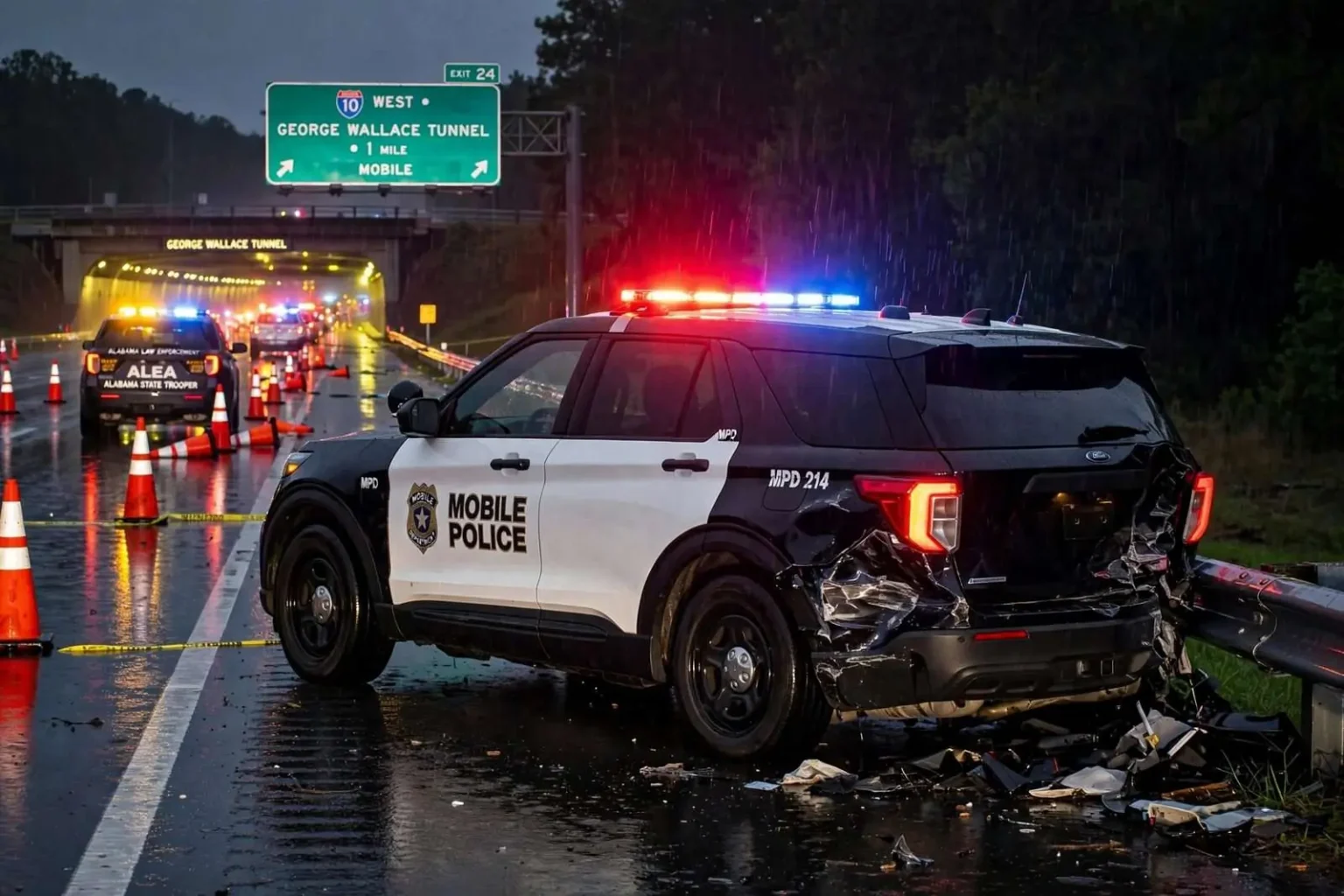
A Mobile Police Department SUV was struck by a passing vehicle early Sunday morning while officers were responding to a prior crash on Interstate 10, prompting the Alabama Law Enforcement Agency to remind motorists about the state’s Move Over Law.
The incident occurred around 1 a.m. The police vehicle had its emergency lights activated to manage traffic as Mobile officers investigated the earlier crash when another vehicle collided with it. No significant injuries were reported, according to ALEA.
“Look for our lights, slow down,” said Senior Trooper Anna Peoples with the Alabama Law Enforcement Agency, stressing the dangers first responders face when working along roadways.
The crash underscores a hazard that responders along the Gulf Coast know well: Interstate 10 funnels enormous volumes of traffic through Mobile around the clock, and the stretch that crosses the city — including the George Wallace Tunnel beneath the Mobile River — leaves little margin for error when a lane is blocked and drivers must merge suddenly in the dark.
Alabama’s Move Over Law
Since 2019, Alabama law has required drivers to move over into a different lane when they encounter an emergency vehicle with its lights activated, or to significantly slow down if changing lanes is not possible. The statute is designed to protect law enforcement officers, firefighters, tow truck operators and other roadside workers.
The law’s reach is broad. It covers police cruisers, fire engines, ambulances, wreckers, utility and service vehicles, and highway maintenance crews — essentially any situation where someone is working at the roadside with warning lights displayed. Drivers who cannot move over because of traffic, a barrier, or road conditions are expected to reduce their speed well below the posted limit and pass with caution, giving the scene as wide a berth as the roadway allows.
“Every time you’re behind the wheel of a vehicle, you’re behind a weapon,” Peoples said. “If you see lights and you’re not sure what lane they’re in, slow down.”
Enforcement of the law falls to state troopers and local police departments, who can issue citations to drivers who fail to move over or slow down. But troopers say the goal of the statute is not tickets — it is preventing the struck-by crashes that injure and kill responders on highways across the country every year. Nationally, traffic incidents rank among the leading causes of on-duty deaths for law enforcement officers, firefighters, and tow operators, and many of those incidents happen at scenes where warning lights were clearly displayed.
Why Secondary Crashes Happen
Safety officials describe the collision involving the police SUV as a secondary crash — a collision that occurs because of a prior incident rather than independent circumstances. Secondary crashes are a persistent problem on high-speed highways, where an unexpectedly stopped or slow vehicle, even one covered in flashing lights, can be struck by a driver who is drowsy, distracted, impaired, or simply traveling too fast for the conditions.
The risk multiplies at night. Headlights reveal a stationary vehicle far later than daytime conditions would, and emergency lighting can create visual confusion for approaching drivers, who may not immediately register which lane is blocked or how traffic ahead is shifting. Around 1 a.m., the mix of fatigue and reduced visibility makes the window for reacting especially narrow.
That is why responders stage scenes the way they do. When Mobile officers work a crash on I-10, they park the patrol vehicle behind the scene with emergency lights activated to shield the work area, positioning the vehicle to absorb an impact if one comes. The tactic — sometimes called a protective barrier or blocking position — is standard practice, and it is precisely what put the SUV in the path of the striking vehicle early Sunday.
Officers, medics, and tow operators involved in such incidents are trained to keep themselves out of the traffic lanes whenever possible, to approach stopped vehicles from the side away from traffic, and to exit quickly. Agencies across Alabama reinforce those habits through training because the numbers leave little room for complacency: struck-by incidents at roadside scenes continue to injure responders nationwide despite years of move over campaigns.
The I-10 Corridor Through Mobile
Interstate 10 is the principal east-west artery of the Gulf Coast, carrying commuter, tourist, and heavy freight traffic between Florida and the Mississippi line. Through Mobile, it compresses into a corridor that includes the tunnel crossing beneath the river, where lane availability is limited and a single incident can back up traffic for miles in either direction.
Crashes on the corridor are frequent enough that law enforcement and transportation agencies maintain standing response plans. When a wreck occurs, police or troopers secure the scene, wreckers clear the vehicles, and traffic is funneled past — often at night, when volumes are lower but speeds are higher. Every one of those scenes puts responders within feet of live traffic, and every passing vehicle represents a driver who must notice the scene, decide to move over or slow down, and execute that decision in a second or two.
Agencies urge drivers to build a habit: at the first sign of flashing lights ahead, begin checking mirrors and preparing the lane change before the scene is close. Waiting until alongside the incident leaves too little room, especially on a crowded interstate at night.
The Sunday Morning Incident
Details released about the incident itself remain limited. ALEA said the collision occurred while Mobile officers were managing traffic at the earlier crash, that the police vehicle’s emergency lights were activated at the time, and that no significant injuries were reported — an outcome responders describe as fortunate given the speeds typical of the interstate even in the middle of the night.
The agency said the crash is still under investigation and that the incident appears to have been accidental, though the agency continues to emphasize the importance of driver attentiveness near emergency scenes. Investigators will look at the striking driver’s speed, attention, and any impairing factors, as they would in any interstate collision, but the initial assessment suggests no indication of a deliberate act.
Damage to the police vehicle was not detailed, but a patrol car struck at highway speed typically requires replacement of major components even when no one is hurt. The prior crash being investigated was cleared and traffic flow restored, and the incident stands as an example of how one roadside emergency can nearly become two.
The Reminder Troopers Keep Repeating
For ALEA, the episode is the latest in a long line of teachable moments. Senior Trooper Peoples’ phrasing — look for our lights, slow down — compresses the agency’s message into a form drivers can act on without overthinking. The underlying guidance breaks into a few simple habits: scan far ahead at night rather than watching only the pavement in the headlights; treat any cluster of flashing lights as a signal to move over early; and if traffic or a barrier blocks the lane change, slow down substantially before passing the scene.
Troopers also remind drivers that the law’s protections extend beyond crashes. Utility crews repairing storm damage, highway workers resurfacing lanes, sanitation trucks on collection routes, and tow operators loading disabled vehicles all work beside traffic with lights flashing, and all are covered by the same statutory duty to move over or slow down.
The costs of inattention are borne by the responders themselves. An officer standing beside a wrecked car has no protection but the parked vehicle behind them and the judgment of the drivers approaching in the dark. That is the point Peoples and her colleagues return to after every incident like Sunday’s: the law exists because the people working those scenes cannot protect themselves from traffic — only the drivers passing by can.
The investigation into the collision is continuing, and ALEA said additional details will be released if they become available. In the meantime, the agency’s message to Gulf Coast motorists is unchanged — when you see lights on the shoulder ahead, look, slow down, and move over.
How Drivers Can Prepare
Troopers suggest a simple mental routine that turns the Move Over Law into reflex. When you spot flashing lights — even a mile out — begin assessing the lanes around you: is the lane beside the scene open, is traffic ahead braking, is there a truck beside you blocking the change? Making that evaluation early removes the panic decision at the last second, which is where most secondary crashes begin.
On the I-10 corridor through Mobile, the routine has extra value because incidents cluster where lanes are few. A wreck near the tunnel or on a bridge approach can leave drivers with only a single lane to merge into, and the earlier a driver commits to moving over, the smoother the flow for everyone behind them.
Motorists should also remember that slowing down remains the legal fallback when moving over is impossible. A vehicle crawling past a scene at a reduced speed gives responders a fraction of a second more to react — often the difference between a near miss and a tragedy like the ones this law was written to prevent. The Mobile officers whose SUV was struck early Sunday walked away, thanks partly to the blocking position that absorbed the impact; the next driver to fail to move over may not encounter a barrier that forgiving.


