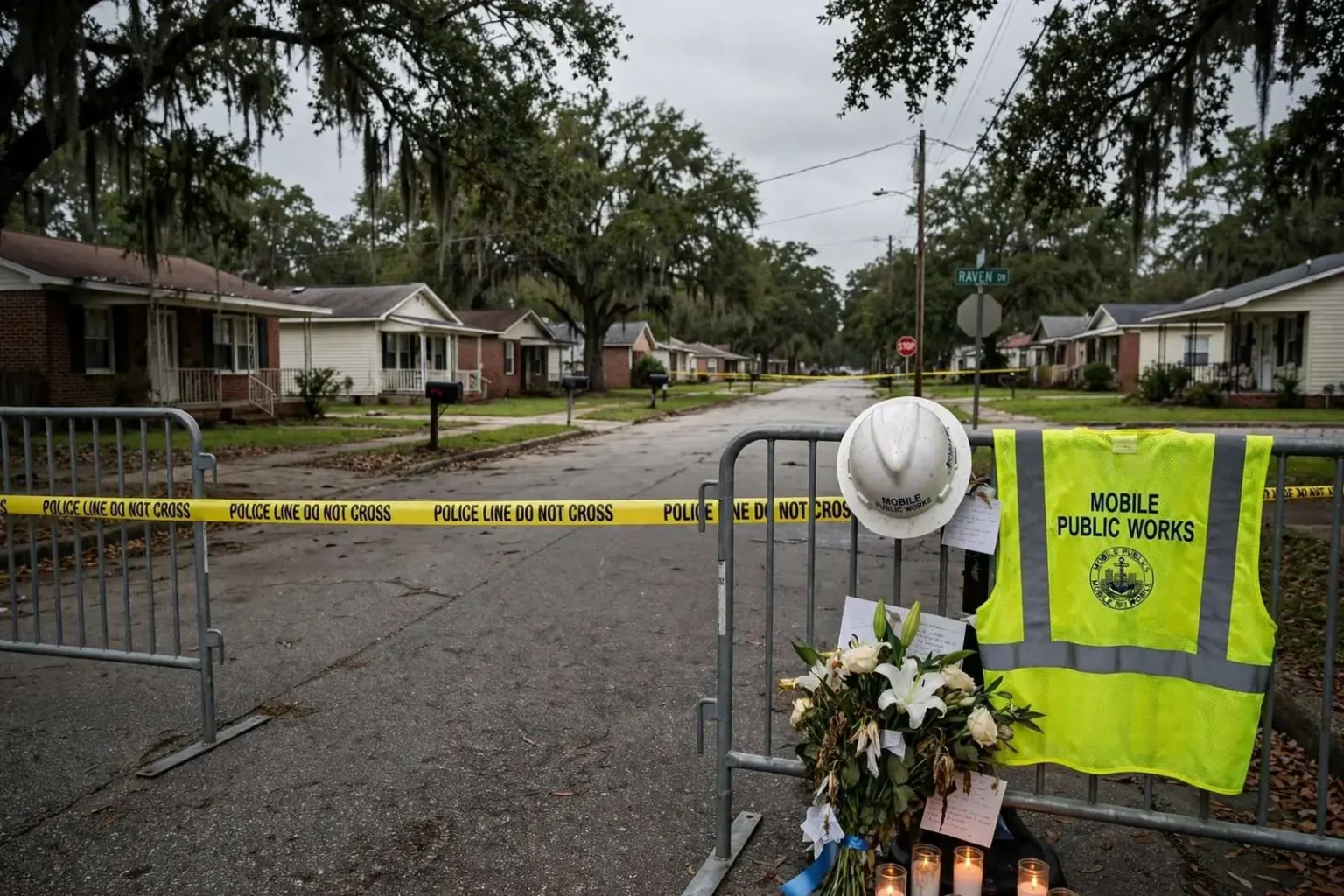
Two men charged in the shooting death of Mobile Public Works employee Justin Mooney have been indicted by a Mobile County grand jury. Mooney was killed in the Birdville community in October 2018 after being struck by gunfire that prosecutors say was intended for rival gang members. The indictment moves the case from the arrest stage toward trial in Mobile County Circuit Court.
Patrick Johnson, 25, and Myles Caples, 19, each face capital murder charges and two counts of attempted murder in connection with the killing. Assistant District Attorney Keith Blackwood identified both men as known gang members, stating they were shooting at rivals on Raven Drive when Mooney, described as an innocent bystander, was struck and killed. The attempted murder counts arise from the same episode of gunfire that ended Mooney’s life.
Mooney was a city of Mobile Public Works employee who was killed while going about ordinary activity in his own neighborhood. Birdville is a residential community in the western part of Mobile, and Raven Drive sits in the middle of it — streets of houses, churches, and neighborhood traffic where residents had no reason to expect a gunbattle. Prosecutors say the shots that killed him were aimed at rival gang members, making him the random victim of a fight that was not his.
His death drew attention across the city precisely because of who he was: a working man, on the job for the city he lived in, cut down by someone else’s fight. Public Works employees are a visible part of daily life in Mobile — collecting garbage, maintaining streets and drainage, clearing right-of-ways — and Mooney’s death was a reminder that the city’s workers live in the same neighborhoods they serve.
The Charges and What Capital Murder Means in Alabama
Capital murder is Alabama’s most serious homicide charge. Under state law, a killing can be charged as capital when it occurs in connection with another listed felony, when the victim has a protected status, or when the killing takes place in certain circumstances defined by statute. A capital conviction carries a sentence of life in prison without the possibility of parole or, in some cases, the death penalty, following a separate sentencing proceeding.
Each defendant also faces two counts of attempted murder, reflecting prosecutors’ position that the gunfire endangered more than one intended target. Attempted murder charges are common in gang shooting cases where multiple people were fired at, allowing a jury to consider each intended victim separately even when only one person died.
The grand jury stage is a threshold moment in any Alabama felony case. A Mobile County grand jury hears evidence presented by the District Attorney’s Office and decides whether probable cause exists to formally charge a defendant with the crimes listed in the indictment. An indictment is not a finding of guilt; it is the formal accusation that allows the case to proceed to arraignment and, eventually, trial in circuit court.
Case Status and Bond
Johnson has remained in jail since his initial arrest on murder charges. Caples, however, had bonded out prior to the indictment and had not been re-arrested at the time the grand jury returned its charges. In Alabama, bond amounts are set at or shortly after initial arrest, and a defendant who posts bond remains free pending trial unless the bond is revoked or the conditions of release are violated.
With the indictment now returned, the case will move into the scheduling phase. A trial date for the two defendants has not yet been set. Capital cases in Alabama typically take longer to reach trial than ordinary felonies because of the additional procedures attached to the charge, including a separate sentencing phase if a jury convicts, and because both the prosecution and the defense conduct extensive pretrial investigation.
The case highlights the collateral damage of gang violence in Mobile’s communities, as a city employee going about his daily work became an unintended victim of gunfire between rival groups. That pattern — intended targets surviving while bystanders are struck — has shaped how prosecutors in Mobile County approach gang cases, pairing the most serious charges available with testimony about the organizations and rivalries behind the shooting.
For the Birdville neighborhood, the October 2018 shooting left questions that residents had pressed for years: how groups of young men came to be trading gunfire on a residential street, and what it takes to hold the shooters accountable. The indictment of two alleged gang members answers the second question in part, though the trial will determine whether the charges are proven.
How Gang Cases Are Built in Mobile County
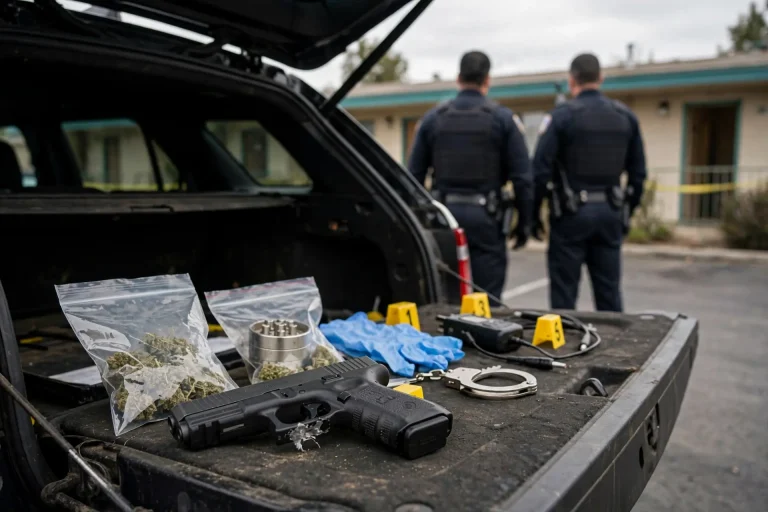
Prosecuting a gang-related shooting requires connecting individuals to both the violence and the organization. Investigators typically combine physical evidence from the scene — shell casings, ballistic matches, and forensic analysis — with witness statements, social media activity, and testimony about rivalries between groups. Assistant District Attorney Keith Blackwood’s identification of both defendants as known gang members reflects that investigative work, which is standard when prosecutors seek capital charges in a shooting case.
The two-count attempted murder structure also matters for how the case will be presented. Jurors will hear evidence about who the shooters were aiming at on Raven Drive, and the attempted murder counts let the state argue its theory even apart from the homicide: that firing at rivals in a residential neighborhood was itself an attempt to kill, whatever the outcome.
Capital cases also carry procedural protections that extend the timeline. Defendants facing capital charges in Alabama are entitled to counsel experienced in capital litigation, and the state must provide notice of the aggravating circumstances it intends to prove. Motions practice, competency evaluations, and discovery in a case of this scale routinely take a year or more between indictment and trial, which is why no trial date has been set for Johnson and Caples.
What the Indictment Means for Mooney’s Family and Neighborhood
An indictment is a milestone, not a conclusion. For Mooney’s family, it formalizes the accusation against two named defendants and puts the case on a path toward a public accounting. For the Birdville community, it is the point at which the shooting stops being an open wound without a court date and becomes a case that will be heard — with evidence, witnesses, and verdicts that residents can follow.
Mobile’s experience over the past decade has shaped the way local officials talk about cases like this one. Neighborhood associations, faith leaders, and city departments have repeatedly emphasized that most victims of street violence in the city are not the intended targets, and that each stray round fired in a residential area carries a risk that extends to everyone nearby. Mooney’s death — an innocent bystander struck by bullets meant for someone else — is the kind of loss that underlies those appeals.
The District Attorney’s Office has not announced which defendant will be tried first or in what order the charges will proceed. Both men remain charged with capital murder and two counts of attempted murder, and both will be arraigned on the indictment before the court sets any schedule. Johnson remains in the Mobile County jail, Caples remains on bond, and the case now moves through the circuit court system toward a trial that has not yet been calendared.
What happens in that courtroom will not restore what Birdville lost in October 2018. But the indictment does something the neighborhood has not had since the night Justin Mooney was killed: it puts two named defendants formally on trial for his death, in the open, before a Mobile County jury.
The circumstances of the shooting itself explain why prosecutors treated it as capital from the start. Police and prosecutors said the shots fired on Raven Drive were directed at rival gang members, and that Mooney was hit by rounds fired in that exchange. When a death occurs during the commission of another violent act, Alabama law allows the killing to be charged as capital murder, which is the theory the grand jury’s indictment reflects.
Mobile County’s court system will now manage a case that involves two co-defendants, multiple felony counts, and the enhanced procedures that come with a capital charge. Co-defendant cases move through pretrial in tandem: shared hearings, common discovery, and defense teams that file separate motions on each man’s behalf. Judges in such cases often manage scheduling so that neither defendant’s preparation is prejudiced by the other’s, one reason trial dates in multi-defendant capital cases are set only after substantial pretrial work is complete.
Mooney’s death in October 2018 joined a long, painful local conversation about violence in Mobile’s neighborhoods. City leaders have repeatedly pointed to cases like this one when arguing for coordinated enforcement and neighborhood investment, and the Birdville community, like others across the city, has seen the pattern: a brief exchange of gunfire, a bystander struck, and years of legal proceedings that follow. The indictment of Patrick Johnson and Myles Caples on capital murder and attempted murder charges is the formal legal answer to that night — an answer that will now be tested in a Mobile County courtroom, on a schedule the court has not yet set.