22nd Annual ACS Chili Cook-Off Draws 25,000 to Downtown Mobile
The American Cancer Society's 22nd Annual Chili Cook-Off drew an estimated 25,000 people to Bienville Square in downtown Mobile.
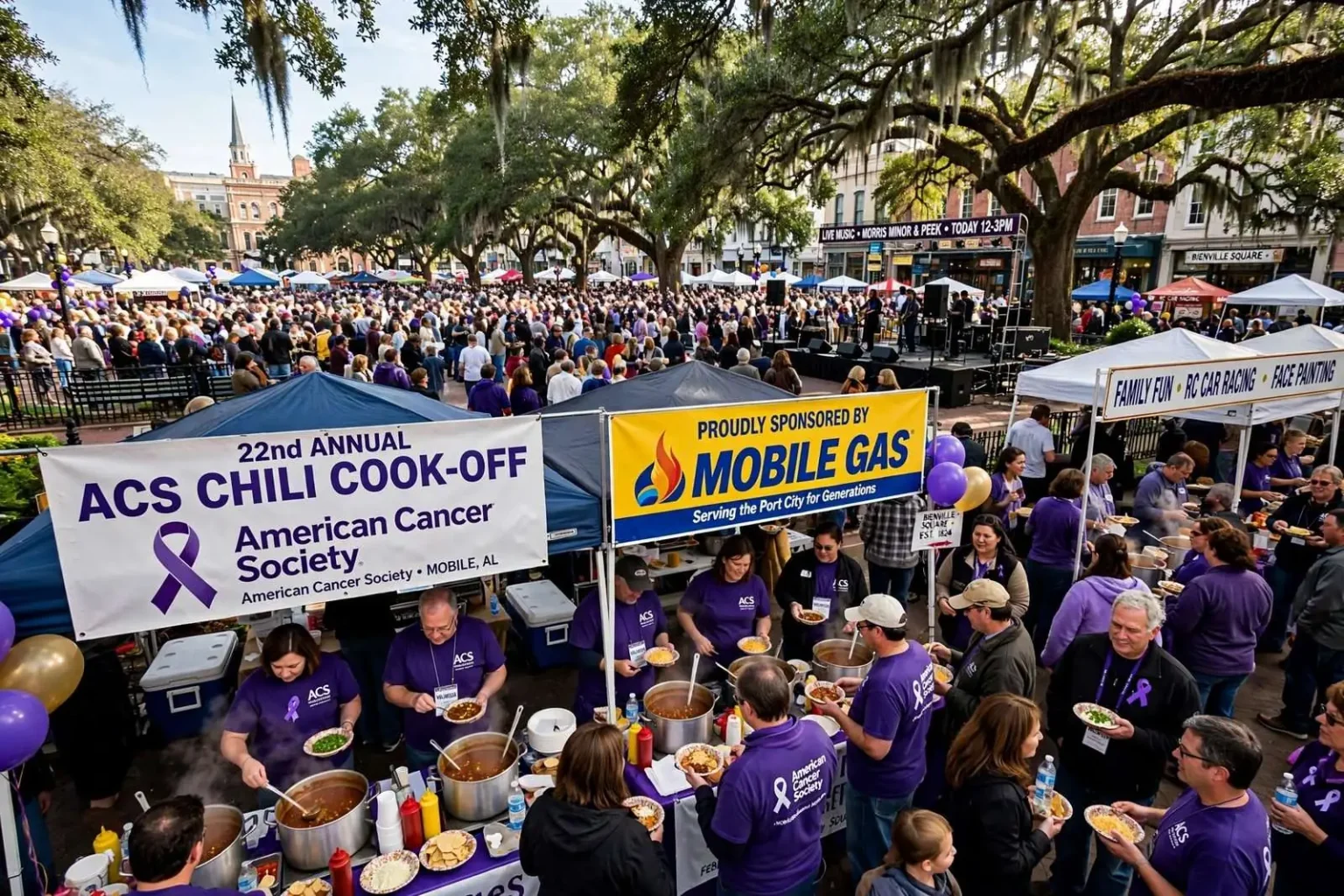
MOBILE — The American Cancer Society’s 22nd Annual Chili Cook-Off drew an estimated 25,000 people to Bienville Square in downtown Mobile on Saturday, February 12, 2011, cementing its place as one of the largest community fundraisers on the Gulf Coast. Chaired by Hallie Croom, the event surpassed expectations as organizers reported 18,000 attendees by noon alone. By the time the last bowls of chili were served, the crowd had swelled to roughly 25,000, filling the square and surrounding streets with a festive atmosphere of food, music, and friendly competition.
The mid-February date put the cook-off squarely in the heart of Mobile’s mild Gulf Coast winter, the kind of weather that has long made outdoor civic gatherings practical even in the middle of the calendar year’s coldest stretch. Bienville Square itself carries deep civic weight for the city. The park has anchored downtown Mobile as a public gathering place since the nineteenth century and takes its name from Jean-Baptiste Le Moyne de Bienville, the French colonial founder of Mobile. For one February Saturday, the historic green space became a sprawling open-air kitchen, with competing cooking crews working over their pots while thousands of chili lovers circulated around the square sampling the entries.
Attendance of that magnitude made the cook-off one of the single largest one-day crowds that downtown Mobile sees in any given year, rivaling the foot traffic generated by the city’s most established festivals. The sheer volume of visitors also gave downtown shops, restaurants and bars an afternoon trade that few ordinary Saturdays could match, a spillover effect organizers have pointed to when describing the event’s broader value to the city beyond the dollars it raises for charity.
A Day of Chili, Music, and Community Spirit
Sponsored by Mobile Gas, the cook-off ran from 11:00 a.m. to 3:00 p.m. and featured teams from across the Mobile area vying for top honors across four judging categories. Mobile Gas, the natural gas utility that has served the Port City for generations, has been a fixture of the event in its role as sponsor, and the afternoon schedule gave attendees a compact window to sample entries, hear the music lineup and browse the family attractions before the awards were decided.
Beyond the chili competition itself, attendees enjoyed live music from Morris Minor and PEEK, RC car racing, and a wide range of family-friendly activities throughout the afternoon. The blend of music and games gave the event the feel of a street festival as much as a cooking contest, with families spreading out across the square while the bands kept a steady stream of entertainment coming from the stage between judging announcements.
When the official festivities wrapped up, the energy spilled over into the surrounding Dauphin Street entertainment district, where bars and restaurants reported being packed with cook-off attendees extending their afternoon downtown. Dauphin Street serves as the centerpiece of downtown Mobile’s nightlife corridor, lined with restaurants, taverns and music venues housed in blocks of restored historic storefronts, and on cook-off day the street absorbed a wave of thousands of visitors already gathered within a few blocks’ walk.
That connection between the square and the surrounding streets has become part of the event’s identity over its two decades. What begins as a charity cooking contest at lunchtime grows into a de facto downtown-wide festival by late afternoon, and merchants along Dauphin Street have come to count on the cook-off as one of the winter calendar’s busiest afternoons. City officials have generally welcomed the crowd as evidence of downtown’s vitality, and the 2011 turnout of roughly 25,000 gave them little reason to reconsider that assessment.
From Humble Beginnings to a Community Tradition
The Chili Cook-Off had humble origins, launched by Chuck McNeil and Bruce Reynolds with just six teams at the Lumberyard, where the inaugural event raised $900. From those early days drawing roughly 200 people to Cathedral Square, the event had grown into a massive community celebration attracting tens of thousands and raising hundreds of thousands of dollars for cancer research and patient services. The trajectory from a few hundred dollars at a small venue to a quarter-million-dollar annual fundraiser traces one of the more remarkable growth stories in Mobile’s nonprofit calendar.
Cathedral Square, the small park in the shadow of the Cathedral-Basilica of the Immaculate Conception on Dauphin Street, provided the event’s early home before the growing crowds forced a move to the larger quarters of Bienville Square. The progression from one downtown park to another mirrored the event’s expansion from a modest neighborhood contest into one of the largest American Cancer Society fundraising events on the Gulf Coast, with each year’s attendance building on the last.
By 2010, the cook-off had drawn 126 competing teams and raised more than $254,000 for the American Cancer Society’s programs in the Mobile area. The scale of that operation meant that the cook-off had long since outgrown its origins as a casual cooking contest; by the time the 2011 edition arrived, it functioned as a months-long fundraising campaign culminating in a single afternoon of judging, music and public celebration in the heart of downtown.
Each participating team was required to sell a minimum of 75 tickets at $10 apiece and pay a $25 supply fee to enter. That structure turned every cooking team into a fundraising engine of its own, pushing contestants to mobilize coworkers, friends, church groups and customers as ticket buyers in the weeks leading up to the event. The $25 supply fee covered the basics of the cooking operation while the ticket sales carried the charitable weight, ensuring that the money raised came not only from the teams themselves but from the thousands of attendees who paid their way in through the teams they supported.
The model has been credited with giving the event its staying power. Because each team’s ticket quota is modest on its own but enormous in aggregate — 126 teams selling 75 tickets apiece translates into thousands of presold attendees before a single bowl is ladled — the cook-off arrives each year with a built-in crowd, which in turn draws casual visitors who buy tickets on site. The formula has kept the event growing steadily since the founders’ first six-team gathering, and the 2011 turnout of 18,000 by noon suggested that the pattern was showing no signs of slowing.
Supporting Cancer Programs Across the Gulf Coast
All proceeds from the cook-off went directly to the American Cancer Society’s local initiatives, including educational programs focused on early detection and prevention, transportation assistance for patients traveling to treatment, prosthetics, counseling, and emergency financial aid for families affected by cancer. The funds also supported the organization’s ongoing lifesaving research efforts. For the Mobile area, the cook-off represents one of the single largest annual infusions of charitable dollars into those programs, and the scale of the 2011 event meant the local impact would be substantial.
The American Cancer Society, founded in 1913 as the American Society for the Control of Cancer, has grown into one of the nation’s largest voluntary health organizations, funding cancer research while operating a network of patient-facing services delivered largely through local offices and community volunteers. Its educational programs emphasize screening and early detection — the interventions most closely tied to survival rates — and its patient services are designed to remove the practical obstacles that often accompany a cancer diagnosis, from the cost of getting to treatment to the strain of covering household expenses during illness.
Transportation assistance is among the most direct of those services. Many cancer patients in the Mobile area require frequent treatment appointments at facilities that can be a significant drive from home, particularly for residents of outlying Baldwin, Washington and Clarke counties who come to Mobile’s medical centers for care. Volunteer-driven transportation programs of the kind the society operates nationwide exist precisely to close that gap, and cook-off proceeds help sustain them locally. Similarly, the prosthetics and counseling components address needs that insurance often does not fully cover, and the emergency financial aid program provides grants to families whose incomes collapse under the combined weight of illness and treatment costs.
The research side of the society’s mission has a long record of national impact, with decades of society-funded work contributing to advances in cancer prevention, diagnosis and treatment. For Gulf Coast donors and volunteers, the local event serves as the fundraising gateway to that national research enterprise while keeping the majority of its tangible benefit — education, rides to treatment, counseling, direct aid — close to home.
Chaired by Hallie Croom and backed by a large corps of volunteers, the 22nd edition demonstrated how deeply the event has woven itself into Mobile’s civic fabric. The annual cook-off had become a signature event on Mobile’s community calendar, bringing together local businesses, civic groups, and families for a day of friendly competition in service of a cause that touches nearly every household in South Alabama. With a quarter of a million dollars raised the year before and a crowd of 25,000 filling Bienville Square in 2011, the event stood as both a tribute to its founders’ original idea and a working engine of the American Cancer Society’s mission across the Gulf Coast.