Amtrak takes its Mobile rail fight to Twitch with live freight counter
Amtrak streamed a Gulf Coast rail line on Twitch to show how little freight traffic it carries as the Surface Transportation Board weighs passenger rail.
As a federal board weighs whether Amtrak can share freight tracks for new passenger service between Mobile and New Orleans, the railroad took its argument to a live online audience.
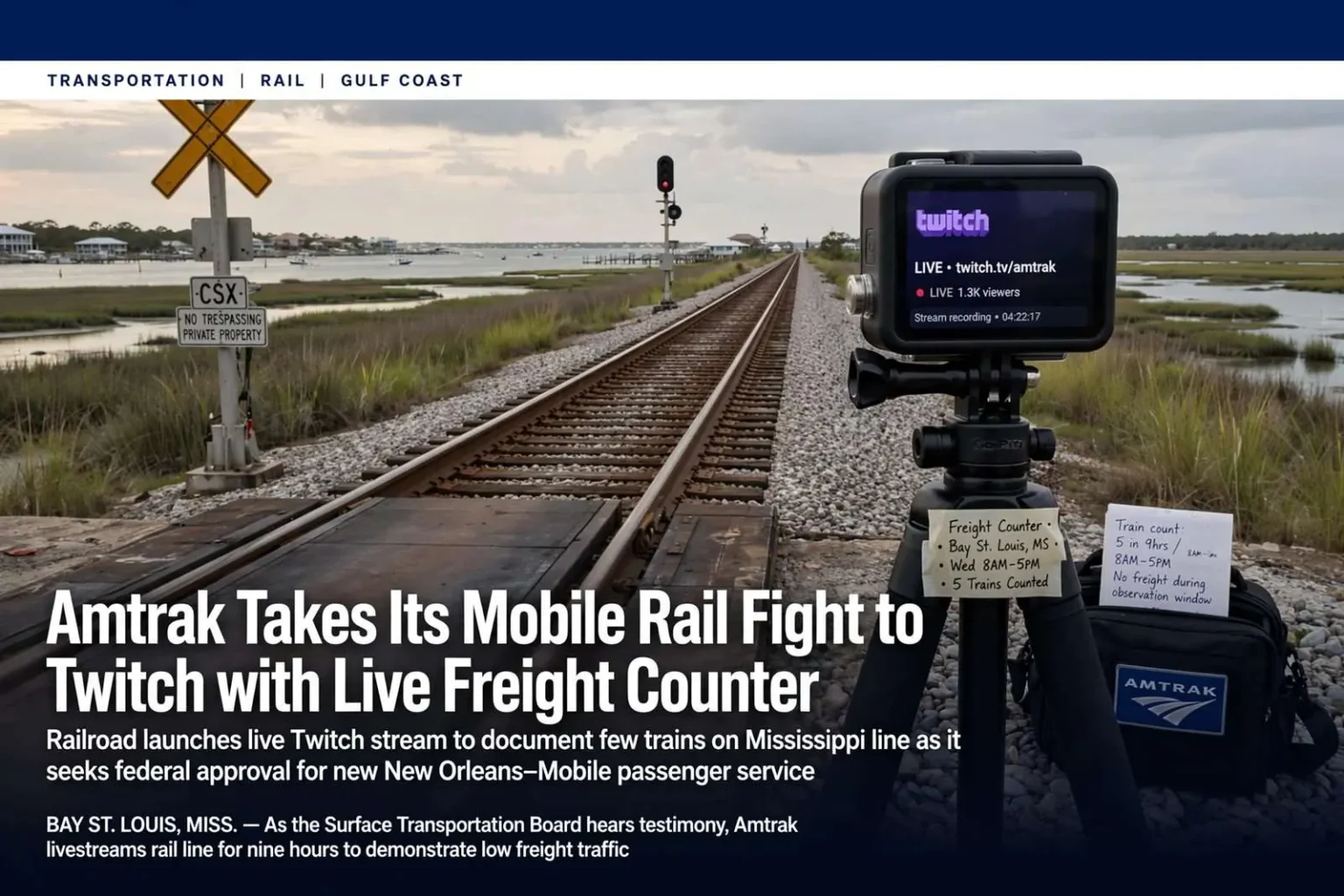
Amtrak launched a Twitch stream Wednesday along a stretch of railway in Bay St. Louis, Mississippi, to show viewers how infrequently freight trains pass. The move comes while the Surface Transportation Board hears testimony in a case pitting Amtrak against freight operators.
The choice of platform was itself part of the message. Twitch, the livestreaming service best known for video games, reaches a younger audience than a federal docket ever will, and a fixed camera pointed at a rail line for hours at a stretch made the railroad’s argument in the plainest possible terms: here is the track, all day, and here is how little happens on it. Viewers could watch for themselves rather than read dueling descriptions of train counts.
Spokesman Marc Magliari said technical issues made the GoPro camera “up and down” from noon to 5 p.m., but that he was on-site from 8 a.m. to 5 p.m. and counted five trains.
Five trains over a nine-hour window was the number Amtrak wanted on the record. The railroad’s case for restoring passenger service on the Gulf Coast route rests on the claim that the line has room to spare — that a pair of daily passenger round trips can share rails still dominated, in Amtrak’s telling, by empty hours.
CSX Pushes Back
CSX spokeswoman Cindy Schild pushed back, writing that the freight company sees eight to 10 trains a day on the track, along with coal trains and local trains that may not travel the full route. She called focusing on one point of a 138-mile line “grossly misleading.”
The freight carrier’s argument is that a single camera at a single crossing cannot capture the traffic picture across the whole corridor. Trains that enter or leave the line at intermediate points — serving industries, yards and port facilities along the way — would never pass the Bay St. Louis camera, and coal trains running on parts of the route would be invisible to a viewer watching one stretch for one day. From CSX’s perspective, the stream was advocacy dressed as evidence: a sample selected because it supports the sampler’s conclusion.
Magliari implied Schild’s figures were misleading too, noting some coal trains never leave Mobile. “To suggest that those trains would be so disrupted by two trains spending less than 30 minutes in Mobile is misleading,” he said.
The exchange highlighted how the same corridor can produce two irreconcilable traffic counts. Trains originate and terminate at different points along the route, serve sidings and industrial tracks, and run on schedules that shift day to day, so the number of trains passing any given mile depends on which mile and which day. The dispute over counts is really a dispute over capacity: whether the railroad’s operations would leave enough slack for passenger trains to run on time, and at what cost to freight movements.
The Stakes for the Gulf Coast
What is being decided at the Surface Transportation Board is whether Amtrak can require access to the freight line under federal law to launch the long-sought New Orleans-to-Mobile passenger service. The route would restore passenger rail along the Gulf Coast corridor, connecting Mobile — the largest city in Alabama without intercity passenger rail service — to communities along the Mississippi coast and on to New Orleans.
Gulf Coast passengers lost direct service after Hurricane Katrina devastated the route in 2005, and the region’s transportation agencies and elected officials have spent the years since pressing for restoration. The Southern Rail Commission, the interstate compact that advocates for passenger rail across Louisiana, Mississippi and Alabama, has been among the leading voices in that effort, and the proposed service has drawn support from cities along the corridor who see it as an economic and mobility link between Mobile, the Mississippi Gulf Coast casinos and communities, and New Orleans.
The Rail Commission’s View
Local Southern Rail Commission members sided with Schild that a single camera on one stretch of Mississippi track is not proof freight would be unharmed. SRC member Wiley Blankenship said the issue is “the impact, not the number of trains,” and praised the port’s quick growth.
Blankenship’s distinction gets at the technical heart of the case. The question before the board is not simply how many trains roll past a camera in Bay St. Louis on a Wednesday, but what happens to railroad operations when passenger trains are threaded into the schedule. Passenger service requires dispatching priority, and inserting scheduled trains into a freight railroad’s operations can force freight crews to hold, sidings to stack and switching patterns to be reworked — costs that CSX argues would fall on its customers and, ultimately, on the port and industries the line serves.
His praise of the port’s growth reflects why the freight side of the ledger carries real weight in Alabama. The Port of Mobile has invested heavily in capacity in recent years, and its container and bulk traffic has grown accordingly, feeding rail volumes into the corridors that connect the port to the interior. Any rail line that handles port traffic is part of that economic engine, and state and local officials are loath to see friction introduced into it. The proposed passenger route shares track with lines that serve port and industrial traffic, which is precisely why the traffic-impact question has dominated the proceeding.
Blankenship believes Amtrak and freight can coexist, but said it will take more investment. “It’s called resources,” he said. “That’s probably what it’s going to take.”
The point about investment is a quiet acknowledgment of what most rail observers consider the likely endgame: additional passing sidings, signal upgrades and dispatching improvements that would let both operations run without impeding each other. Rail capacity is not fixed; it is built. The commission’s position suggests that the answer to the corridor’s dispute is not an either-or between freight and passengers, but capital spending that expands what the line can handle — spending that would presumably draw on federal and state sources alongside the railroads themselves.
What Happens at the Board
The board was set to take more testimony Friday before possibly scheduling another round of hearings, after which it could decide whether Amtrak may share the tracks.
The Surface Transportation Board’s process gives both sides room to build a record before a decision. Evidence sessions, rebuttal filings and the possibility of further hearings mean the proceeding could stretch on, and whichever way the ruling goes, it is likely to shape how passenger rail restoration is argued on freight lines elsewhere in the country. Railroads have resisted mandated access in other regions, fearing the precedent; Amtrak and passenger rail advocates see the Gulf Coast case as a test of whether the federal statute protecting passenger service has teeth.
For Mobile, the outcome determines whether the city’s long campaign for passenger rail connection advances. City and county officials have supported the effort, and the proposed station service would plug Mobile into a corridor that supporters say was a missing link in the Gulf Coast’s transportation network ever since the storms of 2005.
In the meantime, the argument continues to play out in unusual venues — federal hearing rooms, dueling press statements, and, for one Wednesday, a livestream watched by rail fans and curious onlookers from a camera in Bay St. Louis, counting trains.
The Route and the Region It Would Serve
The proposed service would follow the coastal corridor between New Orleans and Mobile, a route that threads through a string of communities with deep rail history. Bay St. Louis, where Amtrak pointed its camera, is one of the Mississippi towns along the line, and stations on the corridor would serve Gulf Coast cities whose residents currently depend on interstate highways for the New Orleans-Mobile trip. The drive between the two cities runs about two and a half hours by car, but a rail link would connect them without the parking, traffic and fuel costs of the highway drive, and would put intermediate stops within walking distance of downtown districts that have rebuilt since Katrina.
Supporters of the service have long argued that the corridor is a natural for passenger operation: it links two major cities, passes through a tourism region that draws millions of visitors a year, and uses trackage that was built for exactly this kind of mixed traffic in an earlier era. The line’s history runs back to the Louisville and Nashville Railroad, which operated passenger trains along the Gulf Coast for decades before Amtrak took over intercity service in 1971.
How the Dispute Reached This Point
The path to the current proceeding has stretched across years of negotiation. Amtrak and the freight railroads that own the corridor studied the route, exchanged proposals and disputed costs without reaching an operating agreement, leaving the passenger carrier to invoke the federal process that allows the Surface Transportation Board to order access when negotiations fail. That statutory pathway is rarely used, which is why the Gulf Coast case has drawn attention from rail advocates and freight operators far beyond the region.
Mobile’s role in the dispute is distinctive: it is the endpoint that stands to gain the service, and also home to port and industrial traffic that shares the region’s rail network. City officials have backed the passenger restoration effort, and the proposed downtown Mobile stop would restore a passenger rail presence the city lost when service ended after the 2005 hurricane season.
The Twitch stream may prove a footnote in the formal record, but it captured something real about the case: both sides believe the numbers are on their side, and both sides are willing to get creative about showing them. The board will sort out which numbers matter. On the Gulf Coast, riders, freight customers and the communities in between are waiting to find out.