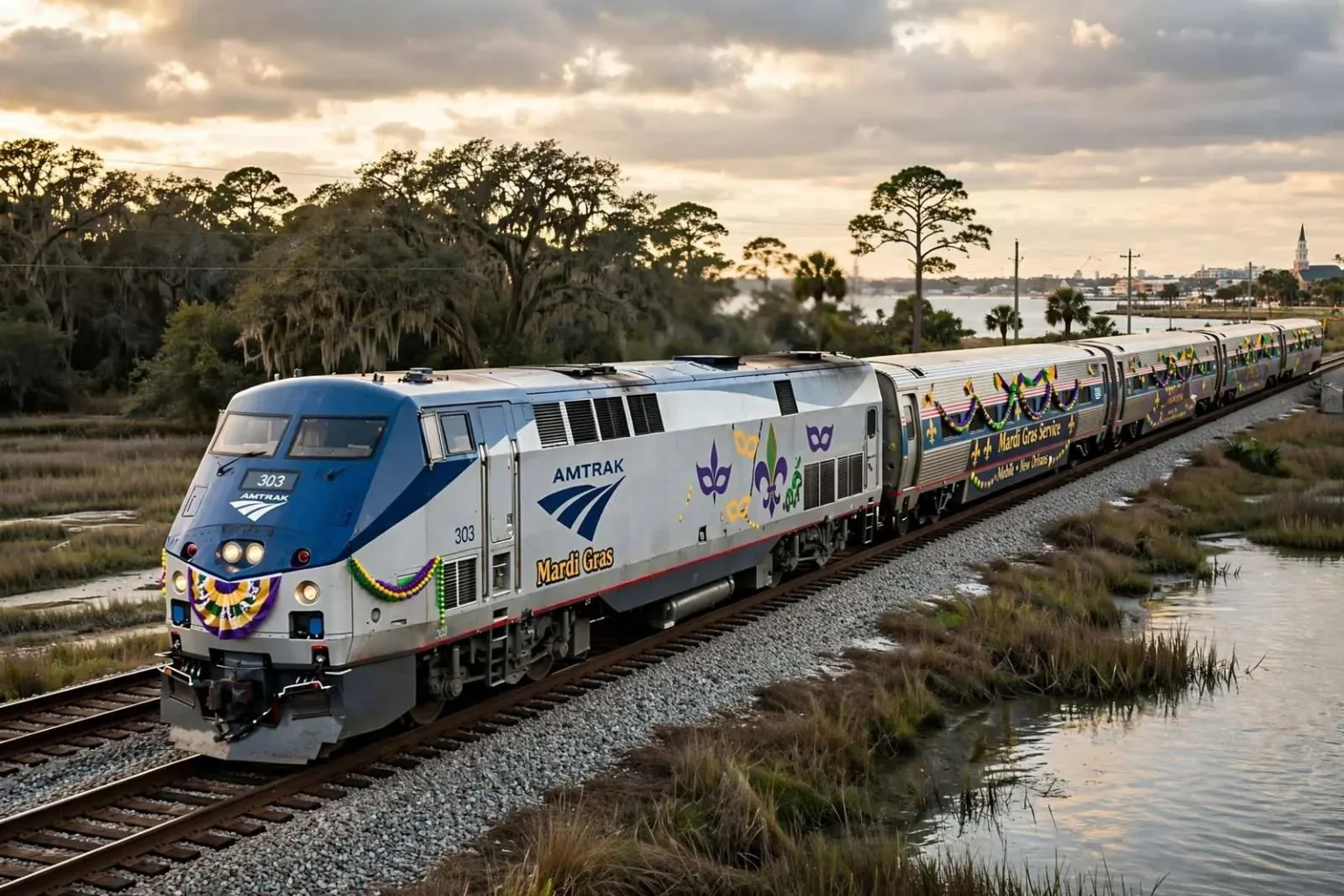
Amtrak’s Mardi Gras train along the Gulf Coast has posted a far stronger first year than anyone projected, surpassing its first-year ridership goals months ahead of schedule and finishing the year with nearly four times the riders that were anticipated. The train — decorated with Mardi Gras themes and festivities — drew 150,000 riders in its first year of service, compared with a projection of 38,000, and generated more than $5 million in revenue along the way. The numbers have made the route one of the most talked-about passenger rail stories in the region and have given momentum to conversations about the future of Gulf Coast rail travel.
“What can you say?” said Todd Stennis, director of government affairs with Amtrak, before boarding the service in downtown Mobile. “It’s exciting. Everyone who uses the service is excited about it. It speaks volumes for the Gulf Coast communities from Mobile to New Orleans and their support for this service and for those who ride it.”
Stennis’ remarks captured the mood that has surrounded the service since it began carrying passengers. The route links Mobile with New Orleans, restoring passenger rail travel along a Gulf Coast corridor where trains once ran regularly between the two cities and their communities in between. The route’s popularity has exceeded expectations at every turn, with riders using it for day trips, weekend getaways, football weekends, festival travel and ordinary business between the two Gulf cities.
A Ridership Story That Kept Beating Expectations
When passenger service along the Gulf Coast was being planned, projections called for 38,000 riders in the first year — a figure that planners treated as a reasonable benchmark for a new route finding its audience. The actual result of 150,000 riders did not merely beat that benchmark; it nearly quadrupled it, and it happened months before the first year was even complete. The revenue picture followed the ridership, with the service generating more than $5 million in its first year of operation.
Beating projections by that margin is rare for any new transportation service, and it has forced observers to rethink assumptions about demand for intercity rail in the Gulf South. The corridor between Mobile and New Orleans passes through a string of communities with strong ties in both directions — family connections, college loyalties, tourism traffic and commerce that has always moved along Highway 98 and Interstate 10. What the ridership numbers demonstrate is that a meaningful share of that travel was waiting for an alternative to driving, one that lets passengers read, relax or enjoy the scenery instead of navigating traffic on the interstate.
The train’s Mardi Gras theming has been part of its identity from the start, giving the service a festive character that matches the region it serves. The name and decorations tie the route to one of the Gulf Coast’s most famous cultural traditions, and they have helped turn the train into more than transportation — for many riders, the trip itself has become part of the outing. That blend of practical utility and regional personality is reflected in the enthusiasm Stennis described among everyone who uses the service.
What the Route Means for Mobile and the Gulf Coast
The restoration of passenger rail between Mobile and New Orleans has been a long-sought goal for Gulf Coast communities. When service between the cities ended years ago, the corridor became a missing link in the region’s transportation network, and local officials, chambers of commerce and rail advocates spent years pressing for its return. The success of the Mardi Gras service has vindicated that advocacy and demonstrated that the demand exists to sustain a Gulf Coast route.
For Mobile, the train has made New Orleans a practical day-trip destination and vice versa, and it has connected the Port City to one of America’s most visited tourist cities without the burden of a three-hour drive. Riders can attend events, connect to other travel, and enjoy the festivity that surrounds the route. For communities between the two endpoints, the train offers a link that local economies have not had in the region for a generation.
The ridership success also carries significance beyond the current route. Gulf Coast leaders have long discussed extending passenger service east of Mobile toward Florida, and the strength of the Mobile-to-New Orleans numbers has become a talking point in those conversations. A service that drew nearly four times its projection in its first year makes a compelling case for investment in the corridor, and it gives Amtrak and state and local partners real data to work with as they consider what comes next.
Boarding Facilities Lag Behind Demand
Despite the train’s popularity, the boarding facilities — especially on the Mobile side — are noticeably lacking. The downtown stop in the Port City is uncovered except for a pop-up tent, which causes real problems for riders in both rain and heat. Mobile’s climate makes that deficiency more than a cosmetic issue: summer heat and humidity, afternoon thunderstorms and the occasional tropical system all bear down on an open platform, and passengers waiting to board or waiting for arriving family members have little protection from the elements.
The contrast with other stops on the route is part of the frustration for local riders and officials alike. Travelers who board the train in New Orleans and at other stations along the way encounter more substantial, permanent facilities, while Mobile — the eastern terminus and one of the route’s anchor cities — offers a tent and a platform. Riders have noticed the difference, and the feedback has made its way to the people involved in operating and promoting the service.
“We get that feedback from customers that they want to see something more permanent like they see from the other stops,” said Ashley Rains, a spokesperson for Visit Mobile. “The conversations are always open. Everyone wants this to be as comfortable as possible…We continue to hear of people coming in for day trips and finding the train platform serving as a gateway into our downtown entertainment district.”
A Gateway Into Downtown Mobile
Rains’ description of the platform as a gateway into downtown Mobile points to why the station question matters beyond passenger comfort. The downtown stop places arriving riders within reach of the city’s entertainment district, its restaurants, its hotels and its waterfront, and the train has been delivering a steady stream of visitors into that footprint. Day-trippers arriving from New Orleans step off the train and walk into downtown Mobile, spending money at local businesses before boarding a return train the same day.
That dynamic has turned the modest platform into one of downtown Mobile’s busiest arrival points, and it has raised the stakes for what the city does with the site. A first impression as basic as shelter from the sun and rain shapes how visitors experience the city from the moment they arrive. City leaders and tourism officials are well aware that the current arrangement does not match the volume or the importance of the traffic the train is delivering.
There has been talk of building a permanent facility, discussion that has likely been accelerated by the popularity of the Mobile-to-New Orleans trip. A permanent station would give riders a waiting area, cover from the weather, and a proper front door for a city that is now receiving tens of thousands of train passengers a year. No plans have been announced, however, and until they are, the pop-up tent remains the city’s arrival hall for Gulf Coast rail travelers.
What Comes Next for the Corridor
The first-year results have created both an opportunity and a challenge for the communities the train serves. The opportunity is to build on demonstrated demand — to consider expanded service, improved facilities and eventual extension of the corridor. The challenge is infrastructure: platforms, stations and support facilities that were sketched out for projected ridership now face real numbers that dwarf the projections. The situation in Mobile illustrates that gap better than anywhere else on the route.
For now, the train keeps running, and the riders keep coming. The first-year totals of 150,000 passengers and more than $5 million in revenue stand as a rebuke to any suggestion that Gulf Coast residents would not embrace passenger rail. They stand, too, as a measure of how much the communities from Mobile to New Orleans wanted a connection that had been missing from the region for years.
The conversations about a permanent Mobile facility remain open, as Rains emphasized, and everyone involved appears to want the same outcome — a boarding experience that matches the quality of the service itself. Until plans are announced, riders arriving in the Port City should pack for the weather. But the trajectory of the route suggests that the tent’s days as Mobile’s train station are numbered, and that the Gulf Coast’s return to passenger rail is only beginning to show what it can become.