Analysis Shows West Mobile Annexation Would Likely Pay for Itself in New Revenue
A financial analysis of proposed West Mobile annexation suggests new property and sales tax revenue would largely offset added service costs, even as some residents in the police jurisdiction voice mixed feelings about joining the city.
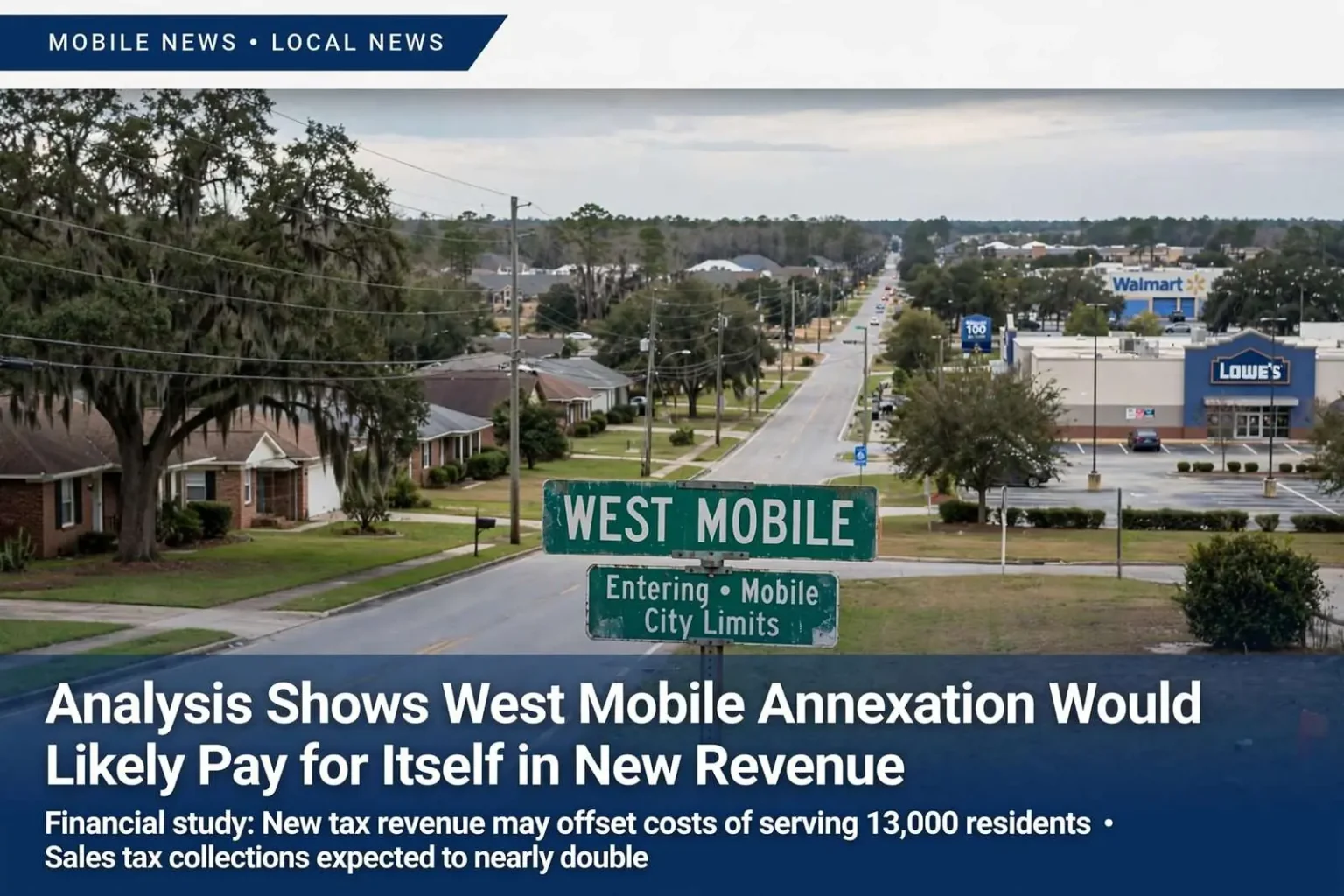
A financial breakdown of the proposed annexation of parts of West Mobile into the city suggests that one of the loudest arguments against the move — that it would cost too much to serve roughly 13,000 additional residents — may not hold up once new tax revenue is factored in. Trash and garbage collection has long been cited as one of the most expensive services the city would need to extend to newly annexed neighborhoods.
But an analysis of the city’s budget shows that added property tax revenue alone would nearly offset that cost, even before counting the sales tax dollars that officials expect to roughly double once residents move from the police jurisdiction into full city limits.
The city of Mobile currently spends about $147 per household each year on garbage and trash collection, a figure derived by dividing the roughly $10 million line item for the service by the city’s approximately 68,000 households.
City spokesperson Jason Johnson described the $10 million figure as an all-in number that covers man-hours, equipment, maintenance, fuel and tipping fees, among other expenses. Applying that per-household cost to the roughly 11,000 additional households that could be affected by annexation would add an estimated $1.6 million a year to the city’s garbage and trash budget.
On the revenue side, property tax collections on a home valued at $200,000 would bring in about $140 per year, which translates to roughly $1.5 million in additional annual revenue citywide once the new households are included. State law would delay that additional property tax burden for newly annexed residents for five years under a grace period built into the annexation process.
Sales tax figures present an even larger swing. The city currently collects an estimated $12.5 million a year from businesses in the areas being considered for annexation.
Because businesses located in the police jurisdiction pay only half of the city’s standard sales tax rate — 2.5 cents instead of the full 5-cent rate charged inside city limits — that revenue is expected to double as soon as the areas are formally annexed. Taken together, city officials have said they expect annexation to generate about $2 million more in revenue than it would cost in additional expenses, once police, fire, infrastructure, and garbage and trash services are all factored into the equation.
For residents living in the police jurisdiction just outside Mobile’s city limits, the numbers are only part of the story. Many describe a lingering frustration with paying into a system they have no vote in.
Elmer Schultz, who lives in the Randlett Trace subdivision, said he already considers himself a supporter of the city despite having no formal voice in its decisions. His property sits about 100 feet from a Walmart that falls within Mobile’s city limits, yet even if the City Council allows some West Mobile residents to vote on annexation, Schultz said he expects to be left out of that referendum. “I’m about 100 feet from those places,” he said. “I already support the city of Mobile. I’m just asking for a voice in it.”
Schultz places some of the blame on past city administrations, which he said used the promise of future sales tax revenue to carve up West Mobile in ways designed to affect as few residents as possible. He argues that annexation is ultimately necessary for the city’s long-term growth, warning that unincorporated areas to the west could eventually incorporate on their own if Mobile doesn’t act first.
“If they don’t [annex] out west, they’re not going to grow anymore,” Schultz said. “I want to see the city of Mobile grow. All the councilors have to do is sit there at Airport [Boulevard] and Schillinger [Road] and see where people are headed.” “The people out there will incorporate,” he added. “I don’t want to see that.”
Not every resident in the affected area shares that sense of urgency. Arthur Ball, who lives within the boundaries under consideration for annexation, spent years opposed to the idea and served as a member of the West Mobile Fire District Committee, an effort to explore forming an independent, publicly owned fire district for the area rather than joining the city. His position has softened somewhat in recent years, largely out of concern over the private ambulance coverage residents outside city limits currently rely on, though he stopped short of saying he now fully supports annexation.
“I’d still like to see the area create its own fire district,” Ball said. “I want the district to be publicly owned because I don’t want to hire a private company.”
Ball said one of his biggest reservations about joining the city is losing the ability to choose his own garbage service. Residents in unincorporated parts of the county can currently select from competing private haulers, an option that disappears once a property comes under the city’s municipal collection system. “I like the way things are right now,” he said. “If I become unhappy with my service I can switch it. There’s more of a choice out here.”
Even so, Ball said the prospect of paying additional taxes as part of the city doesn’t trouble him as much as it does some of his neighbors who oppose annexation outright. “People are going to get taxed one way or another,” he said. “If we create our own fire district, there will be a tax to be paid.”
Ball said he currently splits his in-person shopping between retailers in the county and those inside city limits, though the bulk of his purchases happen online rather than at a physical store. “I do the vast majority of it online,” he said. “My shopping by going to a physical location is limited to Lowe’s.”
The debate over West Mobile annexation has simmered for years, with city leaders balancing the promise of expanded revenue and long-term growth against the concerns of residents who worry about losing services, choice and a voice in decisions that would directly affect their households and property taxes.
How Annexation Works in Alabama
Alabama law allows a city to grow in several ways. Owners of property next to the city limits can petition to join. The Legislature can pass a local act. Or voters living in the area can decide in an election that the city calls. The last method is the one Mobile leaders were weighing for the West Mobile neighborhoods.
Mobile eventually took that route. On July 18, 2023, voters in three West Mobile areas chose to join the city. When the results were certified on July 25, 2023, about 19,000 new residents were added and the city’s population rose to more than 206,000. That made Mobile Alabama’s second-largest city again. As the analysis above described, city property taxes in the annexed areas do not take effect for five years.