
Andrew Gillum Arrested Again in Baldwin County After Testing Positive for Methamphetamine
Former Florida gubernatorial candidate Andrew Gillum was ordered back to the Baldwin County Jail after testing positive for methamphetamine at a drug court appearance, just weeks after his first Alabama arrest.
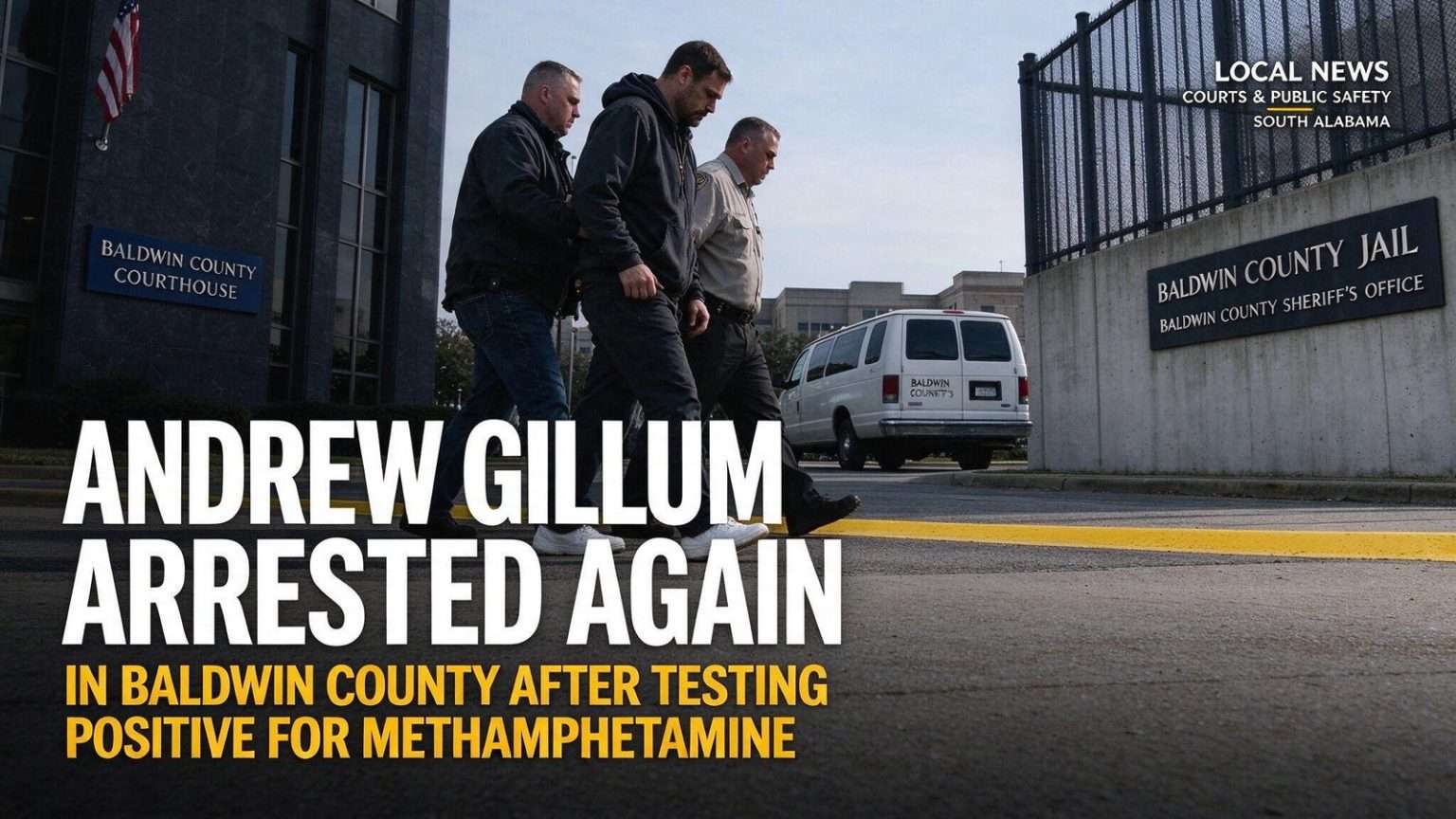
Andrew Gillum, the former Florida Democratic gubernatorial candidate, has been arrested again in Alabama, just over a month after a prior arrest in July. According to court documents, a judge on Thursday ordered Gillum, 46, to be taken to the Baldwin County Jail after he missed a drug screening and then tested positive for methamphetamine during a drug court appearance Thursday. The sequence of events — a missed screen followed by a positive test, followed by a judge’s order — unfolded entirely within the machinery of the local court system, and it now leaves one of Florida’s best-known political figures in a county jail across the state line from the city where he built his career.
Prosecutors had previously weighed sending Gillum to drug court instead of pursuing criminal prosecution on his earlier charges. Drug court is an alternative track offered in many Alabama jurisdictions, designed to route defendants whose cases are rooted in substance abuse into supervised treatment, regular screening and accountability hearings rather than straight into trial and sentencing. Participants who comply can, over time, work toward resolution of their charges; participants who miss screenings or test positive face immediate consequences, including the kind of custody order Gillum received this week.
The rapid escalation is a familiar pattern for anyone who has watched a drug court docket. These programs are built on strict, predictable rules precisely because they trade the uncertainty of prosecution for the certainty of supervision. A missed screening is rarely treated as an oversight; it is treated as the first sign of relapse or noncompliance, and judges typically act on it the same day. That Gillum was taken into custody at his own court appearance, on the day of the positive test, reflects how quickly that system moves once the conditions are violated.
The incident underscores the kind of day-to-day public safety work that residents of Mobile and the surrounding communities have come to expect from their local law enforcement agencies. High-profile defendants pass through the same courtrooms, jails and screening programs as any other defendant, and the same procedural rules apply. For the deputies who transported Gillum and the court staff who processed the order, the case was routine work — the daily business of holding participants in court-supervised programs to the terms they agreed to.
How the Local System Works
Residents across Mobile County and Baldwin County rely on a network of municipal police departments, the Mobile County Sheriff’s Office, the Baldwin County Sheriff’s Office, and state troopers to handle day-to-day calls. Each layer of that network has a distinct role. Municipal departments handle calls inside city limits, from traffic stops to burglaries; the sheriff’s offices cover the unincorporated areas and run the county jails; and state troopers patrol the interstate and highway corridors that tie the two counties together. Baldwin County’s jail, where Gillum is being held, is operated by the Baldwin County Sheriff’s Office and serves as the holding facility for arrests made across the county, from the Eastern Shore to the beach communities.
Major cases are typically handled by the investigative divisions of those agencies, often working in coordination with one another. Coordination matters along the bay in particular, because the region’s population and its criminal cases do not respect the county line — a suspect picked up in Spanish Fort may have been tracked from Mobile, and defendants held in Baldwin County routinely have ties, charges or court obligations on the other side of the water. Task forces and mutual-aid arrangements allow investigators to move information across jurisdictions without the friction that a formal handoff would create.
Mobile-area news outlets and the police agencies themselves frequently release updates on investigations, arrests, and charges, and the public can typically follow developments through official statements and court records. Alabama’s court system posts case dockets and hearing outcomes that are accessible to the public, and jail rosters are updated as inmates are booked and released. That transparency is how a case like Gillum’s — including the court documents describing the missed screening and the positive test — becomes public in the first place, and it gives residents a way to track a case from arrest through disposition without relying on secondhand accounts.
Across the Bay From the Case
Baldwin County lies directly east across Mobile Bay and is the largest county by area in Alabama. Its communities include the Eastern Shore cities of Fairhope, Daphne, and Spanish Fort, along with the Gulf-front municipalities of Gulf Shores and Orange Beach. The county has been among the fastest-growing in the state for two decades, driven by retirees, second-home owners, and tourism along the white-sand beaches. That growth has reshaped nearly every public institution in the county, including its courts and jail, which now serve a population spread from the Causeway suburbs all the way down to the Florida line.
Daphne sits on the eastern shore of Mobile Bay just south of Spanish Fort. It grew rapidly in the 1990s and 2000s as a suburban community serving commuters working in Mobile and at the industrial sites along the bay’s eastern edge. The city’s evolution from a quiet bayfront town into one of the shore’s busiest suburbs is part of the broader Baldwin County story — a county whose courthouse dockets now reflect the same volume and complexity as those of much older urban areas.
The region’s higher-profile cases tend to draw attention precisely because the daily work of the courts is usually quiet. Arraignments, status conferences, drug court review hearings and bond proceedings move through Baldwin County’s courtrooms in steady rotation, and most pass without notice. A case involving a nationally known figure briefly illuminates the ordinary machinery — the screening appointments, the review hearings, the custody orders — that operates the same way for every participant in the system.
One Region, Two Counties
Alabama is a southeastern U.S. state bordered by Mississippi, Tennessee, Georgia, Florida, and the Gulf of Mexico. Its state capital is Montgomery, its largest city is Birmingham, and Mobile serves as the major urban center of the lower Gulf Coast. The state’s court structure mirrors its county system: circuit courts handle felony prosecutions and major civil matters in each county, while specialized dockets like drug courts operate as alternatives within that structure for eligible defendants.
Mobile and Baldwin County together form a single regional economy, with commuters, students, and shoppers moving daily across the bay, and with shared concerns about transportation, schools, public safety, and growth that play out in both counties’ public meetings and local news coverage. The bay’s bridges and tunnels are the region’s connective tissue, and the constant back-and-forth traffic is one reason law enforcement and court systems in the two counties work as a de facto single network when cases cross the water.
Local and state government decisions frequently shape how Mobile, Baldwin County, and the broader region grow and govern themselves. City and county governments along the upper Gulf Coast hold regular public meetings, with agendas and minutes typically posted online and broadcast or recorded for residents who cannot attend in person. Decisions about jail funding, court staffing and treatment-program capacity — the kinds of budget lines that determine how a drug court operates — are made in those meetings, often with little public attention until a case like this one makes the system visible.
News from across south Alabama frequently highlights the ways in which local decisions in city halls, county commissions, school board meetings, and state offices in Montgomery interact with daily life for residents from Saraland to the Eastern Shore and from downtown Mobile to the Gulf beaches. Public safety coverage sits at the center of that beat, because it touches every municipality in the two-county region and because the agencies involved are among the most visible arms of local government.
The Broader Regional Picture
Long-running coverage of the Port of Mobile, the Brookley aeronautics complex, and the industrial corridor along the Mobile River connects stories about steel, shipbuilding, aerospace, and shipping into a single regional narrative. Those employers draw workers from both sides of the bay, and the same daily commute that moves that workforce also moves the population that the courts, jails and police agencies on both shores serve. Growth along the industrial corridor has been a defining feature of the last decade for Mobile, while Baldwin County’s growth has been powered more by residential development and tourism — but the two counties’ public safety systems increasingly operate as one.
Local school systems, including Mobile County Public Schools and the Baldwin County Public Schools system, are among the largest employers in the region and are a focus of ongoing community attention, particularly around school construction, teacher staffing, and student performance. Their campuses and buses are part of the daily landscape that patrol deputies and school resource officers share, and their growth patterns mirror the population shifts that keep pressure on the region’s court and jail capacity.
Hurricane and severe-weather preparedness is a recurring topic for residents across the coast, with annual public drills, sandbag distributions, and updates from local emergency management agencies as the Atlantic hurricane season progresses each year. Sheriff’s offices and municipal police departments play central roles in that work — evacuation staffing, search and rescue, and post-storm security — which is one more reason the region’s residents follow the agencies closely in ordinary times as well as extraordinary ones.
Residents who want to follow ongoing coverage of the issues that affect their community can typically find it in the daily local newspaper, on regional television stations, and in a growing number of local digital outlets that focus specifically on the cities and towns of south Alabama. Court records, jail rosters and official agency statements remain the primary documents behind that coverage, and for a case involving a figure as prominent as Gillum, the paper trail — the missed screening, the positive test, the judge’s order — will continue to be public at every step that follows.
What happens next in the case will be decided in the same local system that produced this week’s events: additional drug court review hearings, further screening requirements, or a return to the criminal track that prosecutors had considered before opting for treatment-based supervision. For now, Gillum remains in the Baldwin County Jail, and the case stands as a reminder that in the two-county region around the bay, the accountability mechanisms of the local courts apply the same way to everyone who enters them.


