
Appeals Court Drops Fairhope Assault Charge After Prosecutor Misses Filing Deadline
The Alabama Court of Criminal Appeals dismissed Fairhope prosecutor Marcus McDowell's late appeal, ending an assault case against bar owner Ronan McSharry.
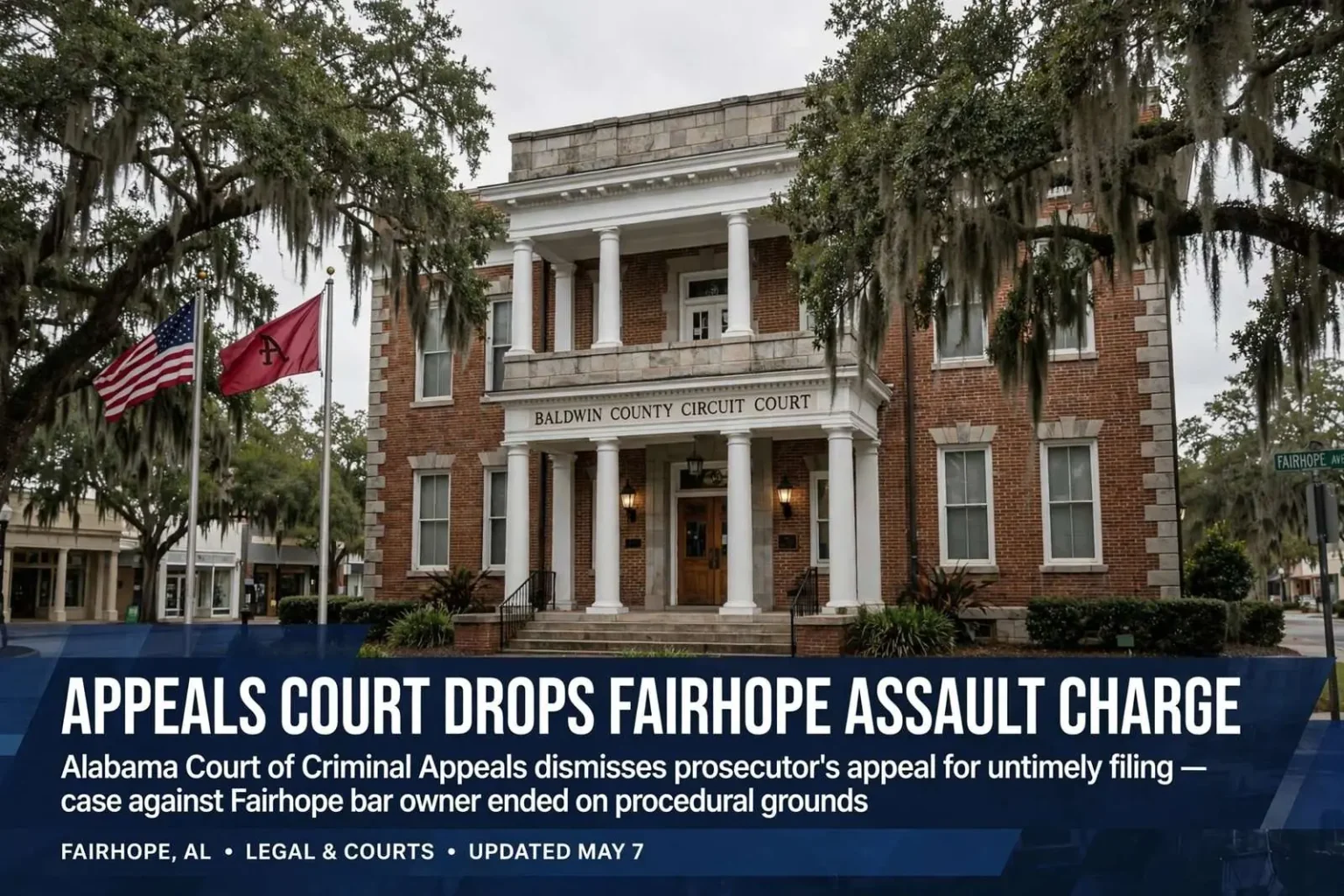
An assault charge against a well-known Fairhope bar owner is effectively gone after the Alabama Court of Criminal Appeals dismissed the city prosecutor’s appeal as untimely, according to court records. The case stemmed from an incident on Nov. 22, 2018 at the Little Whiskey Christmas Club in Fairhope. Paula DiNardi says video shows Ronan McSharry — owner of McSharry’s Irish Pub — struck her in the throat with his forearm, knocking her backward onto a concrete floor and leaving her with what she describes as a concussion and serious physical injury. Surveillance footage of the encounter was presented in court.
The dismissal ends, at least on the criminal side, a legal saga that has wound through Fairhope’s municipal court, Baldwin County’s circuit bench and the state’s appellate courts for years. Its final chapter turned not on the facts of the night in question but on a filing deadline — a procedural failure by the city prosecutor that the Court of Criminal Appeals found could not be cured.
From Municipal Conviction to Dismissal
Fairhope’s municipal judge found McSharry guilty of assault and public intoxication and imposed a 180-day sentence, citing officers’ testimony that he smelled strongly of alcohol and could barely walk. At the time, McSharry was serving probation from an earlier breach-of-peace plea involving artist Nall Hollis. McSharry appealed.
The municipal conviction was the first official judgment on the events at the Little Whiskey Christmas Club, a bar in the heart of Fairhope’s downtown. Officers who responded testified about McSharry’s condition that night, and the judge weighed that testimony alongside the surveillance footage DiNardi’s account relied upon. The 180-day sentence represented the maximum range for the charges in municipal court, a signal of how the court viewed the evidence.
McSharry’s appeal moved the case to the Baldwin County Circuit Court, where defendants convicted in Alabama’s municipal courts receive a full trial de novo — a completely new proceeding in which the municipal verdict carries no weight. That structure is a longstanding feature of Alabama’s justice system: municipal courts handle high-volume, quick-resolution cases, and the circuit court serves as the safety valve for defendants who want a second, fuller hearing with the procedural protections of a trial court of record.
But before that trial could happen, the case took its decisive turn. In March, Baldwin County Circuit Judge Clark Stankoski dismissed the assault charge after finding a defect in the charging document: it did not allege that McSharry “did cause physical injury to another person.” The missing phrase matters because Alabama’s assault statute turns on physical injury — an assault charge that does not allege injury alleges something other than assault. A charging document that omits an essential element cannot support a conviction, no matter how strong the underlying evidence might be, and defense attorneys routinely scrutinize complaints and citations for precisely this kind of defect.
City prosecutor Marcus McDowell then appealed to the Alabama Court of Criminal Appeals on April 17. According to Presiding Judge Mary Windom, the appeal was filed outside the statutory 14-day window and lacked a required docketing statement. McDowell was given 14 days to show cause why it should not be dismissed; the court record indicates no response was filed, and on May 7 the appeal was formally dismissed as untimely.
The appellate court’s ruling was, in effect, a three-part judgment. First, the appeal was late — filed beyond the 14 days Alabama law allows for this type of appeal. Second, it arrived without the docketing statement the court requires, the document that frames the issues and identifies the record on review. Third, when given a final opportunity to explain the failures, the prosecution filed nothing at all. Any one of those steps might have been survivable; together they left the court with no discretion to reach the merits of the state’s argument about the defective charging document.
Appellate deadlines are strict for structural reasons. The Court of Criminal Appeals handles thousands of appeals from Alabama’s trial courts, and its jurisdiction exists only within the windows the Legislature has set. A court that overlooked missed deadlines in one case would face pressure to overlook them in every case, which is why presiding judges routinely note that procedural defaults bind the court regardless of how compelling the underlying dispute may be. The 14-day window for this kind of appeal is short by design — it reflects the Legislature’s choice to resolve lower-level criminal matters quickly rather than leave defendants and victims in limbo for months.
The practical consequence for McSharry is that the assault charge is effectively gone. With the circuit court’s dismissal standing and the appellate route closed, there is no pending criminal vehicle for the assault allegation. The dismissal does not erase what happened at the Little Whiskey Christmas Club from the record of the case, but it does foreclose the state from pursuing a conviction on that count through the ordinary criminal process.
What Comes Next
McDowell said the public intoxication case remains pending and that “everything that went on that night” would be presented at that trial whenever courts resume normal operations. He noted the two charges carry identical potential sentences.
The prosecutor’s statement reflects the reality of the disposition: while the assault count has been dismissed on procedural grounds, the public intoxication charge survived and remains live. McDowell’s comment that the two charges carry identical potential sentences points to the 180-day municipal sentence as the benchmark — public intoxication in Alabama’s municipal courts can carry jail time in the same range, meaning the city can still seek a punishment equivalent to the one originally imposed, even though the theory of the case has narrowed from an injury-based assault to a lesser offense.
His promise that “everything that went on that night” would be presented suggests the city intends the surviving trial to function, in effect, as a full public airing of the incident — the officer testimony, the surveillance footage and the events at the bar. Whether an assault that is no longer charged can be detailed at a public intoxication trial is a question evidence rules will help answer; courts admit background evidence within limits, and prosecutors frequently argue that the circumstances of an encounter are inseparable from the offense charged.
For DiNardi, the appellate dismissal lands after years of proceedings she says she often learned about secondhand. She maintains she was assaulted and has filed a separate civil lawsuit against McSharry that is under review by the Alabama Supreme Court. She has also suggested she may pursue claims against the city, saying she was never properly kept informed about her own case. “I’m not one to back down and I don’t intend on backing down,” she said.
The civil track now carries the weight the criminal case cannot. A civil assault and battery suit requires only a preponderance of the evidence rather than proof beyond a reasonable doubt, and it can reach remedies the criminal court never could — compensation for medical costs, lost earnings and the lasting effects of the injury she describes. Her suit’s journey to the Alabama Supreme Court indicates that preliminary issues in the case have already been contested up the appellate chain, a common pattern in litigation against defendants with means and in cases where questions about the suit’s framing are fought early.
Her consideration of claims against the city opens a different front. Municipal liability in Alabama runs through narrow channels, and claims against a city must clear procedural requirements that differ from those governing private defendants. But her stated grievance — that she was never properly kept informed about her own case — goes to a concern victims’ advocates have long raised about municipal prosecution: that cases are managed, plea-bargained, dismissed and appealed with the complainant on the periphery. A victim in a municipal assault case has no standing to appeal a dismissal herself; the prosecution speaks for the state, and when the prosecution’s appeal is thrown out for lateness, the victim’s options narrow to the civil courts.
The episode also shines a light on the machinery of small-city prosecution. Fairhope’s prosecutor handles the city’s criminal docket alongside a private law practice, as municipal prosecutors across Alabama typically do. Deadlines in appellate procedure are unforgiving in that environment, and a missed 14-day window has consequences that no amount of advocacy in the trial court can repair. The case will likely be cited locally as a cautionary example: a conviction obtained in municipal court, a defect found in circuit court, and a golden opportunity to fix the charging document thrown away on the calendar.
For Fairhope, a city whose downtown thrives on the very bar-and-restaurant scene where this began, the case has been an uncomfortable fixture for years. McSharry’s Irish Pub remains a well-known establishment, the Little Whiskey Christmas Club remains part of the district’s nightlife, and the incident between them has now produced a conviction, a dismissal, an appellate default and a civil war still being fought in the courts. The criminal chapter has effectively closed with no assault conviction standing. The questions DiNardi has pressed since November 2018 — what happened that night, and who answers for it — move on to the civil docket, where she says she has no intention of backing down.