Archdiocese of Mobile: Father Alex Crow Not Permanently Removed From Priesthood
The Archdiocese of Mobile says Father Alex Crow has not been permanently removed from the priesthood as the sheriff's criminal investigation continues.
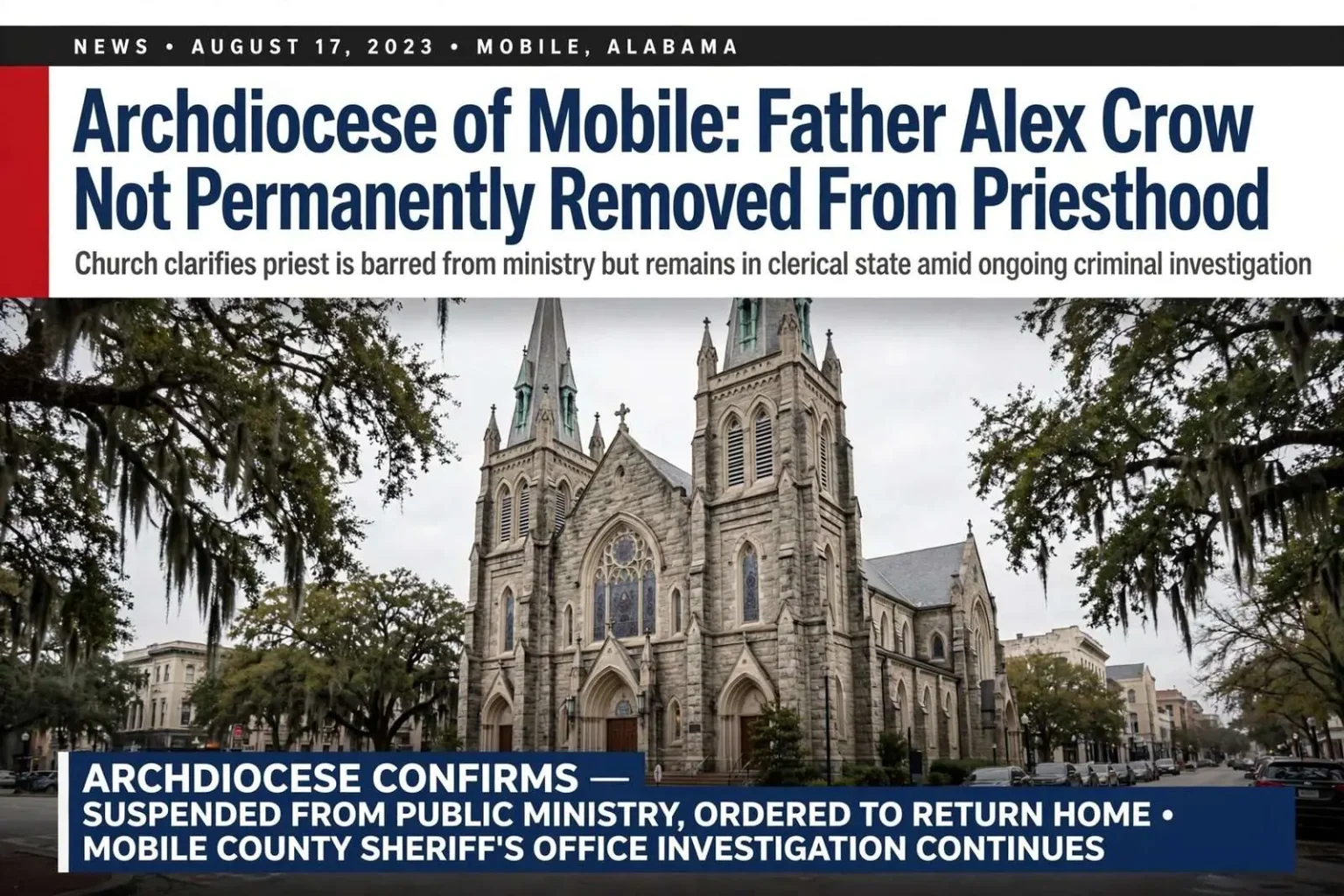
MOBILE, Ala. — The Archdiocese of Mobile moved to clarify the status of Father Alex Crow on Thursday, Aug. 17, 2023, saying that despite widespread reports to the contrary, the priest who left the country with a recent high school graduate has not been permanently removed from the priesthood. Crow left the United States nearly a month earlier along with a recent high school graduate, prompting a criminal investigation by the Mobile County Sheriff’s Office.
The clarification came as rumors circulated that Crow had already been stripped of his clerical status — a development that, under church law, requires a formal process measured in months, not days. The Archdiocese’s statement aimed to correct the record while reaffirming the two restrictions already in place: Crow is barred from functioning publicly as a priest, and he has been ordered to return home.
The case has gripped Mobile since mid-July, when word spread that the priest had left the country alongside a young woman who had just finished high school. The Mobile County Sheriff’s Office opened a criminal investigation into the circumstances of the departure, and the case has since unfolded on two tracks — one in the church’s internal legal system in Rome and Rome’s canon law courts, and one in the county’s criminal justice system, with the sheriff’s office in the lead.
Sheriff: Crow Still Presents Himself as a Priest
Mobile County Sheriff Paul Burch, whose office is investigating, said Crow continues to dress and act as a priest in Italy. “He took everything related to being a priest with him when he went,” Burch said.
According to the sheriff, Crow and the young woman appear to have no means of supporting themselves abroad and may be getting by on goodwill shown toward a priest. “I think Italy has a large Catholic population, but if they knew the things he said and did here, they probably wouldn’t be so welcoming,” Burch said.
The sheriff’s account raises a complication unusual in cases like this: a cleric barred from public ministry in his home diocese presenting himself abroad as a priest in good standing. American dioceses publish lists of clerics removed from ministry, but those notices carry no legal force in another country, and Italian parishes have no routine way of checking the standing of an American visitor who presents as a priest. Burch’s remarks were, in effect, a warning delivered through the press to an audience he could not otherwise reach.
Investigators have not detailed what charges, if any, may result from the inquiry. The sheriff’s office has said only that the investigation remains active, and officials have been careful to distinguish between what is publicly known about the departure and what an investigation can prove. No timeline for the criminal inquiry has been offered.
Why Full Removal Takes Time Under Church Law
The Archdiocese explained that Crow has not been “defrocked” — formally and permanently removed from the priesthood. Under church law, that process requires Archbishop Thomas Rodi to convene a panel of three priests to hear the case, a step that could not begin until January under the timeline involved. The Archdiocese said it intends to pursue Crow’s permanent removal from the priesthood.
Church law separates discipline from dismissal. A bishop can prohibit a priest from public ministry immediately — the suspension Crow is already under — but returning him to the lay state, the permanent removal often called laicization, is a judicial process under the Code of Canon Law. The local panel’s review is the first stage; its findings and the archbishop’s petition then go to the Vatican, where the Dicastery for the Doctrine of the Faith or the responsible office reviews the case, and the pope alone can dispense a priest from the obligations of his office and dismiss him from the clerical state. The process exists precisely so that removal is not arbitrary — the same protections that make it slow.
Burch, however, criticized the church’s response so far as half-hearted: “Some of the things that they have done are a little disappointing,” he said. “The archdiocese has provided what we asked for. They didn’t go out of their way, but they provided what we asked for.”
The Two Systems at Work
The Crow case has become a public lesson in how differently church and state process the same conduct. The criminal investigation answers to Alabama law: it can compel testimony, issue warrants and, ultimately, produce charges that a court would adjudicate. The canonical process answers to the Code of Canon Law: it can restrict ministry, remove a priest from the clerical state and bar him from celebrating the sacraments, but it cannot compel anyone to return to the country or punish conduct under civil law.
The two systems also run on different clocks, which is the source of much of the frustration visible in the sheriff’s comments. A diocese’s administrative suspension can be imposed the day a bishop learns of serious misconduct, and the Archdiocese did that. But the full removal Crow’s critics are demanding requires the panel in January, a Vatican review after that, and a papal decision at the end of the line. From the sheriff’s perspective, a man under criminal investigation is still presenting himself as a priest in another country while the church’s machinery turns; from the Archdiocese’s perspective, the process is following the only lawful route the church’s own system provides.
The Archdiocese’s Thursday statement walked carefully between those demands. It confirmed what Crow is not — permanently removed — and what he is: barred from public ministry, ordered home, and facing a diocese that says it intends to see the removal process through. The statement’s urgency reflected the spread of reports that removal had already happened, reports the church clearly feared would create false comfort about a man under criminal investigation.
The View From the Pews
For the parish communities Crow served, the case has produced grief and anger in roughly equal measure, and questions the diocese’s statement could not answer. Parishioners have asked how a priest came to leave the country with a recent high school graduate, what the diocese knew beforehand, and whether the young woman left willingly — the last question being the focus of the sheriff’s inquiry, and one that officials have declined to answer publicly while the investigation continues.
The Archdiocese has restricted itself to confirming facts and announcing process, a discipline that has left a vacuum filled by rumor. The Thursday clarification was an attempt to shrink that vacuum, but the underlying tensions — between the speed the community wants and the speed canon law allows, between the church’s authority over its own clergy and the sheriff’s authority over a criminal case — will outlast any single statement.
Burch’s public criticism is itself notable. Sheriffs rarely comment on another institution’s handling of an overlapping matter, and his remarks — that the Archdiocese provided what was asked for but “didn’t go out of their way” — signal a working relationship under strain. Investigators depend on institutions’ records and cooperation; the sheriff’s assessment that cooperation was adequate but not proactive is, in effect, a message to the Archdiocese delivered in public.
What remains is the wait. The canonical panel convenes in January; the sheriff’s office continues its work without a published timeline; and a young priest barred from ministry in Mobile, by the sheriff’s account, is still saying he is one in Italy. The Archdiocese says it intends to see him permanently removed from the priesthood. The county says it intends to establish what happened. Both processes now proceed on their own clocks, in parallel, toward conclusions neither has promised to reach quickly.
What Suspension Means — and What It Does Not
The suspension Crow is under is worth understanding precisely, because the distinction between it and removal is the heart of the Archdiocese’s clarification. A suspended priest is forbidden from exercising his ministry: no Masses celebrated publicly, no sacraments administered, no preaching, no wearing of clerical garb in any official capacity. In the eyes of canon law, however, ordination itself leaves an indelible mark — a suspended priest remains a priest, with all the obligations of his ordination, until the church formally dismisses him from the clerical state.
That is why “defrocked” is a loose word for what happens next. The canonical term is loss of the clerical state, and it can be reached by a papal dispensation or by an administrative or judicial penalty after the process the Archdiocese has described. Once it occurs, the man is returned to the lay state and permanently barred from ministry, though the ordination itself, in the church’s theology, is never undone. The distinction matters to the faithful — a man still claiming to be a priest abroad is, in canon law, exactly what he claims, until the Vatican says otherwise — and it explains why the church’s defenders describe the process as deliberate while its critics call it slow.
The Archdiocese’s handling also reflects lessons from two decades of clerical-misconduct scandals, during which the church’s credibility suffered most from statements that turned out to be premature. Announcing a removal that had not occurred — or removing a priest administratively while a criminal investigation was underway, only to have the case later collapse in the Vatican’s review — would compound the damage. The statement’s careful accuracy is, in that light, institutional caution as much as legal necessity.
For the sheriff’s office, none of that changes the assignment. Detectives must establish the facts of the departure, the ages and circumstances of the people involved, and whether Alabama law was broken — work that proceeds whether the man at its center is a suspended priest in the church’s eyes, a civilian suspect in the state’s, or, as Burch reports, something else entirely in the eyes of parishioners in Italy.
The next public developments will come from the two processes themselves: the January panel in the church’s calendar, and whatever charges or determinations the sheriff’s office announces. Until then, the Archdiocese has said what it can say — Crow is not yet removed, is barred from ministry, and is ordered home — and Mobile is left to wait for the machinery of two very different legal systems to reach the conclusions its residents are asking for now.