Arizona Cardinals sign Pensacola native Alfred Morris
The Arizona Cardinals are expected to sign Pensacola native and former Pine Forest High School standout Alfred Morris, ESPN reported.
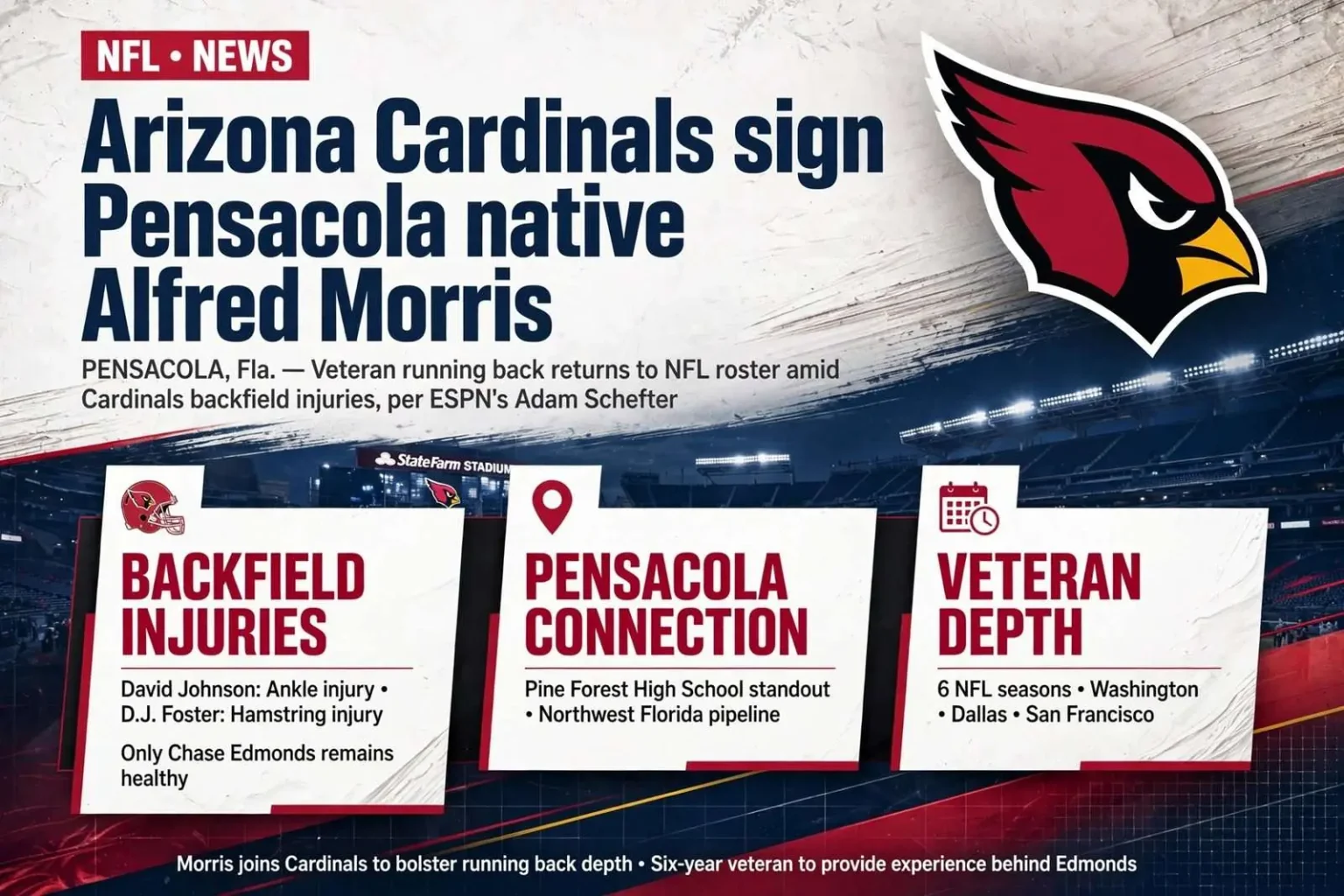
PENSACOLA, Fla. — The Arizona Cardinals are expected to sign former Pine Forest High School standout Alfred Morris, according to ESPN’s Adam Schefter, bringing the Pensacola native back to an NFL roster as his old division rival scrambles to fill a suddenly thin backfield. Morris, a proven veteran of six NFL seasons, plans to join the Cardinals to add depth to an injury-depleted running back group in need of experienced bodies.
The need in Arizona is acute. David Johnson, the team’s franchise running back, is dealing with an ankle injury, and D.J. Foster is nursing a hamstring issue. That leaves Chase Edmonds as the only healthy running back on the roster, a precarious position for any NFL team to occupy in the middle of a season. Signing Morris gives the Cardinals a proven veteran who can carry a workload if needed while Johnson and Foster work their way back, rather than relying on a single unproven ball carrier.
Morris comes to Arizona with a familiar recent history with the club. He was in training camp this year with the Dallas Cowboys but was cut before the regular season, and he later worked out for the Cardinals in September, though the team did not sign him at that time. The intervening weeks have evidently changed the calculus, with injuries pushing the Cardinals back to the veteran market and Morris still in shape and waiting for the phone to ring.
From Pensacola to the NFL
Morris made his name at Pine Forest High School in Pensacola, where he emerged as a powerful high school runner in a city with a proud football tradition. Pensacola and the surrounding Escambia County have sent a steady stream of players to college football and the NFL over the decades, and Morris carved his path through that pipeline before moving on to a record-setting college career that put him on the professional map. His rise from Northwest Florida to NFL starter made him a point of pride for the local community, where high school football on Friday nights remains a central fixture of the sports calendar.
His professional résumé is substantial. Morris spent four seasons with Washington from 2012 to 2015, establishing himself almost immediately as a rookie and becoming one of the league’s more reliable runners during that stretch. He then spent two seasons with the Dallas Cowboys from 2016 to 2017, serving primarily as a complement in the backfield while continuing to demonstrate the durability that defined his career. Most recently he played for San Francisco last season, rushing for 428 yards and two touchdowns in a reserve role.
What he brings to Arizona
The Cardinals’ interest reflects the value Morris offers even in the twilight of his career. At his best, he was a between-the-tackles runner with rare balance and the ability to absorb contact and keep his feet moving, a style that aged well because it depends less on breakaway speed than on vision, patience, and physicality. In a reserve role, a back with his experience can protect the quarterback, pick up short yardage, and give a coaching staff a trusted option on early downs while a starter recovers.
For Morris, the signing is another chapter in a career built on persistence. Running backs not selected in the draft’s early rounds face steep odds of long NFL careers, and Morris outlasted that expectation many times over, going from sixth-round afterthought to multi-year starter to dependable veteran. Each stop — Washington, Dallas, San Francisco, and now Arizona — has come with a different role, and his willingness to fill whatever role a team needs has kept him employed as younger backs cycle through the league.
The Cardinals’ backfield situation
Injuries to running backs are a fact of life in the NFL, where the position absorbs more collisions than any other on the field. Arizona’s situation, with both David Johnson and D.J. Foster sidelined and only Chase Edmonds healthy, forced the front office to act rather than hope. Teams routinely keep four running backs on their active roster for exactly this reason, and signing a veteran free agent who already knows the league’s schemes is usually the fastest remedy available midseason, since no rookie-integration period or playbook crash course is required.
Edmonds, the lone healthy back, is a promising but lightly used player, and asking an unproven runner to carry a full workload in the NFL is one of the quickest routes to trouble. Morris’ arrival protects Edmonds from overuse and gives the coaching staff flexibility in how it divides carries once Johnson and Foster return. It also provides insurance against another injury, the scenario every running back room quietly prepares for.
A career of durability
What has kept Morris in demand is his durability and professionalism. Across four seasons in Washington he was one of the steadiest backs in the conference, then moved to Dallas where he backed up one of the league’s premier runners while still contributing in his own looks. His season in San Francisco added another system to his ledger, with 428 yards and two touchdowns showing he could still produce when called on. Teams value that kind of track record in a depth signing, because it removes guesswork: they know exactly what they are getting.
The Cowboys’ training camp cut this year underscored how quickly the league moves on, but it did nothing to erase the résumé. Veterans of Morris’ standing frequently spend the early weeks of a season in waiting mode, staying ready for the injury wave that arrives every fall, and the Cardinals’ September workout showed he was on their radar well before the current emergency. When the need became urgent, the familiar name was the natural call.
Pensacola’s football pipeline
Morris’ story is part of a larger Northwest Florida tradition. The Pensacola area has produced NFL talent across generations, with Pine Forest, Escambia, Tate, and the other area high schools sending players to college programs across the Southeast and beyond. The region’s football culture runs deep, from youth leagues through Friday nights, and players who make it to the professional level become fixtures of local pride, their careers followed closely by fans who watched them play in high school stadiums.
That hometown following has tracked Morris’ career from Washington’s playoff runs through his stops in Dallas and San Francisco, and the Arizona signing gives Pensacola fans another team to pull for on Sunday afternoons. For the young players coming up through the local programs, his path — from Pine Forest standout to six-year NFL veteran — is the kind of example that makes the distant goal feel attainable.
What comes next
Much depends on how quickly Johnson and Foster recover, but Morris’ signing gives Arizona stability either way. If the injuries linger, he is capable of handling a heavier share of the carries for a few weeks; if they heal quickly, he slides into a supporting role and special-teams-adjacent duty that suits a 30-something veteran. Either way, the Cardinals add a professional whose six seasons in Washington, Dallas, and San Francisco taught him how to prepare, and whose most recent game action showed his legs still work at this level.
For the Pensacola native, the call from Arizona is also a reward for staying ready. Months after being let go in Dallas, and weeks after working out for the Cardinals without a contract offer, Morris is expected to sign with a team that needs exactly what he has spent his career providing: reliable, physical running back play on a Sunday that must go on without its stars.
How veteran signings work in the modern NFL
The market for veteran running backs follows a predictable rhythm each season. Roster cuts at the end of training camp release a wave of experienced players, teams fill their needs with younger and cheaper options, and the veterans settle into a holding pattern — training, staying in shape, waiting for the injuries that inevitably come. When a backfield is depleted, general managers reach first for the free agents with proven track records, because a midseason signing must contribute immediately rather than develop over time. Morris, with six seasons of game film and a reputation as a consummate professional, is precisely the profile teams look for in that moment.
Speed of integration matters too. A signing like this typically involves learning a condensed playbook, getting up to speed on pass-protection assignments, and building timing with the quarterback — tasks that are much easier for a player who has seen every look an NFL defense can present. Workouts with a team, as Morris had with the Cardinals in September, also help, since the staff has already evaluated his condition and familiarity with their system.
The running back life cycle
Morris’ career arc mirrors the life cycle of his position. Running backs peak early in the league, absorb enormous punishment, and find their roles changing as they age — from featured starter to complement to situational contributor to veteran depth. Navigating that transition gracefully is harder than it sounds, and Morris has done it by accepting each role his teams asked of him. Four years as Washington’s workhorse, two as a supporting piece in Dallas, a reserve season in San Francisco with 428 yards and two touchdowns, and now an emergency call-up in Arizona trace a career sustained by adaptability as much as talent.
The financial realities of the position shape these decisions as well. Veteran backs sign modest contracts at the end of their careers, and the security of a roster spot midseason is valuable in itself. For players like Morris, staying ready during the fall is a job in its own right, and the ones who keep themselves in playing shape are the ones whose phones ring when Week 6 injuries strike. His expected signing with the Cardinals is the payoff for that discipline.
What it means for the Cardinals’ season
Arizona’s season ambitions hang on how long David Johnson remains out, but the Morris signing changes the short-term outlook. With a healthy veteran in the fold, the Cardinals can keep their offensive schemes intact rather than warping the game plan around a depleted backfield, and Chase Edmonds can grow into his role without the burden of carrying the ground game alone. When Johnson returns, the room will be deeper than it was before the injuries, with experienced depth that many teams lack at this point in the season.
For fans in Pensacola, the move keeps a hometown favorite in the league and adds a new jersey to watch on Sundays. Morris’ journey from Pine Forest High to a six-year NFL career and now an Arizona Cardinals contract is a testament to the Northwest Florida pipeline that keeps sending players to the league, and a reminder that in the NFL, durability and readiness are careers of their own.