Armed Man in Custody After Mobile County Standoff
Mobile County deputies were involved in a standoff with an armed man during a court-requested probate pickup in Trinity Gardens before taking him into custody.
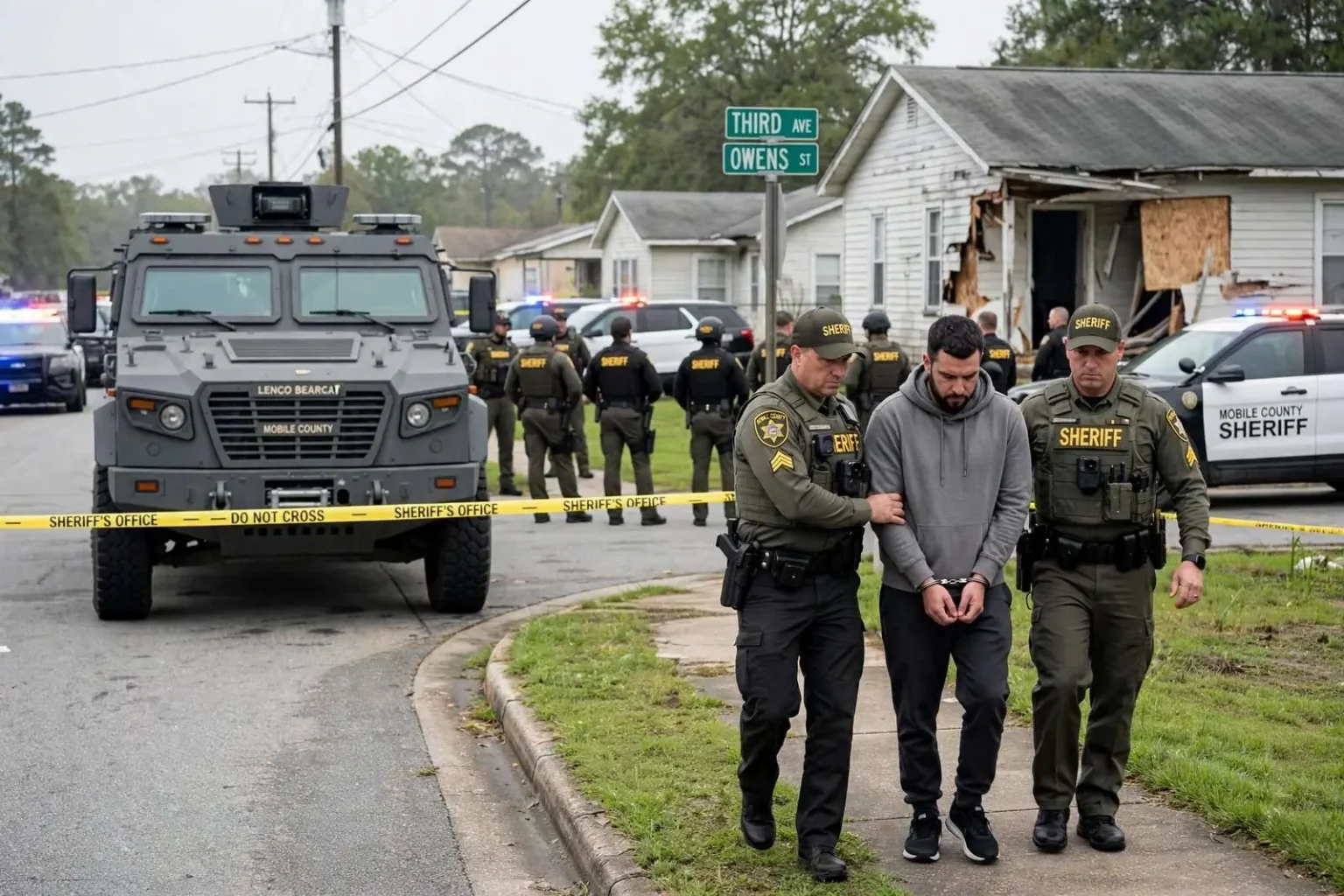
MOBILE COUNTY, Ala. — Deputies with the Mobile County Sheriff’s Office were involved in a standoff Wednesday morning while attempting to carry out a court-requested pickup, officials said. The encounter, which ended with a man in handcuffs, shut down activity around a residential block in the Trinity Gardens community for several hours and drew the sheriff’s office’s specialized equipment to a quiet street corner.
According to the sheriff’s office, deputies had been asked to complete a probate pickup. When they arrived at a home at Third Avenue and Owens Street in the Trinity Gardens community, the man was “aggravated” and initially refused to come outside. Deputies waited, and the man eventually stepped outside — but officials said he was armed and told deputies he did not want to go with them.
At that point the routine errand became a barricade situation. Deputies called in the sheriff’s office’s specialized units and its Bearcat armored vehicle, and the neighborhood around the intersection filled with the personnel and hardware of a full tactical response.
What a probate pickup is
A probate pickup is a court-ordered transport that originates in the Mobile County Probate Court, most often involving a person who has been the subject of a mental health proceeding. When a family member, physician or other petitioner convinces the probate court that someone needs evaluation or involuntary treatment, the court signs the order, and law enforcement officers — usually deputies — are tasked with locating the person and transporting them for the evaluation. The pickups are among the most delicate assignments deputies handle, because the subject has typically not been charged with a crime and the encounter is about care as much as custody.
That is what makes a standoff at a probate pickup so complicated. Deputies arrive knowing the person may be in psychiatric crisis, and the entire encounter is shaped by the need to avoid making a health emergency worse. Training emphasizes patience, de-escalation, and bringing family members or crisis-trained negotiators into the conversation where possible. In most cases, the person agrees to go. Wednesday’s encounter in Trinity Gardens was the exception, complicated further by the presence of a weapon.
How the standoff unfolded
With the man armed and refusing to go with deputies, the sheriff’s office escalated deliberately. Its specialized units — the tactical operators who handle barricaded subjects — took over the scene, and the Bearcat, the office’s armored rescue vehicle, was positioned at the home. The Bearcat exists for exactly this kind of call: it shields officers from gunfire during approaches and allows them to get close to a structure without exposing themselves.
Officials said deputies ultimately had to knock down part of the home to get the man to talk. Once inside, deputies deployed gas because, they said, the man remained armed. The combination — a breached wall, chemical agents and negotiators keeping contact — is a standard sequence for moving a barricaded, armed subject toward surrender without a shootout, and in this case it produced the outcome deputies wanted: the man was ultimately walked out of the home in handcuffs, with no shots fired and no injuries to officers reported at the scene.
The Trinity Gardens setting
Trinity Gardens is an established community inside the Mobile city limits but patrolled in part through the county’s sheriff’s jurisdiction, a neighborhood of modest homes and longtime residents east of the downtown corridor. Third Avenue and Owens Street sit in its residential heart, where a Wednesday-morning tactical operation — armored vehicles, uniformed deputies and closed streets — draws every neighbor to a window. Standoffs in residential blocks carry risks beyond the subject himself: nearby homes, passing traffic and onlookers all become part of the scene deputies must manage while the negotiation or breach is underway.
Residents of the block described the morning’s activity as unmistakable. The Bearcat alone is enough to stop a street, and the additional specialized units meant deputies were working the intersection and the approaches to the home for an extended period. Sheriff’s officials did not report any injuries to neighbors, deputies or the subject during the operation.
The specialized units behind the response
Every large sheriff’s office in Alabama maintains some version of the units deployed Wednesday. The tactical team trains for barricaded subjects, hostage scenarios and high-risk warrant service; negotiators train to talk a subject out without a breach; and the Bearcat — a Lenco armored vehicle acquired by agencies nationwide through federal programs after its success in military use — gives the team a mobile shield. The sequence at a standoff is usually negotiation first, mechanical means second. Deputies went to the breach Wednesday only after the man, armed and refusing, left no other route to him.
The use of gas inside a structure is likewise a calculated step. Chemical agents are intended to drive an armed subject out of a defensible position without forcing deputies into a gunfight inside tight quarters. Deploying them after entering the home indicates the man was still armed and still refusing as deputies cleared the structure — the most dangerous phase of any barricade call.
What happens to the man now
Officials said charges against him are possible, but the matter remains an active investigation. That wording leaves the legal outcome open: investigators will weigh what the man was armed with, whether any laws were broken during the standoff, and how his mental health status — the presumed reason for the probate order — interacts with any charge the district attorney’s office might pursue.
In cases that begin as mental health transports, prosecutors and courts often navigate between the criminal docket and the civil one. A person picked up on a probate court order may be evaluated and treated rather than prosecuted, or may face charges stemming from the standoff itself — resisting, menacing, or weapons offenses — depending on the facts investigators document. The sheriff’s office said the investigation continues, and any charge decision will follow its report to the district attorney.
What this means for the neighborhood
For Trinity Gardens residents, the morning was a close-up view of how county law enforcement resolves its most volatile calls. The operation ended the way deputies train for: subject in custody, no officer injured, no exchange of gunfire, and the street returned to its routine by the time the Bearcat pulled away. The intersection of Third Avenue and Owens Street went back to being a corner like any other — but for a few hours Wednesday, it was the scene of the kind of patient, staged response that ends standoffs without funerals.
The outcome also reflects the restraint deputies exercised across a long morning. A man aggravated and refusing at the door could have escalated at any of several points — when he stepped outside armed, when the wall came down, when gas filled the rooms he was holding. At none of them did the encounter turn into a shooting, which is the measure of how the specialized units were used: as a slow, deliberate pressure that ended with the man in handcuffs and everyone else on the street untouched.
The mental health dimension of the call
Standoffs that begin as probate pickups are part of a wider pattern that law enforcement agencies across Alabama have been working to manage more carefully. Deputies are, in practice, the state’s first responders to psychiatric crises, and the probate court orders they execute put them at the door of people in the middle of one. Agencies have responded with crisis intervention training, which teaches deputies to recognize the signs of a mental health emergency, slow their approach, and use language that lowers rather than raises the temperature. The Mobile County Sheriff’s Office has incorporated such training for the deputies most likely to take these calls.
The presence of a weapon changes the calculus but not the underlying nature of the call. Officers still try to resolve the encounter through conversation, and every escalation step — the tactical team, the armored vehicle, the breach, the gas — is taken in the hope of ending the standoff without a gunshot. Wednesday’s operation followed exactly that arc, and the man walked out alive into the custody of the same deputies who had first knocked on his door.
Families who initiate probate proceedings often describe the process as a last resort — a step taken when a loved one’s condition has deteriorated to the point that no other route to treatment remains. The court order deputies carry is, from the family’s perspective, a plea for help; from the subject’s perspective, it can feel like an ambush. Deputies are trained to hold both realities at once, and the hours they spend talking at a doorstep before any breach attempt are the practical expression of that training.
Where the case goes from here
The active investigation will now determine what, if anything, the man is charged with. Investigators will document the weapon, the refusals, the damage to the home and any statements the man made during the standoff, then present their findings for a charging decision. Whatever the legal outcome, the man remains in custody, and the probate matter that started the morning — the reason deputies were sent to Third Avenue and Owens Street in the first place — remains a live question that the courts will address alongside any criminal case.
For the neighborhood, the operation’s end restored the ordinary rhythm of a Wednesday. The armored vehicle left, the street reopened, and the specialized units returned to their normal rotation, ready for the next call of this kind — which, in a county of Mobile’s size, is rarely far away. The sheriff’s office has not released the man’s name or further details about the weapon or the probate order, citing the ongoing investigation, and additional information will come only when that review is complete.