Sen. Arthur Orr Says Alabama Should ‘Clamp Down’ on Flock Cameras in the Next Session
State Sen. Arthur Orr says Alabama's 2021 license plate reader law did not go far enough and lawmakers should consider whether to allow Flock cameras at all, or impose far tighter limits.
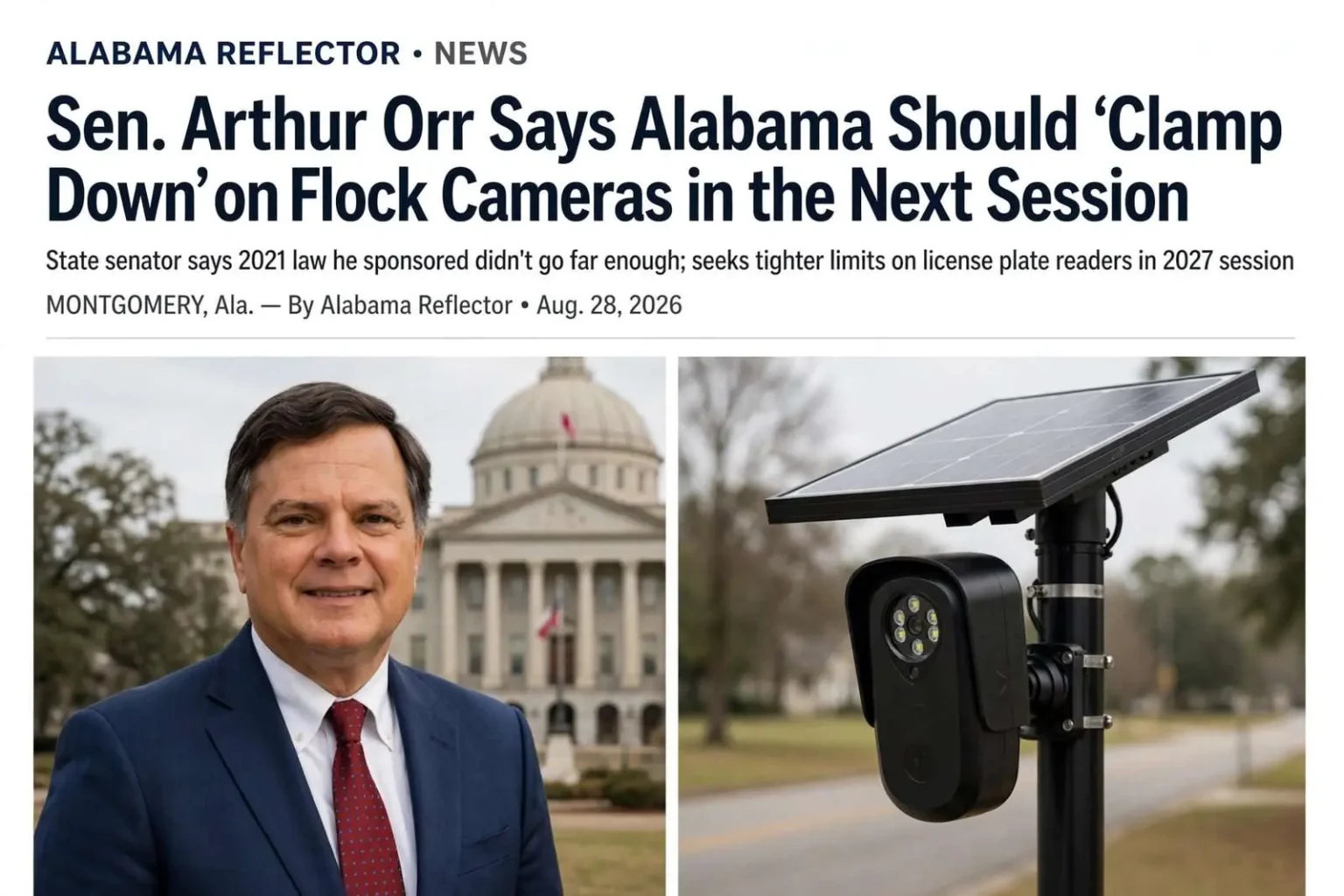
MONTGOMERY, Ala. — State Sen. Arthur Orr believes the next legislative session will bring an opportunity to place firmer limits on law enforcement use of Flock cameras, and he says the 2021 law he helped pass did not go far enough.
Orr, a Republican from Decatur, sponsored legislation five years ago that imposed some restrictions on license plate reader cameras. Speaking during a radio interview Thursday, he made clear he considers that framework inadequate.
The admission from a bill’s own sponsor is an uncommon one in Montgomery, where legislators typically defend their handiwork. Orr’s willingness to reopen the subject suggests the five-year-old law has aged badly in his judgment — overtaken by a surveillance industry that expanded far faster than the rules written for it.
Policies he calls ‘very, very loose’
“When the legislation ran into a lot of headwinds from my colleagues at the time, the best deal I could cut at the time was to get ALDOT to put policies in place, and I was assured by the transportation director at the time, Mr. Cooper, that they would, and they did,” Orr said. “In my opinion, they’re very, very loose. They’re not as tight as I would like to see.”
The description of the original compromise explained why. Facing resistance in his own chamber, Orr traded statutory limits for administrative ones — policies adopted by the transportation department rather than restrictions written into law. Agency policies can be revised or quietly relaxed by later administrators; statutes require the legislature to undo them. The senator now regards that trade as insufficient, a judgment he says time has confirmed.
The political environment has shifted since then. Flock Safety CEO Garrett Langley recently apologized for instances of misuse of the technology by officials, and backlash against automated license plate readers has grown across the country.
An industry founder apologizing for his customers’ misuse is a marker of how the debate has moved. Automated plate readers were sold for years as crime-fighting infrastructure — networks of cameras on poles that log every plate that passes and flag stolen cars or wanted drivers. As the networks multiplied across Alabama cities and neighborhoods, so did questions about who could search the data, how long it was kept, and whether it was being used for purposes its buyers never advertised.
Starting with a more basic question
Orr suggested lawmakers may need to begin further upstream than regulation.
“Now that it seems, as you say, the public has awakened, I’m ready to revisit the issue and really clamp down on these,” he said. “If the public even wants them at all, and I think that’s the initial debate out of the gate: do we do we even want to have them? And then, if we do, we really need to put some restrictions and guardrails and more limitations on the usage of them.”
Framing the question as whether the cameras should exist at all puts him ahead of most legislative debates on surveillance, which usually begin with how to regulate an installed base. In Alabama, as in much of the country, the cameras arrived city by city — municipal contracts, pole by pole — before any statewide framework existed, which is precisely the sequence that produces regulation as an afterthought.
Support for police, with checks
Orr was careful to separate his concerns about the technology from his position on law enforcement generally.
“And we all know we support the police, but they’re bad actors among the police,” he said. “And what happens if you get a cop that wants to check up on his girlfriend and see where she’s going, or somebody else, or a business associate, or whatever? We don’t need that, and if that happens, they need to be punished accordingly.”
The example he chose — an officer tracing a private individual’s movements through plate data — is the scenario privacy advocates most often cite, because it requires no hacking and no conspiracy, only the ordinary credentials of a police database and a personal motive. Systems built to catch stolen cars are equally effective at following a spouse or a business rival, and the audit trails that would catch such use are only as strong as the agency’s policies.
The constitutional question — and the practical one
Notably, Orr does not argue that the cameras violate the Constitution. His case rests on a different foundation: that private companies are operating commercial surveillance infrastructure in publicly owned space, which gives the state clear authority to set terms.
“My real problem is these companies are using government right away to do this. So that gives us the right to really come in and limit how they’re used,” Orr said. “[On] your private property, a license plate reader that reads vehicle tags as they come by, there is nothing that you could do to to stop that, but using government airspace above interstates and other roadways, etc. That’s where we get involved and are able to draw some lines around.”
That distinction — between private property and public right-of-way — is likely to shape how any future Alabama legislation is drafted, and it sidesteps the Fourth Amendment arguments that other officials have advanced.
The property-rights framing has practical advantages in the Statehouse. Constitutional Fourth Amendment claims require courts and invite years of litigation over what a plate scan “is” under search-and-seizure doctrine. Property authority requires neither: the state owns the rights-of-way above its highways, and it can lease, license or refuse that space on whatever conditions it writes. A bill built on that footing would regulate the mounting of cameras on public infrastructure rather than the technology itself — a line that maps cleanly onto the industry’s actual business model, which depends on public poles, overpasses and rights-of-way.
It also leaves private installations alone, which Orr acknowledged is a limit of the approach. Driveways, gated communities and private lots can host readers the state cannot touch. Any Alabama framework built on public-space authority would therefore cover the largest networks — those bolted to public infrastructure — while leaving the smaller private ones to whatever local ordinances apply.
A widening debate
Orr joins a growing list of Alabama officials weighing in on license plate readers. State Auditor Andrew Sorrell has called for the cameras to be removed entirely. Others have raised Fourth Amendment objections, while some in law enforcement have defended the technology’s role in solving crimes.
The range of positions spans the plausible policy spectrum, from abolition to acceptance with guardrails, and the intra-party texture of the debate matters. Orr and Sorrell are both Republicans, meaning the challenge to the camera networks is coming from inside the majority rather than from its opposition — the configuration in which legislation usually actually moves.
Law enforcement’s defense of the systems rests on results: recovered stolen vehicles, solved hit-and-run cases, missing-persons alerts triggered by a plate read at a traffic light. Those cases are real, and they are the reason the networks were bought. The legislative question is whether those benefits can be preserved inside a framework that restricts who searches the data, how long it is kept, and what purposes beyond warrant-backed investigations it may serve.
Local governments sit in the middle of that argument. Cities that bought camera networks pitched them as force multipliers for understaffed departments, and now find the equipment at the center of a statewide fight they did not start. Some have begun writing their own usage policies while they wait for Montgomery to act, a patchwork that itself argues for a statewide rule.
The question appears headed for the 2027 legislative session.
That calendar gives all sides time to organize. Municipalities with existing contracts would face grandfathering questions; the industry would lobby for retention; sheriffs and police chiefs would be asked what restrictions they can live with; and the auditor’s abolition position would test how far the appetite for removal actually runs among legislators whose cities have already installed the cameras.
For residents, the practical stakes are simpler than the statutory ones. Every plate read builds a record of where a vehicle was and when — commutes, church attendance, medical visits, late-night errands — retained by a private vendor on behalf of a public agency. Whether that record is searchable at will, audited, or tightly restricted is the difference between a crime-fighting tool and a movement database, and it is precisely the line the 2021 compromise left loose.
Orr’s return to the issue he once settled for less signals that the compromise era is ending. The senator who cut the original deal now says the deal was too thin, and he intends to thicken it — starting, he says, with the more basic question of whether Alabamians want the cameras at all.