
As Mississippi Launches Sports Betting, Alabama Remains on the Sidelines
Mississippi has become one of the first states to launch legal sports betting, but Alabama remains on the sidelines as lawmakers debate the issue.
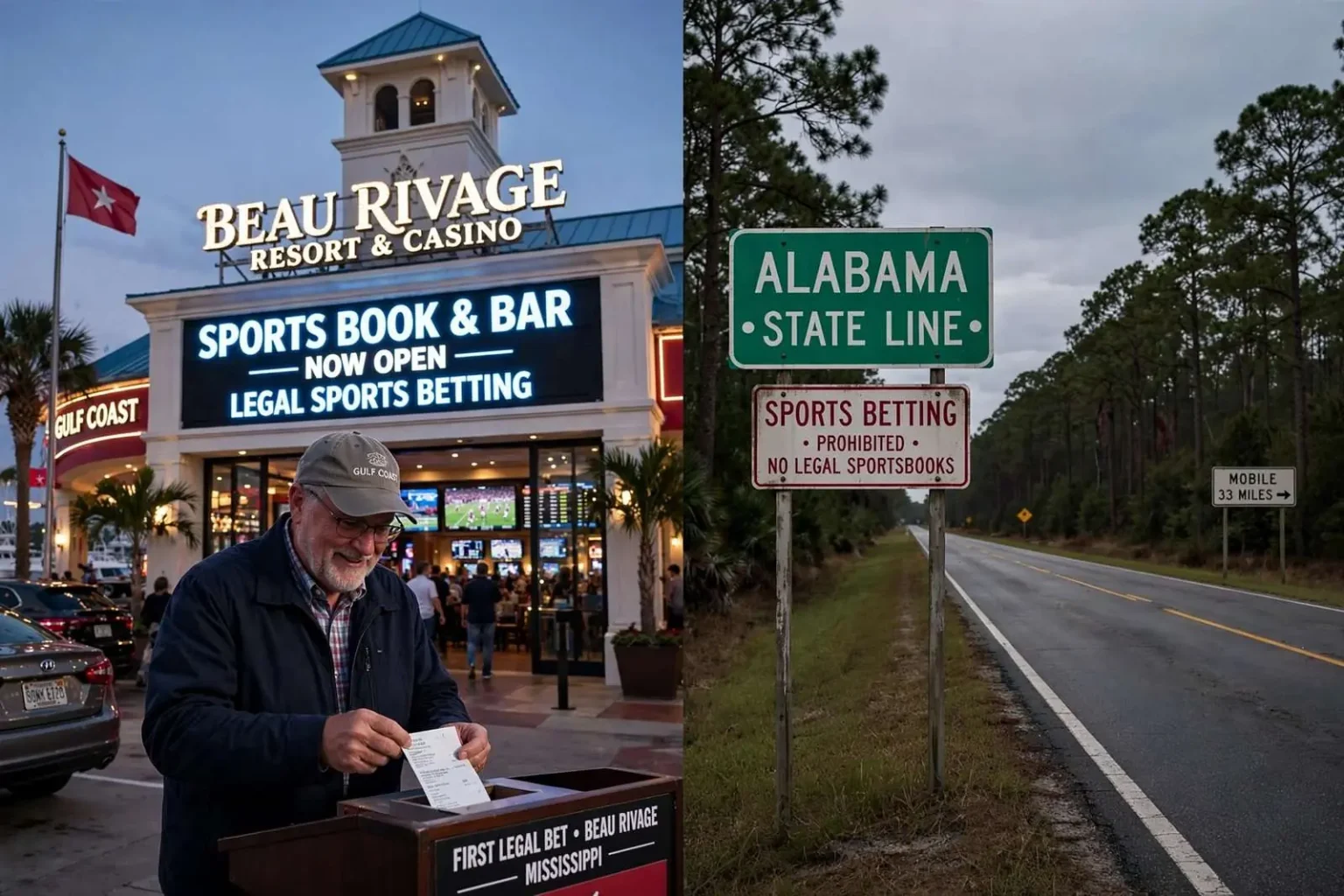
Mississippi has become one of the first states in the nation to launch legal sports betting, with the Beau Rivage Resort and Casino in Biloxi taking some of the country’s first wagers following a U.S. Supreme Court ruling that cleared the way for states to authorize sports books.
The high court struck down the Professional and Amateur Sports Protection Act of 1992, a law that had blocked states from allowing sports gambling for nearly three decades. With PASPA gone, the decision over whether to permit sports betting returned to the states — and Mississippi was ready on day one.
Mississippi lawmakers had positioned the state to move quickly, passing enabling legislation more than a year before the decision. That head start explains why Biloxi’s casinos, perched on the Gulf Coast just over an hour’s drive from Mobile, were among the first in America to open legal sports books rather than months or years behind the ruling.
Mobile native and legendary oddsmaker Danny Sheridan placed one of Mississippi’s first legal bets at the Beau Rivage’s new Sports Book & Bar — a symbolic moment for the Gulf Coast, where for decades the only legal way to wager on a game was to drive across a state line and hope nobody asked.
Alabama’s long resistance
Sheridan, though, cautioned that Alabama is unlikely to follow soon, noting that a large share of gambling revenue in neighboring states already comes from Alabamians who cross the line to play. That pattern — Alabama dollars funding Mississippi’s casinos, Georgia’s lottery and Florida’s facilities — is precisely the dynamic that has animated gambling debates in Montgomery for years without breaking the deadlock.
Alabama has long resisted expanded gambling. The only legal gaming in the state is operated by the Poarch Band of Creek Indians, whose facilities operate under a compact with the federal government rather than comprehensive state gambling law. And state law even bars those facilities from offering table games such as blackjack and poker — a restriction that keeps Alabama’s legal gaming among the most limited in the region.
Efforts to authorize a state lottery or casino gambling have repeatedly stalled in the Legislature. Alabama remains one of the few states without a lottery, and proposals that would pair one with casino regulation or a gaming commission have died repeatedly in the Statehouse, caught between religious objections, anti-gambling legislators and turf disputes over who would regulate the industry.
Gov. Kay Ivey has said the public should be allowed to vote on the matter, while other elected officials remain opposed. That split — a governor willing to put expanded gaming before the voters, a Legislature where the votes have never materialized — captures why Alabama’s position has barely moved even as the map around it has transformed.
What the Supreme Court changed
PASPA, enacted in 1992, had frozen sports gambling in place nationally: states that already had legal sports wagering could keep it, and every other state was barred from authorizing it. For nearly three decades, Nevada held a near-monopoly on legal American sports betting, and the illegal market filled the gap everywhere else — including across the Gulf Coast, where betting on Alabama and Auburn games has always been popular and always been illegal closer to home.
The Supreme Court’s decision to strike the law down reorganized that landscape overnight. Sports betting became a state-by-state choice, and states with casinos and gaming infrastructure — none better positioned than Mississippi — could launch within months. Biloxi’s casinos did exactly that, with the Beau Rivage’s Sports Book & Bar among the first legal operations in the country to take a bet.
For the Gulf Coast economy, the timing amplified a familiar flow. Mississippi’s casino industry has drawn Alabama visitors since the first coastal casinos opened in the 1990s, and legal sports books give those visitors one more reason to make the trip — particularly during football season, when wagering interest in Alabama peaks and the nearest legal book is a drive down Highway 90 or Interstate 10.
The crossover economy
Sheridan’s point about Alabamians already bankrolling neighboring states’ gambling revenue is the arithmetic that proponents of Alabama gaming cite most often. Every Alabama resident who drives to Biloxi to bet on a football game, or buys a lottery ticket across the line in Florida, Tennessee or Georgia, is tax and revenue that stays outside the state. Estimates of that outbound spending have featured in every major gambling debate in Montgomery for the past two decades, and the advent of legal sports betting only widens the gap.
Mississippi’s approach also illustrates a design choice Alabama has never confronted. Rather than authorizing sports betting statewide through mobile apps, Mississippi required in-person wagers at licensed casinos — a more conservative rollout that keeps the new revenue anchored to existing resort properties like the Beau Rivage, and keeps the state’s existing gaming structure at the center of the expansion.
What it means for Alabamians now
For now, Alabamians who want to wager on sports must continue traveling to Mississippi, where all 12 Biloxi casinos plan to offer betting. The legal alternative to the illegal bookmaker or the offshore website is now a road trip — legal, regulated, and taxed by another state.
The practical consequences follow the state line in both directions. Alabama football fans making the trip during the season will find sports books operating inside resort casinos that already draw Gulf Coast visitors, and the wagers they place will generate revenue and taxes in Mississippi that a change in Alabama law could theoretically capture at home. Meanwhile, wagering that happens inside Alabama remains what it has always been: illegal under state law, with no consumer protections and no state oversight.
Whether that picture changes depends on Montgomery. The elements of a shift are all present: a Supreme Court ruling that removed the federal barrier, a governor willing to let voters decide, neighboring states demonstrating the revenue at stake, and public polling that has long shown Alabamians support at least a lottery. What has been missing, session after session, is the legislative agreement to put any of it on the ballot.
Until that changes, the Gulf Coast’s gambling geography stays as it has been for decades: Alabama residents providing the demand, Mississippi’s casinos — now with sports books at the Beau Rivage and across Biloxi — providing the supply. Danny Sheridan’s first legal bet at the Beau Rivage made the new era official. For Alabamians, reaching it still means crossing the line.
The politics that keep Alabama on the sidelines
Alabama’s inaction on expanded gambling is not the product of one failed bill but of a recurring pattern: broad coalitions form around a lottery or gaming package, opposition coalesces, and the legislation dies before reaching the voters. Lottery bills have passed one chamber only to die in the other; comprehensive gaming packages have collapsed over questions of who would regulate casinos and where they could operate; and proposals tied to the Poarch Band’s federal trust process have drawn resistance from competing gaming interests.
The governor’s position — that the public should be allowed to vote — frames the question as one of process rather than preference. A statewide referendum would settle the matter the way other states have settled it, with Alabama voters deciding directly whether to amend the constitution to permit a lottery, casinos, sports betting or some combination. But getting a referendum on the ballot requires the Legislature to act first, and that is where every effort has stalled.
The constitutional structure adds another layer. Alabama’s 1901 constitution concentrates gambling policy in the state constitution itself, meaning even modest expansions require constitutional amendments rather than simple statutes. That makes gambling legislation harder to pass in Alabama than in neighboring states, where ordinary legislation suffices — a structural reason the state has watched lotteries and casinos proliferate around it while standing still.
How Mississippi built its head start
Mississippi’s speed out of the gate after the Supreme Court ruling was no accident. State lawmakers passed enabling legislation more than a year before the decision, writing the rules for sports wagering in anticipation that the federal ban would fall. When the court struck PASPA down, Mississippi had a legal framework ready for its gaming commission to implement — no special session, no drafting from scratch, no delay.
The state’s casino infrastructure made the rollout easier still. Mississippi legalized dockside and land-based casino gambling in 1990, and the Gulf Coast’s resort casinos have operated under a mature regulatory system ever since. Adding sports books to casinos like the Beau Rivage meant extending an existing regulated market rather than creating one — which is why Biloxi properties could open legal sports books among the first in the country, months before larger states finished their own legislative debates.
That contrast — one state moving within months, its neighbor unmoved for decades — is now the regional reality. Alabamians who want to bet legally on sports have a clear path: drive to Biloxi, where all 12 casinos plan to take wagers, or wait for Montgomery to resolve a debate that shows no sign of ending soon.


