As Pensacola Beach reopens, toll booth no longer takes cash
As Pensacola Beach reopens, drivers can no longer pay the $1 toll with cash and will be billed by mail if they lack a SunPass, with a $2.50 monthly fee.
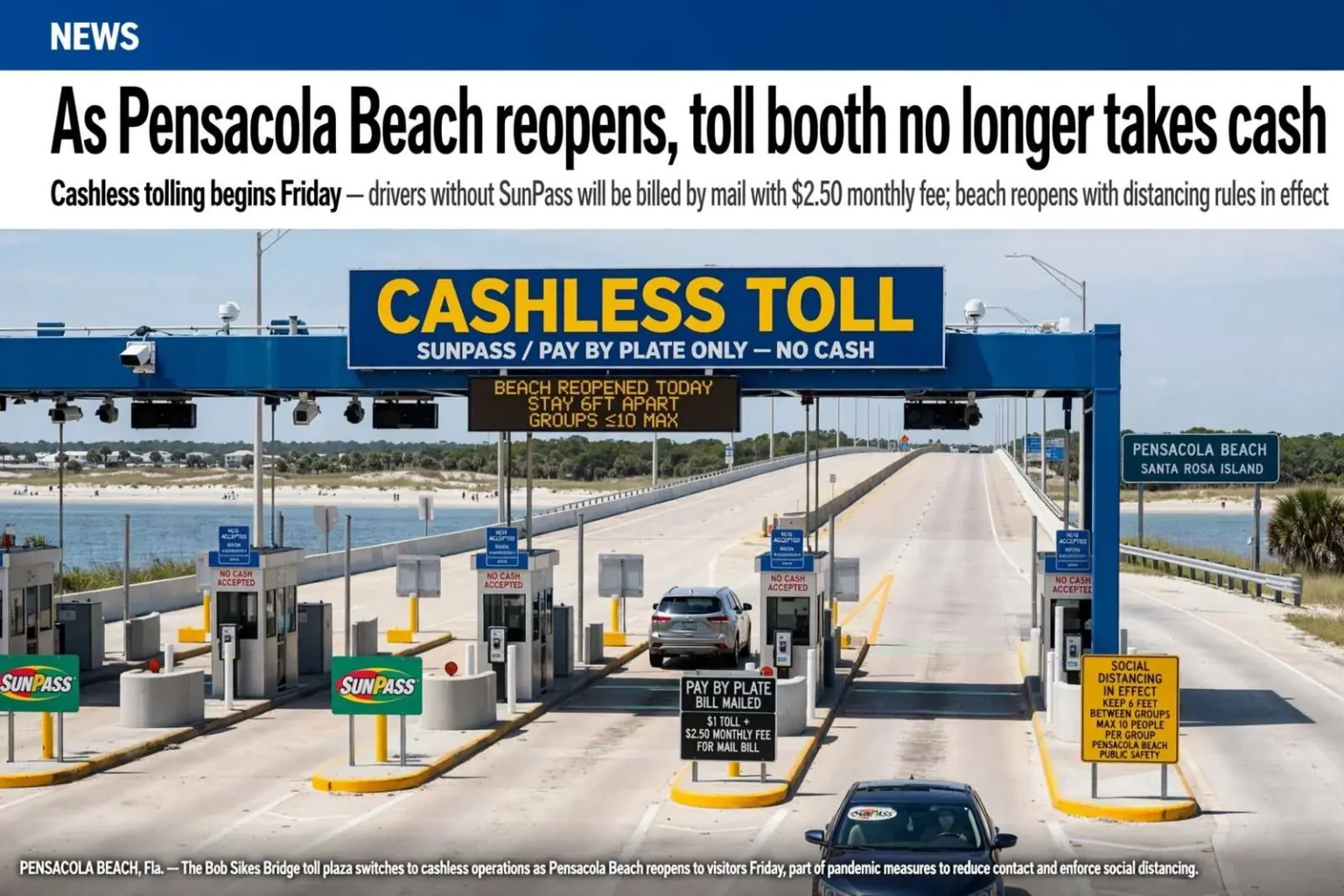
PENSACOLA BEACH, Fla. – When Pensacola Beach reopens Friday, drivers may be surprised to find they can no longer pay the $1 toll with cash. Anyone without a SunPass will drive through the toll booth and be sent a bill in the mail – an arrangement that adds a $2.50 monthly fee. The cashless setup is meant to reduce contact as the beach reopens during the coronavirus pandemic. Once on the sand, visitors will notice other changes, including signs encouraging social distancing. “We’re asking groups to stay six feet plus apart, so no groups larger than 10, and those groups stay six feet plus apart,” said Alex Johnson with Pensacola Beach Public Safety.
The toll change is the most visible of the adjustments visitors will encounter, because it affects everyone who crosses onto the island. Pensacola Beach sits on Santa Rosa Island, a barrier island reachable only by bridge, and the toll plaza on the Bob Sikes Bridge has collected its dollar from arriving vehicles for decades. Under the temporary cashless arrangement, toll booth attendants will no longer exchange cash with thousands of daily visitors. Drivers with a SunPass transponder will pay automatically as they always have. Drivers without one will pass through and receive a bill by mail, with the $2.50 monthly fee attached to that pay-by-plate billing arrangement.
For occasional visitors, the math of the temporary system matters. A family crossing the bridge once for a day trip will owe the dollar toll plus a share of the monthly administrative fee rather than simply handing over pocket change at the booth. For the many regulars who cross year-round, a SunPass avoids the fee entirely, and the reopening prompted a wave of transponder sign-ups among Gulf Coast residents who had simply never needed one before.
Why the Toll Went Cashless
The change was a public health measure, not a revenue one. Exchange points at a toll booth — cash passed hand to hand, coins counted, receipts touched — are exactly the kind of repeated surface contact that health guidance during the coronavirus pandemic urged people to avoid. Removing cash from the transaction eliminated most of that contact in a single stroke, and toll operators around the country made similar moves as the pandemic spread, accelerating a shift toward electronic tolling that had been building for years.
On Pensacola Beach, the reopening itself was the larger story. Florida’s beaches closed in waves during the spring of 2020 as the pandemic took hold, and Escambia County’s barrier island — normally humming by late April with spring and summer visitors — went quiet. The Friday reopening marked the return of the beach’s tourist economy: condominium rentals, souvenir shops, restaurants and charter businesses all dependent on the flow of visitors across the bridge. Reopening with restrictions in place was the county’s attempt to restart that economy without recreating the dense crowds that health officials warned against.
Alex Johnson’s guidance through Pensacola Beach Public Safety framed those restrictions in practical terms: groups of no more than 10, and six feet of separation between groups. The numbers matched the federal and state guidance of the period, which had settled on small gatherings and distancing as the core tools for controlling transmission in public spaces. Signs posted along the beach repeated the message where visitors would actually see it — at walkovers, parking areas and the sand itself.
What Visitors Should Expect
A trip to the beach under the reopening rules looked different from both ends. Before arriving, visitors needed to decide how they would pay the toll, since a cashless booth gives no option to a driver holding only bills. The mail-bill system relies on license plate cameras to match crossings to registered owners, so rental car drivers and visitors in borrowed vehicles needed to be alert about where the bill would land. On the island, the social distancing signs, group-size limits and public safety presence set the terms of the day.
Beach safety personnel were effectively enforcing guidance rather than the ordinary law of the sand, and the first reopened weekends tested how well voluntary compliance would hold. Crowding on a barrier island is self-limiting in some respects — parking is finite, and the island has only so many access points — but good weather weekends in the first summer of the pandemic drew crowds that sometimes pressed against the group-size guidance. Public safety staff worked to keep the messaging consistent: the beach was open, the beach was being watched, and the distancing rules were the price of keeping it open.
The Toll System Behind the Change
The Bob Sikes toll plaza is operated under the Santa Rosa Island Authority, which manages Pensacola Beach and uses toll revenue as one of the funding streams for island services and infrastructure. The dollar toll has been a fixture of island economics for generations, and debates over its level and its collection methods surface regularly among Escambia County residents. Electronic tolling through SunPass and compatible transponders predates the pandemic on the bridge, but the cashless requirement turned a convenience into a necessity almost overnight.
That pattern repeated across Florida and the wider country in 2020. Toll agencies that had spent years encouraging electronic payment found the pandemic accomplished the shift in weeks, and several made cashless operations permanent after discovering that throughput rose, queues shrank, and staffing costs fell. Whether Pensacola Beach’s cashless arrangement would outlast the pandemic remained an open question at the time of the reopening, but drivers crossing the bridge needed to operate under the temporary rules as they stood.
The $2.50 monthly fee attached to pay-by-plate billing is the standard trade in such systems: agencies save the cost of cash handling but pass an administrative charge to infrequent users who lack transponders. Frequent crossers come out ahead with a transponder; once-a-year visitors pay a premium for the convenience of not stopping. Visitors planning repeated trips during the reopened season could weigh the fee against the cost of a SunPass account and choose accordingly.
The Beach Economy Reopens
For the businesses on the island, the reopening arrived with mixed emotions. The spring season had been essentially erased, and summer rentals had been cancelled or rebooked in waves as closure dates shifted. Reopening with distancing rules in place meant reduced capacity on the sand but at least a running start on the season. Restaurants and shops adapted with their own measures — spaced seating, sanitizing routines, occupancy limits — mirroring the gradual reopening taking place across Florida that month.
The public safety message Alex Johnson delivered captured the approach the island was taking: reopen, but reopen responsibly. Groups of ten or fewer, six feet of separation, and signage everywhere reinforcing the point. For a community whose entire economy rests on people being willing to cross a bridge and spend a day on the sand, the balance between welcome and caution defined the summer of 2020 on Pensacola Beach.
Visitors heading across the bridge in the reopened weeks needed to remember three things: the toll is cashless, so a SunPass or a mailed bill is the only way through; groups should number no more than ten and stay six feet or more from other groups; and the signs posted along the beach are the operating rules of the day, enforced by the same public safety personnel who patrol the island every summer. The dollar toll still buys the same thing it always has — a day on one of the finest beaches on the Gulf Coast — it just no longer takes a dollar bill to pay for it.
SunPass and the Regional Driving Picture
For Gulf Coast travelers, SunPass is already part of the landscape. The transponder system covers Florida’s toll roads and bridges, and it interoperates with neighboring states’ electronic tolling systems, meaning a driver from Mobile or Baldwin County who has crossed Florida toll facilities before may already carry an account. Pensacola Beach’s bridge, however, is close enough to home that many local residents made the crossing for years on cash alone, never needing the transponder that Orlando or Tampa drivers take for granted. The cashless reopening converted those drivers overnight, and transponder retail locations across the Panhandle saw the surge during the reopening period.
Visitors from Alabama and beyond faced the same choice with less lead time. A family driving down from Gulf Shores or Pensacola’s mainland neighborhoods for a reopened-beach weekend could either set up a SunPass account in advance or accept the mailed bill and the monthly fee that comes with it. Either way, the days of fishing for quarters in the cupholder at the toll plaza were suspended for the duration of the arrangement.
Public Safety’s Expanded Role
Pensacola Beach Public Safety operates as a combined service on the island, and the pandemic reopening added a layer of public health communication to its usual responsibilities of beach patrol, traffic control and emergency response. Officers and lifeguards became the front line for explaining the group-size limits and distancing expectations, a role that mixed enforcement with education. Most visitors, public safety officials noted during reopenings across Florida, responded to the guidance when it was explained clearly and posted visibly, which is why the island leaned on signs as much as on patrols.
The signs themselves became part of the beach’s appearance during that period — notices at dune walkovers, on lifeguard stands and at parking entrances, restating the six-foot guidance and the ten-person group limit in plain language. Combined with the cashless toll plaza, the message to arriving visitors was consistent from the first moment they crossed the bridge: the beach is open, and the beach is different.
How long the temporary arrangements would last was the question everyone on the island was asking. Pandemic guidance evolved through the summer of 2020, and with it the specific rules governing beach capacity and gatherings. The toll arrangement, likewise, was described as a pandemic measure, to be revisited as conditions allowed. In the meantime, the reopening proceeded on the terms announced: a cashless dollar toll billed to those without a transponder, groups of ten or fewer, six feet of separation, and a public safety team working to keep the first reopened summer of the pandemic as close to a normal beach season as the circumstances allowed.