
At least one dead in two-vehicle crash at Mobile Highway and Boulder Avenue
The Florida Highway Patrol says at least one person died in a two-vehicle crash at Mobile Highway and Boulder Avenue in Escambia County, Florida.
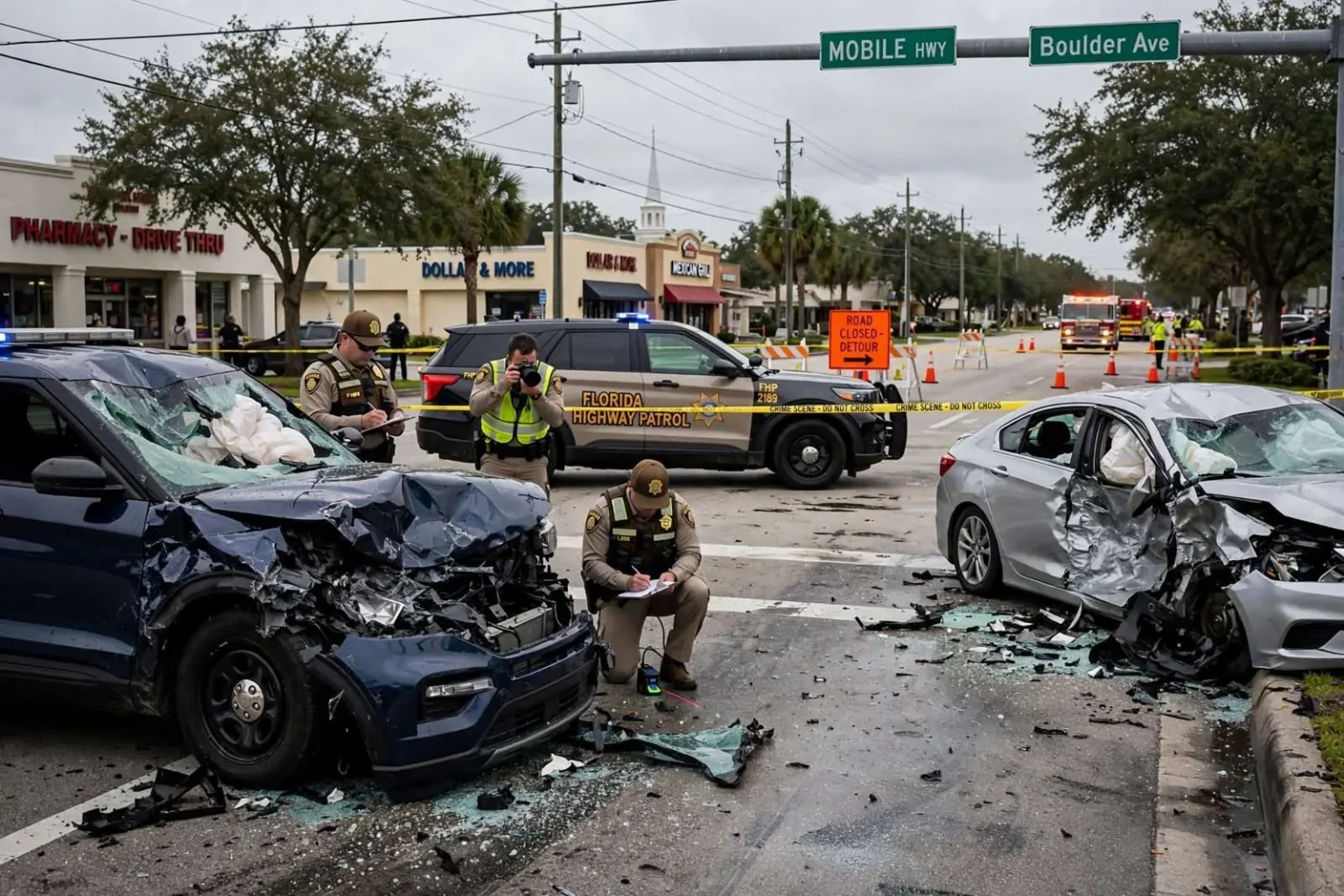
At least one person is dead after a two-vehicle crash at Mobile Highway and Boulder Avenue in Escambia County, Florida, according to the Florida Highway Patrol. Troopers said the collision involved two vehicles at the Pensacola-area intersection. Details about the number of people involved, the cause of the crash, and the identity of the victim were not immediately available as investigators worked the scene. The Florida Highway Patrol is handling the investigation into the fatal wreck.
The early stages of a fatal crash investigation are deliberately quiet. FHP troopers close the intersection, document the positions of the vehicles, photograph the scene, measure skid marks and debris fields, and interview witnesses before any official account is released. That is why, in the hours after the collision at Mobile Highway and Boulder Avenue, the basic questions remained unanswered: how many people were in each vehicle, what led one or both into the intersection, and who the victim was.
What was known came in a few plain sentences. Two vehicles collided at the intersection, which sits on Mobile Highway in the densely traveled corridor west of downtown Pensacola. At least one person died. The Florida Highway Patrol, which has jurisdiction over traffic fatalities on Florida roadways, is conducting the investigation, and its findings will eventually appear in an official report once the work at the scene and the follow-up interviews are complete.
The intersection and its corridor
Mobile Highway is the Pensacola-area stretch of U.S. Highway 90, one of the historic east-west routes across the Florida Panhandle. West of downtown Pensacola it runs through a heavily developed commercial corridor filled with shopping plazas, restaurants, churches, and neighborhoods connected by a string of cross streets, Boulder Avenue among them. The road carries a steady mix of commuters, delivery traffic, and local drivers at nearly every hour of the day.
Intersections along corridors like this one concentrate the risks of urban driving. Traffic enters and exits businesses constantly, cross streets feed vehicles into the main road at unsignalized and signalized points, and the volume of turning movements produces conflict points at a rate few rural roads approach. The stretch around Boulder Avenue serves dense residential blocks, which means drivers of every age and experience level pass through the intersection daily, on foot and behind the wheel.
When a crash at such an intersection proves fatal, it stands out even against the ordinary rate of collisions. Most wrecks on Mobile Highway end in bent metal and insurance claims; the ones that end in death usually involve speed, angle, or some combination of circumstance that the investigation will have to untangle. Until the report is finished, the intersection itself is the only suspect anyone can name.
How the Florida Highway Patrol investigates
FHP’s crash reconstruction process is thorough precisely because the stakes are higher when someone dies. Troopers responding to a fatal wreck treat the roadway as evidence: the vehicles are examined and photographed before being moved, and anything that can be measured, from the final rest positions to the scatter of glass and parts, is recorded for later analysis. Investigators use those measurements to estimate speeds, angles of impact, and the sequence of events.
Witnesses play a central role. Anyone who saw the vehicles before the collision, whether at the intersection or approaching it, is asked to provide a statement, and those accounts are compared against the physical evidence to build a timeline. In corridor crashes like this one, nearby businesses’ security cameras can also supply footage, and troopers routinely collect and review it.
The final product is an official crash report that assigns contributing factors and, where applicable, citations. Causes in intersection fatalities range across the familiar categories: failure to yield, running a signal, speed, impairment, distraction, and visibility obscured by weather or traffic. The report matters to the families involved, to any criminal proceedings that follow, and to the engineers who study whether the intersection itself needs changes in timing, signage, or signalization.
What the response looked like
A fatal crash closes an intersection, and this one was no exception. While troopers worked the scene, traffic along Mobile Highway was diverted around the blocked stretch, with drivers funneling through the neighborhood grid that parallels the corridor. Closures of that kind are an inconvenience to thousands of drivers, but they are a necessity for the investigation, because every measurement troopers take requires the roadway to remain undisturbed.
Emergency responders arriving first at a two-vehicle collision face a triage situation: checking both vehicles for occupants, calling for additional ambulances where needed, and beginning treatment for anyone who can be helped. When at least one person has died, the scene changes character. The medical response narrows to the living, and law enforcement’s role expands, since a fatality on the roadway initiates a formal investigative process that does not apply to ordinary crashes.
The Escambia County area’s emergency system handles this handoff routinely, with EMS, fire units, and FHP troopers converging on the corridor from stations across the west side of Pensacola. The presence of multiple agencies at an intersection like Mobile Highway and Boulder Avenue, even briefly, is standard for a serious wreck on a road that carries the volume this one does.
The human toll of corridor crashes
Behind the investigation’s procedural language is a death, and the announcement of a fatality sets in motion a sequence familiar to every community. A family receives the worst kind of notification. A section of a busy commercial corridor becomes, for a day, a place people point to as they pass. And the routine questions, who, why, could it have been prevented, wait on the official report.
Escambia County’s roads record fatal crashes every year, like every county in Florida, and the corridor highways that run through developed areas account for a significant share of them. Traffic safety advocates point to the pattern: the deadliest wrecks are rarely on the interstates, with their controlled access and consistent design, but on the multi-lane commercial roads where driveways, signals, and cross traffic interact all day long.
The region has invested in countermeasures over the years, from signal timing adjustments to turn lanes and improved lighting at high-crash intersections. Each fatal crash feeds that process, because FHP’s findings and the county’s own traffic studies identify which intersections need attention. Whether the Mobile Highway and Boulder Avenue crash reveals any such need will be determined by the investigation now underway.
What remains unknown and what comes next
As of the initial reports, the essentials were still open questions. The number of people involved in the two vehicles had not been confirmed, the identity of the victim had not been released, pending notification of family, and no cause had been announced. FHP typically releases its fuller account in stages: an initial confirmation, a more detailed release once the scene work is done, and the final report after reconstruction is complete.
For drivers who use the corridor, the case is another entry in the long ledger of intersection risk on Mobile Highway, and the lessons, whatever the report concludes, will be the familiar ones: approach intersections at a speed that allows for error, watch for turning vehicles, never assume the other driver will yield, and put the phone down. None of these habits is complicated, and each one addresses a factor that appears again and again in fatal intersection crashes.
The intersection itself has reopened and the traffic has resumed, as it always does. What remains is the investigation, and with it the obligation owed to the person who died and to the family left behind: an accurate account of what happened at Mobile Highway and Boulder Avenue, assembled carefully from the evidence left on the pavement.
Driving the Mobile Highway corridor
Anyone who regularly travels Mobile Highway west of Pensacola knows its rhythm. The road widens and narrows, signals come in clusters, and every block seems to add another driveway to the traffic mix. Boulder Avenue is one of the residential cross streets that tie the neighborhoods along the corridor into the commercial strip, and vehicles turning on and off the highway at such points make up a large share of the daily conflict that drivers must negotiate.
Local drivers tend to develop corridor habits: known trouble spots where they slow down, intersections where left turns require patience, and stretches where visibility is limited by traffic in the adjacent lanes. These habits matter because corridor crashes are frequently caused not by exotic failures but by an ordinary maneuver, a turn or a pullout, executed into a gap that was not really there.
The presence of heavy pedestrian and local traffic is part of what distinguishes an intersection like this from the high-speed rural stretches of U.S. 90 farther out. A collision at a neighborhood cross street happens at lower speeds but with more vehicles and people around, and the outcome depends on angles, restraint use, and chance as much as on speed itself.
After the report is finished
When FHP’s investigation concludes, its findings become part of the public record, available to the families, the courts, and the county. If the evidence points to a violation, criminal charges may follow; if it points to a roadway problem, the crash joins the data set that traffic engineers use to prioritize improvements. Most often, it points to a combination of ordinary failures that together produced an extraordinary outcome.
For the community along the corridor, the report will also answer the question everyone asks after a fatal wreck: could it have been me? The honest answer, whatever the details, is that intersection safety depends on the cooperation of every driver who passes through, and that cooperation is renewed or broken at each green light.
The Florida Highway Patrol’s work at Mobile Highway and Boulder Avenue proceeds on that premise. Two vehicles, at least one life lost, and a set of questions that only patient investigation can answer: that is where the case stands, and the corridor’s traffic, carrying thousands of drivers past the spot each day, waits for the same answers.


