Atmore Artist Kathleen Nowak Tucci’s Recycled Jewelry Lands on the Cover of Vogue Italia
Atmore artist Kathleen Nowak Tucci was astonished when her recycled rubber necklace landed on the cover of Vogue Italia.
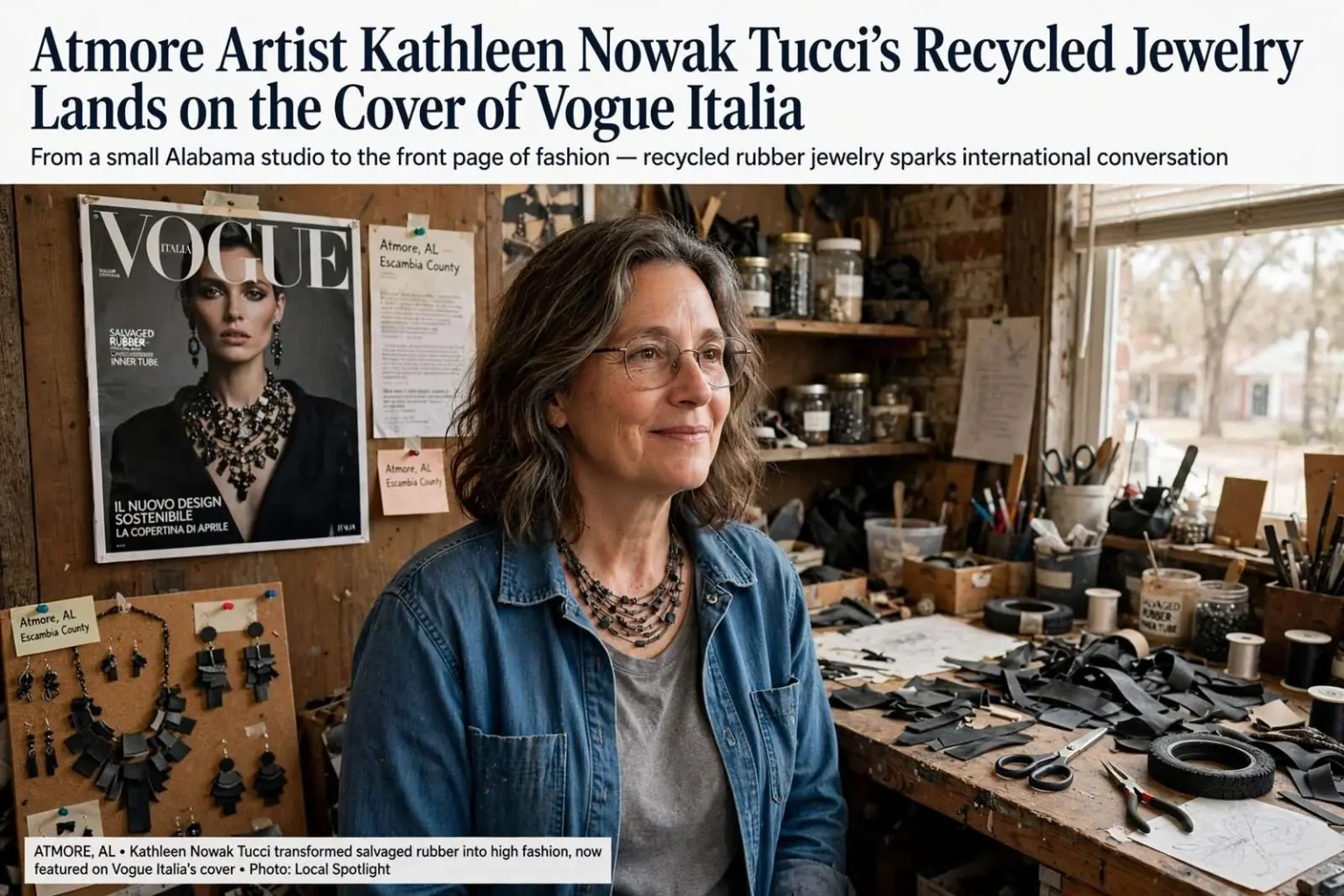
An Atmore artist found her work on one of the most conspicuous stages in fashion. Kathleen Nowak Tucci says she was astonished to learn that one of her necklaces, crafted from recycled rubber, appeared around the neck of an haute-couture model on the cover of Vogue Italia.
The cover proved controversial in fashion circles, but for Tucci it marked an unlikely journey from her Escambia County studio to the front of a major international magazine — and a showcase for the idea that discarded materials can become fine art.
Tucci has built her reputation on transforming salvaged rubber and other castoff materials into intricate, wearable jewelry, work that sits at the crossroads of folk craft, environmental art and high design. The Vogue Italia placement introduced her recycled pieces to an audience far beyond south Alabama.
From Atmore to the fashion world’s front page
Atmore sits in the northern reaches of Escambia County, a small city near the Florida line best known to travelers as a stop along Interstate 65 between Mobile and Montgomery. It is a long way — culturally and geographically — from the Milan editorial offices that decide what appears on the cover of Vogue Italia, one of the most influential fashion magazines in the world. The Italian edition has historically served as the artistic wing of the Vogue family, favoring bold, sometimes provocative imagery over the safer commerce-driven covers of its siblings, and that sensibility is what carried a necklace made of rubber remnants onto its front page.
The controversy the cover stirred in fashion circles says as much about the industry as about the artwork. High fashion has long flirted with recycled and found materials, but a cover is the industry’s most scrutinized real estate, and purists debated whether jewelry made from discarded rubber belonged there alongside couture gowns worth tens of thousands of dollars. The debate, whatever its conclusion, achieved what publicity rarely does for a self-taught artist: it put her name, her method and her hometown into fashion conversations on multiple continents.
For Tucci, the astonishment she described was understandable. A cover appearance of that kind typically goes to pieces commissioned through fashion houses and stylists with budgets to match. A handmade necklace constructed from salvaged material in a small Alabama studio reaching that platform through the pull of its own design is a rarity — and it validated the artistic bet she had made years earlier, that materials others throw away can carry real aesthetic weight.
Turning castoffs into fine craft
Tucci’s medium sets her apart in Alabama’s folk and self-taught art community, a tradition rich in artists who build serious work from whatever is at hand. Her necklaces, earrings and other pieces take salvaged rubber — the kind of material destined for landfills — and cut, shape and assemble it into intricate, wearable forms. The resulting jewelry reads two ways at once: from across a room it carries the ornate silhouette of fine beadwork or metalwork, while up close the transformed industrial material announces itself, turning each piece into a quiet argument about waste and value.
That dual identity is what attracted attention beyond the craft world. Environmental art has grown from a niche concern into a mainstream current, as collectors, curators and consumers look for work that embodies sustainability rather than merely decorating it. Jewelry made from recycled materials occupies a sweet spot in that movement: it is intimate, worn against the skin, and visible in daily life, so its story travels with the person wearing it. A sculpture about recycling sits in a room; a necklace made of reclaimed rubber walks the streets and starts conversations.
Her practice also connects to a broader regional lineage. The Gulf South has produced generations of self-taught artists who turned available materials into distinctive work — a tradition rooted in both necessity and resourcefulness across the rural South. Tucci’s work extends that lineage into contemporary environmental design, and her success illustrates how the region’s folk traditions can leap directly into international markets when the work is strong enough to speak for itself.
What the exposure means for a working artist
For an artist working outside the commercial gallery mainstream, a single international placement changes the shape of a career. The economics of craft are unforgiving: most makers support their practice through regional shows, local galleries and commissions, and the audience for that work is bounded by geography. A Vogue Italia cover is effectively a global endorsement. It reaches stylists, collectors and gallery owners who will never pass through Atmore, and it re-prices the work in the eyes of everyone who sees it — not because the material changed, but because the context did.
The placement also carries lessons for Alabama’s wider arts community. The state’s self-taught and folk artists have historically been discovered by outside institutions — collectors and curators from Atlanta, New York and beyond who recognized value that local markets did not. Tucci’s story follows that pattern but adds a modern twist: the discovery pathway ran through fashion media rather than folk art collections, demonstrating that today’s outside attention can arrive through unexpected doors. An artist working in a small Escambia County studio does not need to relocate to New York; the work, if distinctive enough, can travel instead.
For south Alabama, the story is a small but genuine economic signal. The region has worked to diversify its identity beyond petrochemicals, timber and tourism, and homegrown success stories in creative fields feed that effort. Every artist whose work reaches a national or international audience makes it easier for the next one — easier to find galleries willing to show Alabama work, easier to justify the state’s investment in arts programming, and easier for a young artist in Atmore or Monroeville or Bayou La Batre to believe that the studio in the back room can connect to the wider world.
The unlikely marriage of salvage and couture
The tension that made the cover controversial is the same tension that makes the work interesting. Haute couture trades in rarity — handmade garments produced in tiny quantities for clients who treat them as investments. Recycled rubber is, by definition, common: the material’s whole artistic point is that the world is full of it and wants rid of it. Placing the second on the cover of fashion’s most daring publication forced those two value systems into the same frame, and the fashion world’s argument about it was really an argument about whether artistry or materials confer worth.
Tucci’s answer, embodied in the work itself, is that artistry confers worth — that the hand that cuts, shapes and assembles the salvaged material is the value, not the raw stock. It is an old idea in craft, where quilts made of fabric scraps became American treasures and Depression-era folk art built beauty from nothing. It is a new idea in fashion, where sustainability has moved from marketing language to actual design practice, and designers increasingly mine discard streams for materials that photograph beautifully and tell a story buyers want to wear.
That the necklace appeared on an haute-couture model only sharpens the statement. Fashion photography builds its imagery around the garment and the model; accessories usually support the composition. A recycled piece claiming the cover slot inverts the hierarchy, letting a studio practice from Escambia County carry the image’s meaning. Whatever the fashion circles decided about it, the picture made Tucci’s argument for her.
For Tucci, whose astonishment at the news was plain, the cover marked the moment her improbable medium — junk rubber, cut into art — reached the widest audience an object can have. From a workshop in Atmore to a newsstand in Milan, the journey of one necklace said something durable about south Alabama’s creative reach: that serious work can be made anywhere, from anything, and the world will notice when it is.
The world of self-taught Alabama artists offers useful context for understanding how a cover placement of this kind happens. Collectors of Southern folk art have long scoured the region’s studios, churches and roadside stands for work with a singular voice, and Alabama names hold permanent places in that canon. Museums dedicated to self-taught art across the South draw visitors precisely because this work cannot be replicated by trained insiders — it carries the imprint of its maker’s particular circumstances, materials and place. Tucci’s recycled jewelry fits squarely within that tradition while extending it into a form, wearable design, that bridges to the commercial world.
Rubber itself is an interesting artistic material with a growing following. salvaged inner tubes and industrial rubber scrap have become a staple of contemporary eco-design, prized for its durability, its matte black texture and its working qualities — it cuts cleanly, holds a shape and weathers well. Wearable pieces made from it are lighter than metal, forgiving on the skin and unmistakable at a glance. What Tucci does with the material — building intricate, layered compositions rather than simple bands and hoops — is where the craft separates itself from the many casual upcycling projects the sustainability boom has produced.
The attention also lands in a community that has learned to make the most of it. Atmore and the surrounding Escambia County communities have watched their economic base shift over the decades, and local leaders have promoted cultural assets — from the Poarch Band of Creek Indians’ developments nearby to the town’s historic district — as part of a diversification strategy. A hometown artist appearing on an international magazine cover is exactly the kind of story a small city can build on: it becomes a point of pride, a tourism reference and a credential for the region’s creative economy all at once.