All Aboard for a Whodunit: Atmore’s Community Theatre Stages ‘Murder on the 518’
The Greater Escambia Council for the Arts opens its summer murder mystery in downtown Atmore, with performances across two weekends, twelve-dollar tickets, and a train car full of suspects.
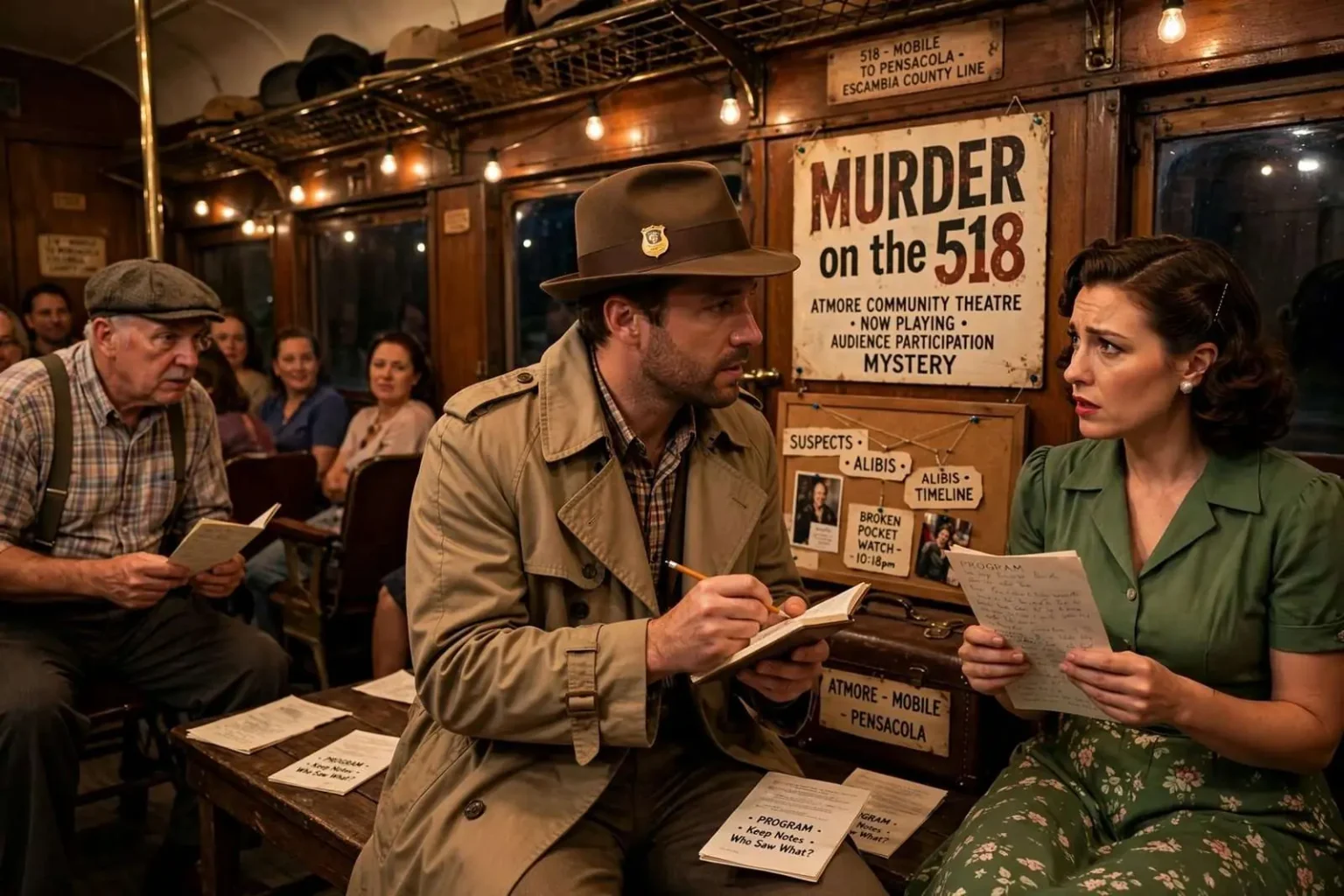
All Aboard for a Whodunit: Atmore’s Community Theatre Stages its latest production, a classic murder mystery that pulls the audience into the action from the moment the curtain rises. The community theatre’s run of performances has become a staple of Atmore’s cultural calendar, and this latest show leans into the kind of audience participation that has made the troupe’s mystery nights a perennial favorite.
The production is built around a familiar setup: a closed circle of suspects, a crime that seems to defy explanation, and a detective whose job it is to walk the audience through the clues until the killer is unmasked. What sets the Atmore Community Theatre’s production apart is the level of interaction built into the script, with cast members circulating through the audience between scenes and inviting patrons to question them about where they were and what they saw at the moment of the crime.
Why Mystery Productions Travel Well
Murder mystery productions are a staple of community theatre programming across the country for a simple reason: the format invites participation in a way that straight plays rarely do. Audiences who might sit quietly through a drama or musical often find themselves leaning forward during a mystery, eager to spot the clue that the detective has missed or to test their own theories against the evidence as it unfolds. That engagement is what makes the format well suited to volunteer-driven community productions, where the energy in the room matters as much as the technical polish of the performance.
The Atmore Community Theatre has leaned into that engagement with this latest production, building the script around a handful of suspects whose motives are clear but whose alibis are not. Patrons who attend the show are encouraged to keep their programs handy and to mark down anything that strikes them as suspicious, because the resolution at the end of the night often turns on a detail that seemed trivial when it was first introduced.
Atmore’s Place on the Cultural Map
Atmore, the Escambia County community that hosts the theatre, sits along the rail line that runs between Mobile and Pensacola, and the city’s history is tightly bound up with the timber and railroad industries that shaped inland South Alabama for more than a century. The community theatre’s productions draw on that history in subtle ways, from the kinds of stories the troupe selects to the volunteers who build sets, sew costumes and run the box office. Each production is, in its own way, an extension of the civic life that has defined the town since its founding.
The community theatre itself has been a fixture of Atmore’s cultural scene for years, putting on a mix of comedies, dramas and musicals in addition to the mystery nights that draw the biggest crowds. The troupe performs at a local venue that has been adapted for theatrical use, and the volunteers who run the organization include actors, directors, designers and crew members whose day jobs range from teaching to retail to local government. The production that is currently on stage is the latest in a long line of community efforts to bring live theatre to Atmore on a regular basis.
What Audiences Can Expect
Patrons who attend the show should expect to be drawn into the action from the opening scene. The script is structured so that the crime happens early in the evening and the detective’s investigation carries the rest of the runtime, with breaks for the audience to question the suspects, examine the clues and compare notes with their fellow theatergoers. The cast is trained to stay in character throughout the evening, so even conversations in the lobby between scenes can become opportunities to extract information from a suspect.
The production is suitable for a wide range of ages, though parents of younger children should know that the script includes the kind of theatrical violence implied by any murder mystery. The community theatre has typically priced tickets affordably to encourage families to attend together, and the run of performances is usually long enough to accommodate multiple visits from repeat patrons who want to see whether their theories hold up on a second viewing.
How to Get Tickets
Tickets for the current production are available through the Atmore Community Theatre’s usual channels, including at the door on the night of the performance and in advance through the troupe’s volunteer ticket sellers. Show times and dates are listed in the community calendar section of the local newspaper and on the theatre’s social media pages, where volunteers also post photos from rehearsals and behind-the-scenes updates as opening night approaches.
For residents of Atmore and the surrounding Escambia County communities, the production is also an opportunity to support local arts in a tangible way. Community theatres rely on ticket revenue, concession sales and donor contributions to keep their seasons going, and a strong turnout for a mystery production helps the troupe plan its next show with confidence that there is an audience willing to show up.
Why Mystery Productions Are a Community Tradition
Murder mystery productions have a long history in community theatre programming because the format makes the audience part of the show. Unlike a straight play or musical, where the audience’s role is to watch and react, a mystery asks patrons to participate actively, asking questions of the suspects, weighing alibis and trying to solve the crime before the detective reveals the answer at the end of the night. That interaction is what makes mystery productions feel like a community event rather than a passive entertainment experience.
The Atmore Community Theatre’s latest production is built to maximize that participation. Cast members move through the audience between scenes, allowing patrons to question them about where they were at the time of the crime and what they saw. Programs are distributed with space for notes, and the detective’s final monologue walks the audience through the clues in order, so anyone who has been paying attention can check their own theory against the solution. The format rewards repeat viewing, and the troupe has typically seen strong return attendance across the run of a mystery production.
What the Production Reveals About Atmore
The fact that Atmore sustains a community theatre capable of producing interactive mystery shows is itself a reflection of the town’s civic character. Productions of this kind require a stable of volunteers who are willing to commit to weeks of rehearsals, build sets, sew costumes and run the box office, all in addition to whatever they do for a living. The volunteers who turn out for Atmore Community Theatre productions include retired teachers, current high school students, local business owners and people who simply enjoy live performance and want to support it.
The variety of the troupe’s programming — mysteries, comedies, dramas and musicals across the year — also reflects a community that takes its cultural life seriously. Audiences in Atmore have come to expect a regular slate of productions from the community theatre, and the volunteers who run the organization plan their seasons accordingly. Mystery productions are often the most popular entries on the calendar, both because the format invites participation and because the scripts lend themselves to a wide range of casting choices.
Looking Ahead to the Next Production
The mystery production currently on stage at the Atmore Community Theatre will run for several weekends before the troupe turns its attention to the next entry on the season calendar. Audiences who want to catch the show should check the community calendar for specific dates and show times, and tickets are typically available at the door on the night of each performance. The troupe’s social media pages also post updates about upcoming productions, auditions and volunteer opportunities for anyone who wants to get involved in the next show.
For residents who have not yet attended a community theatre production in Atmore, the mystery currently on stage is a good introduction. The interactive format is welcoming to first-time attendees, and the production’s emphasis on audience engagement means that even newcomers will find themselves drawn into the action from the opening scene.
For patrons planning to attend, the community theatre typically recommends arriving a few minutes before curtain to pick up tickets and programs. The lobby is often staffed by volunteers who can answer questions about the production and about the troupe’s upcoming season, and refreshments are sometimes available before the show and during intermission.
The troupe’s next auditions will be posted on its social media pages in the weeks following the close of the current mystery run, and volunteers are typically needed both on stage and behind the scenes. Anyone interested in supporting the Atmore Community Theatre, whether by acting, building sets or helping with concessions, can find contact information through the troupe’s usual channels.