Atmore Lions Pack 70 Diabetic Supply Bags for Escambia County Schools, Buses and Classrooms
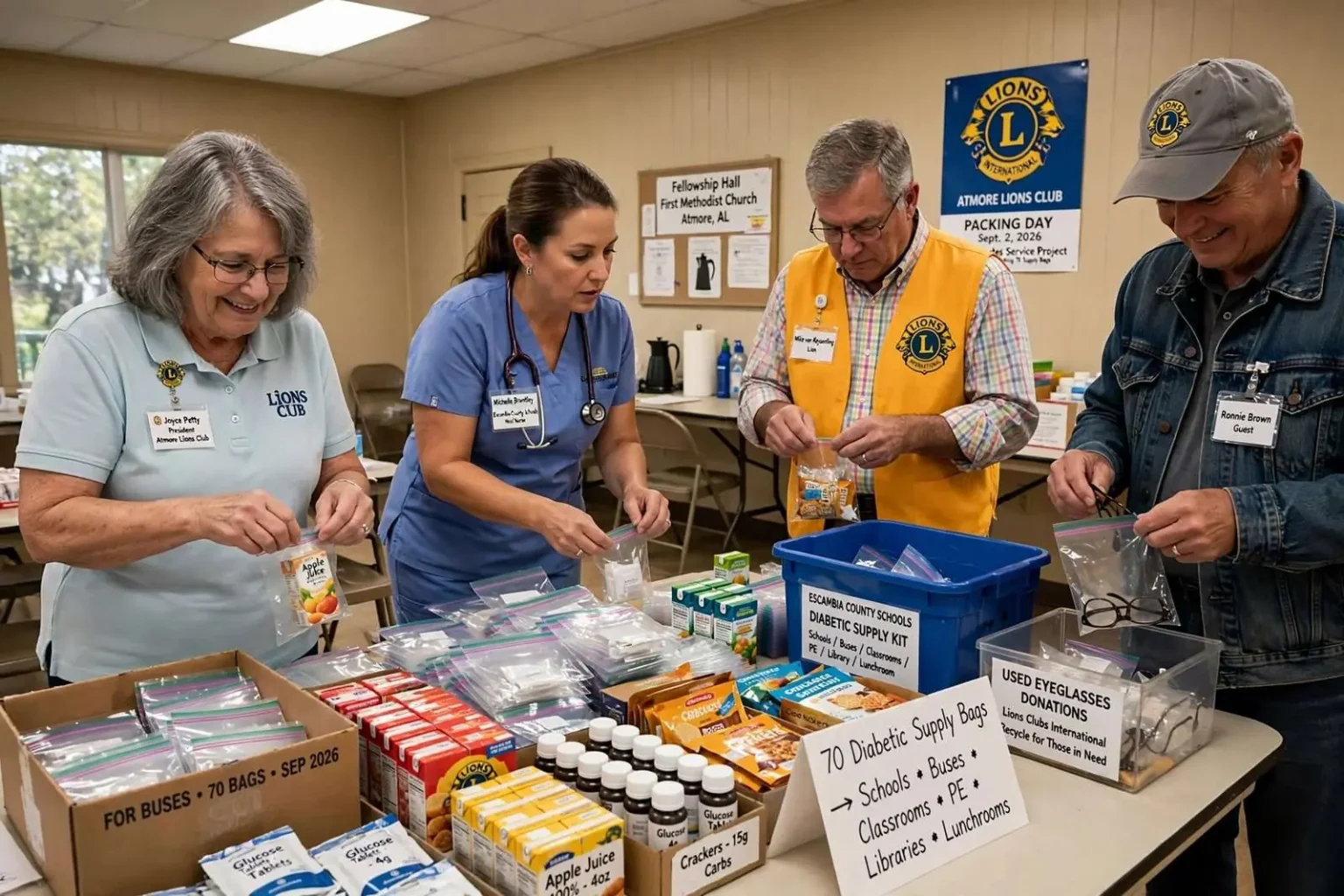
Members of the Atmore Lions Club filled 70 zip lock supply bags at their Sept. 2 meeting for students with diabetes across the Escambia County School System, after hearing from head school nurse Michelle Brantley.
The work that happens in the fellowship hall of a small-town church rarely makes the news, which is a shame, because a fair amount of it ends up mattering a great deal to somebody at three in the afternoon on a school bus.
The Atmore Lions Club met at First Methodist Church on Sept. 2, 2026, and spent part of the meeting doing exactly that kind of work. Members filled 70 zip lock bags with food items that will be distributed across the Escambia County School System for use when a student with diabetes runs into trouble during the school day.
President Joyce Petty called the meeting to order and led the Pledge of Allegiance to the flag. Lion Mike von Keyserling gave the blessing. Lion Sara Smith was in charge of the program and introduced the guests who explained why the bags are needed.
The Program: A School Nurse Explains the Need
Smith introduced Michelle Brantley, head nurse for the Escambia County School System, and Teresa Gohagan.
The two women walked members through how the system handles students with diabetes day to day, and through what has to be stocked at each individual site so that staff can respond if a student has a diabetic problem during the school day or while riding a bus.
That last phrase — on each site — is the heart of the request, and it is worth unpacking for anyone who has not thought about how diabetes care works inside a school district.
A student with diabetes does not spend the day in one room. The day runs through a classroom, a hallway, a cafeteria, a gymnasium or practice field, a library, and, at both ends, a bus. Blood sugar does not check a schedule before it drops. Low blood sugar — hypoglycemia — can come on quickly, and the standard response is straightforward but time-sensitive: get fast-acting carbohydrate into the student, wait, and check again. The widely used guidance is roughly 15 grams of quick carbohydrate followed by a 15-minute wait and a recheck, repeated if the number has not come up.
None of that works if the supplies are locked in an office on the other side of campus. The response has to be where the student is. That is why a district does not stock one central box; it stocks many, and it puts them everywhere a student actually goes.
Where the 70 Bags Are Going
For another year running, the club is supplying the food items that go into those boxes. Members formed their usual assembly line, filling zip lock bags that will then be loaded into the plastic boxes the school system had already supplied.
The group completed 70 bags, which will supply:
- schools across the system
- buses that carry diabetic students
- PE areas
- libraries
- lunch rooms
- the classrooms of students with diabetes
The bus item on that list deserves particular attention in a county like Escambia. Bus routes in rural Alabama cover long distances and long minutes. A student can be on a bus for the better part of an hour at each end of the day, moving through territory where the nearest school building is well behind them and the nearest clinic is not close. A supply bag riding on the bus is not a redundancy. For part of every school day, it is the only thing on board.
The assembly line detail is also more than color. Packing 70 identical bags by hand is a task that goes badly when everyone works independently and well when the job is broken into stations. It is the reason a club meeting can produce a full year’s district supply in a single sitting.
Why Schools Keep Diabetes Supplies On Site
Diabetes is one of the most common chronic conditions among school-age children, and it is one of the few that can require intervention in the middle of a school day, in a classroom, from an adult who is not a medical professional.
Students with Type 1 diabetes generally manage the condition continuously — monitoring blood glucose, counting carbohydrates and dosing insulin — and the balance between insulin, food and activity shifts constantly. A missed snack, a hard PE class, an unusually long bus ride, a growth spurt or an ordinary childhood illness can all push blood sugar in a direction the morning plan did not anticipate. That is why students with diabetes typically have a written plan on file at school and legal protections that require the district to accommodate their care. It is also why supplies belong in the places where those swings actually occur.
School nurses are the professionals who make that system work, and in most districts there are fewer of them than there are buildings. A head nurse like Brantley is responsible for policy, training and supply across an entire system — which in practice means preparing teachers, coaches, librarians, cafeteria staff and bus drivers to recognize a problem and respond correctly before anyone with a nursing license can get there.
Preparation of that kind depends on two things: training, which the district provides, and stocked supplies at every site, which cost money the district must find somewhere in a budget already fully committed. That second half is where an outside partner can do something genuinely useful.
What Lions Clubs Do, and Why This Fits
Lions Clubs International was founded in 1917 and grew into one of the largest volunteer service organizations in the world, built around local clubs that pick projects in their own communities rather than taking assignments from a headquarters.
The organization’s best-known cause is vision. In 1925, Helen Keller addressed the Lions’ international convention and challenged the members to become “knights of the blind,” and Lions have organized their identity around sight ever since — vision screenings, assistance with eye care and, most visibly, the collection and recycling of used eyeglasses for people who cannot afford them.
Diabetes sits alongside that work for a reason that is more than thematic. Diabetes is a leading cause of preventable vision loss, and Lions Clubs International has made diabetes one of its formal global service priorities, encouraging clubs to take on screening, education and support projects. A club packing supply bags so a school district can respond to hypoglycemia is doing local, practical work inside a cause its organization has adopted worldwide.
Both halves of that mission turned up on the same table in Atmore. Ronnie Brown, introduced as a guest at the meeting, arrived carrying a bag of used eyeglasses to donate to the club — and then stayed and worked the line filling the diabetic bags. Recycled glasses coming in, supply bags going out, handled by the same visitor in the same hour.
How Civic Clubs and School Systems Work Together
The partnership on display here follows a pattern that plays out in small districts all over the country, and it works because each side supplies what the other lacks.
The school system supplies the expertise and the infrastructure. Brantley’s office knows which students need supplies, which sites need boxes, what should go in them and how the contents should be used. The district also supplied the plastic boxes the bags go into. None of that can be outsourced; it requires clinical judgment and knowledge of individual students’ plans.
The club supplies labor, money and continuity. A civic organization can absorb a recurring supply cost that would otherwise compete with textbooks and fuel, and it can put a dozen pairs of hands on a repetitive task at no cost to the district. Just as importantly, a club shows up every year. “Again this year” is the phrase that turns a nice gesture into something a school nurse can plan around.
That reliability is the whole value. A district can only build a supply program into its procedures if it knows the supplies will be there next August, and the next one after that.
The arrangement also produces a quieter benefit. When members of a service club spend an hour packing bags after hearing a school nurse explain what those bags are for, a group of adults in the community ends up understanding something about how diabetes affects local children that they did not understand before. Civic clubs are, among other things, a distribution network for that kind of knowledge.
Also On the Agenda
In other business, the club discussed the Christmas parade, William Station Day, the Auburn-Alabama food drive and Taste of the South participation.
Those four items are a reasonable summary of what a service club does across a calendar year. A Christmas parade is community-building of the most visible kind, the sort of event whose absence a town notices immediately. William Station Day is a fixture on the local fall calendar and the kind of event that depends on volunteers to run. Taste of the South is a community gathering that clubs typically staff and support.
The Auburn-Alabama food drive is a small piece of local ingenuity worth naming. Alabama’s in-state college football rivalry, the Iron Bowl, divides households, workplaces and church pews across the state every November. Turning that rivalry into a competitive canned-goods collection converts a season of trash talk into food on a pantry shelf — and gets people to donate who might not have responded to a plain request.
The Value of the Ordinary Meeting
Nothing that happened in that fellowship hall on Sept. 2 was dramatic. A president called a meeting to order. A member gave the blessing. A program chair introduced two guests. A school nurse explained a need. Members formed a line and filled bags. A visitor dropped off used eyeglasses and stayed to help.
The output was 70 bags — enough to put a response within reach in classrooms, cafeterias, libraries, gyms and buses across a rural school system for another year.
Most of those bags will never be opened. That is the point. They exist so that on the day one is needed, in a gymnasium or on a county road twenty minutes from campus, the adult standing next to the student has something to reach for.