Wind Creek Casino and Hotel Raised Development Hopes in Atmore in 2008
The construction of Wind Creek Casino and Hotel in Atmore raised expectations in 2008 for tourism, interstate-exit development and new business activity near Interstate 65.
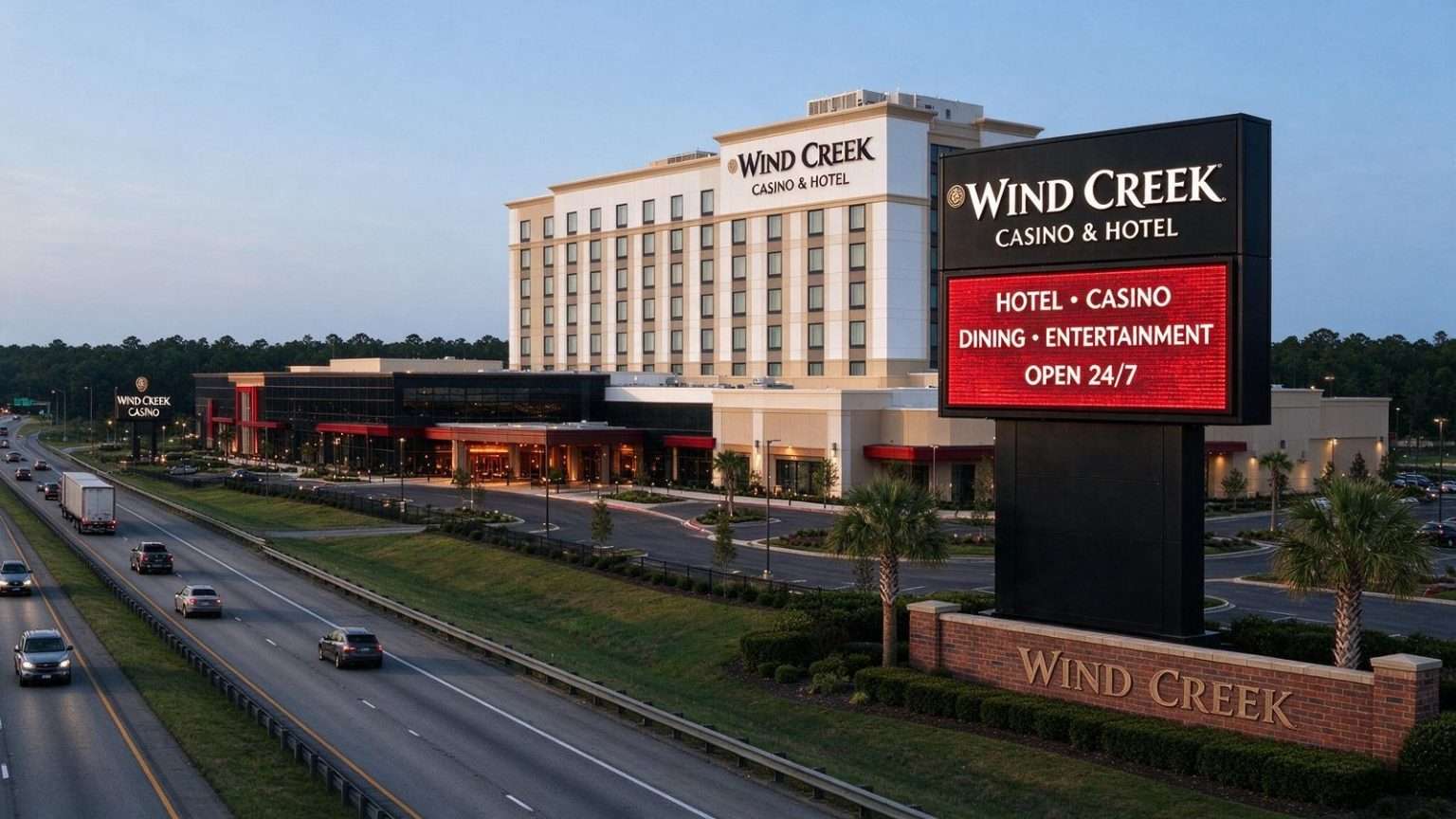
Construction of the Wind Creek Casino and Hotel in Atmore raised expectations in 2008 for tourism and new development near Interstate 65. The project was planned on a 35-acre site and included a casino with 1,600 electronic bingo games, a 236-room hotel and a 65-foot electronic sign intended to draw the attention of interstate travelers.
For Atmore, a city of roughly 7,000 in Escambia County, the project represented the largest single development the area had seen in years. The town sits along Interstate 65 about 50 miles northeast of Mobile, positioned on the corridor that carries travelers between Alabama’s port city and Montgomery. Thousands of vehicles pass the Atmore exits every day, and the casino’s planners counted on that traffic — hence the towering electronic sign, designed to be visible from the interstate and to pull travelers off the highway for a stop they had not planned.
The scale of the development set it apart from anything else on the northern edge of Escambia County. A 236-room hotel would rank among the larger lodging properties in south Alabama outside Mobile itself, and the casino floor’s 1,600 electronic bingo machines made it a major gaming destination by the standards of the region. Construction activity alone — earthmoving, concrete, steel and trades work on a 35-acre campus — brought paychecks and contractors into the local economy before a single guest arrived.
Expectations for Highway-Area Growth
Tribal leaders hoped the facility would develop a reputation as a destination resort. A nearby real-estate agent said the casino and a planned city-owned business park across Highway 21 could create the kind of interstate-exit growth seen in other parts of the country.
The comparison the realtor drew was to a familiar American pattern: the interchange developments that spring up around major highway exits when an anchor attraction lands nearby. Gas stations and restaurants arrive first, then chain hotels, then retail, until the exit becomes a small commercial district of its own. Atmore’s civic leadership saw the casino as exactly that kind of anchor, with the added advantage of drawing visitors from out of state rather than only serving local demand.
The planned city-owned business park across Highway 21 was the other half of that vision. Where the casino would bring visitors, the business park was intended to bring employers — businesses seeking a location with interstate frontage, available land and a community positioned to grow around them. The two projects were discussed together as complementary pieces: one generating traffic and tax revenue, the other providing the sites and infrastructure to convert that momentum into lasting jobs.
The Poarch Band of Creek Indians, whose reservation sits adjacent to Atmore and whose members make up a significant part of the community, drove the project. Gaming operations had already transformed the tribe’s economic position in the region, and the casino-and-hotel combination was designed to move the operation upmarket — from a gaming hall toward a resort that could host conventions, banquets and overnight stays. A destination property keeps visitors in town longer, spending at the casino, the hotel and increasingly at businesses around the interchange.
The Timeline as Reported
The report said the casino was expected to open in January, followed by the hotel in February. The staggered schedule was typical of large hospitality projects: the gaming floor generates revenue from the day it opens, so operators bring it online as soon as regulatory approvals and construction allow, with the hotel tower following once its interiors are finished.
Local anticipation in late 2008 ran high on both sides of the project. Casino jobs — dealers, cashiers, food service, housekeeping, security and management — promised a significant payroll in a county where manufacturing and agriculture had long anchored employment. The hotel added construction jobs in the near term and hospitality positions afterward. For a community that had watched younger residents leave for Mobile and Pensacola for work, the prospect of hundreds of jobs within the city limits carried weight beyond the numbers.
The timing also collided with a difficult economic moment. The autumn of 2008 brought the financial crisis and the beginning of a deep national recession, with fuel prices, travel patterns and discretionary spending all in flux. Whether interstate travelers would keep stopping — and whether conventions and group travel would materialize on schedule — was among the questions hovering over the project’s opening months. Optimists pointed to the property’s location on a busy corridor and argued that a convenient stop between Mobile and Montgomery would hold its own in any economy.
A Historical Development Account
This article records plans and expectations reported in 2008. It does not state the project’s eventual opening dates, financial results or later changes to the site.
That historical framing matters for readers encountering the story years later. The figures presented here — the 35-acre site, the 1,600 electronic bingo games, the 236-room hotel, the 65-foot sign, the January and February opening expectations — are the plans as they stood when the project was reported, not a verified account of what ultimately was built, opened or revised. Development projects of this scale routinely change between announcement and completion, and Wind Creek’s story continued to evolve well beyond 2008.
What the 2008 record preserves is the moment of expectation itself: a small south Alabama city watching a tribal gaming enterprise bet heavily on its future, civic leaders planning a business park to catch the spillover, and a realtor predicting the kind of interchange growth that had transformed exits across the country. For historians of the region’s economy, the account captures a turning point in the relationship between the Poarch Band of Creek Indians and the surrounding community — one in which the tribe’s development ambitions and the city’s growth hopes pointed, for once, in exactly the same direction.
Readers seeking the facility’s later history — its openings, expansions and current offerings — should consult up-to-date sources, since the project described here grew and changed substantially in the years after these plans were reported.
Atmore’s Place on the Interstate Corridor
To understand the expectations of 2008, it helps to understand Atmore’s geography and history. The city grew up around the railroad in the late 19th century, serving the timber and cotton economy of Escambia County, and later became a stop along Interstate 65 between two of the Gulf Coast region’s larger economies — Mobile to the southwest and the Montgomery area to the northeast. That position put the town within easy driving distance of hundreds of thousands of potential visitors without requiring any of them to detour from their route.
Interstate-exit economics had already reshaped communities across Alabama. Towns that once depended on downtown storefronts saw their commercial centers migrate to the highway interchanges, where truck stops, fast food and motels clustered around the flow of through traffic. What most interchange districts lacked was an anchor — a destination big enough to make travelers plan a stop rather than stumble into one. The casino-and-hotel combination was meant to be that anchor for Atmore, and the 65-foot electronic sign was its billboard to the passing world.
The city-owned business park planned across Highway 21 reflected lessons learned from watching other Alabama towns court industry. Sites served by utilities, zoned and ready for construction, give a community a chance at employers that would never consider building their own infrastructure from scratch. Combined with the visitor traffic a casino generates, the park’s planners argued, Atmore could offer businesses something rare in rural south Alabama: an interchange location with destination draws, available land and a workforce staying local for casino jobs.
Gaming and the Poarch Band’s Economic Rise
The Wind Creek project sat within a larger story: the rise of the Poarch Band of Creek Indians as an economic force in south Alabama. The tribe, the only federally recognized tribe in the state, had built its gaming operations from bingo halls into substantial enterprises during the 1990s and 2000s, and by 2008 was among the largest employers in its corner of the state. Gaming revenue funded tribal services, health care and education, and the move toward destination-scale facilities marked the enterprise’s next phase.
For the Atmore community, the relationship was symbiotic. The tribe’s developments sat beside the city, drawing workers, contractors and vendors from the local economy, while the city’s services and housing absorbed the growth. The 2008 reporting captured civic leaders treating the casino not as a competitor for the local entertainment dollar but as the cornerstone of a shared development strategy — the anchor around which the business park, the highway corridor and the city’s own planning were expected to organize.
As recorded at the time, the pieces were all in place: the site acquired and under construction, the game count and hotel size set, the sign designed and the opening dates on the calendar. What the months after January and February 2008 would actually bring — the financial results, the revisions, the growth that followed or failed to — lies beyond this account. The article stands as the record of a confident moment in Atmore’s development history, when a 35-acre project on the edge of town looked like the beginning of something much larger.