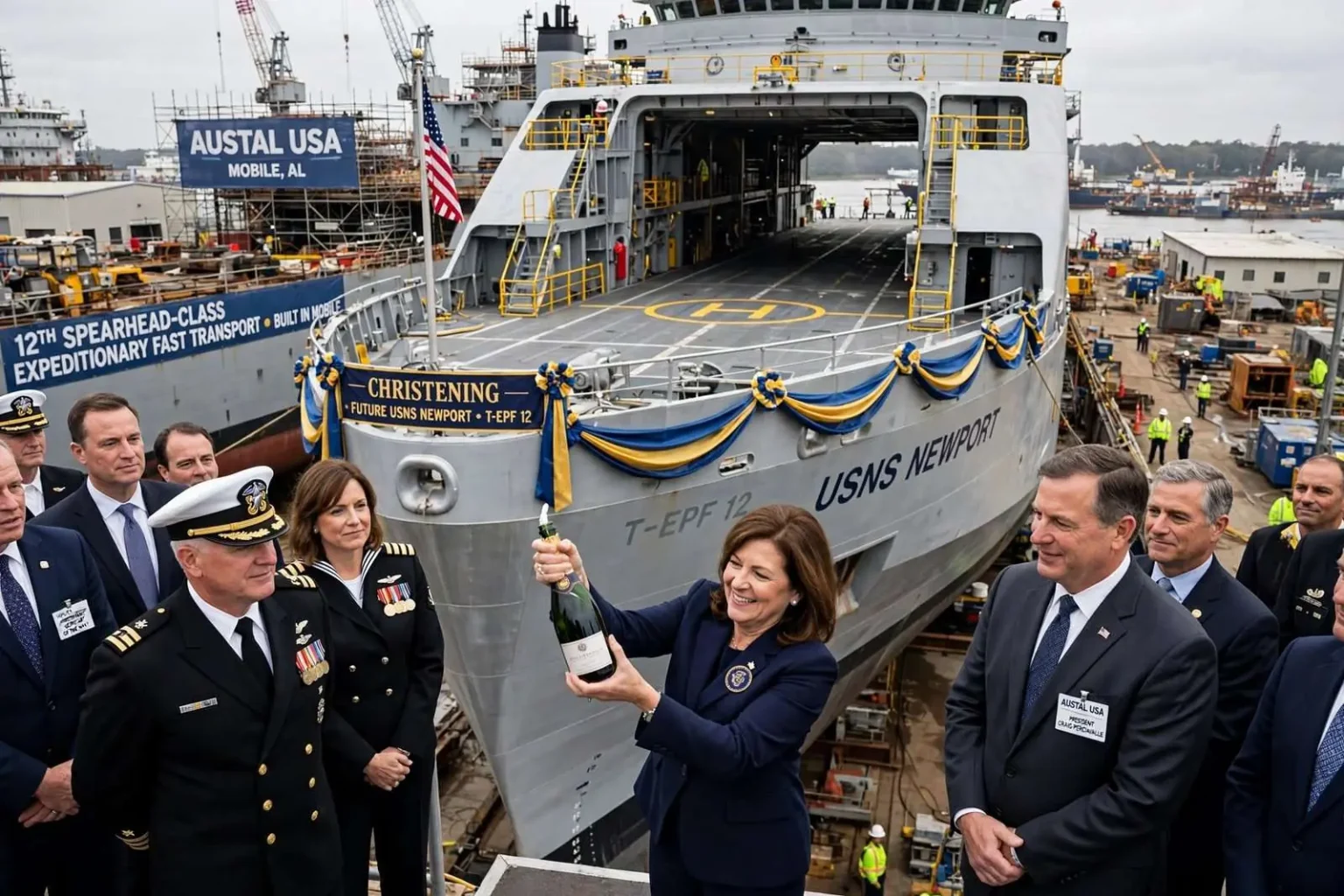
MOBILE, Ala. — Austal USA’s shipyard on the Mobile River will host another naval milestone this weekend: the christening of the future USNS Newport, the twelfth Spearhead-class Expeditionary Fast Transport built at the Mobile facility. The christening ceremony is set for 10 a.m. Saturday at the shipyard. It is not open to the public.
Christenings mark one of the signature moments in a ship’s life — the ceremony, steeped in naval tradition, at which the sponsor formally names the vessel and breaks a bottle of sparkling wine across its bow. The ship will still have outfitting, sea trials, and delivery ahead of it, but the christening gives the crew, the shipbuilder, and the namesake community a first formal moment of pride in the vessel, and Mobile’s shipways have hosted more of these moments in recent years than nearly any yard in the country.
Named for a New England City with Deep Navy Ties
The ship honors Newport, Rhode Island, home of the U.S. Naval War College. The choice ties the vessel to one of the Navy’s intellectual centers — the Newport institution where officers have studied strategy and warfighting since the nineteenth century and where the Navy’s professional education still centers today. Newport has lent its name to Navy ships across many generations, and the Mobile-built fast transport continues that lineage.
Newport City Councilor Lynn Underwood Ceglie was scheduled to attend the ceremony, along with a lineup of senior Navy and company officials. Speakers included Austal USA President Craig Perciavalle; Rear Adm. Robert T. Clark; Bilyana Anderson, Deputy Assistant Secretary of the Navy; Vice Adm. Ricky Williamson, Deputy Chief of Naval Operations for Fleet Readiness and Logistics; and Rear Adm. Shoshana Chatfield, president of the U.S. Naval War College. The roster alone signaled the importance the Navy places on the class: few christenings draw representation from both the service’s fleet readiness leadership and the War College’s presidency at the same ceremony.
For the shipyard workforce, the ceremony is also a moment of recognition. Each hull in the class represents hundreds of jobs — welders, pipefitters, electricians, outfitters, and the engineers and program staff who keep a serial production line moving — and the twelfth ship in a class is a milestone few American shipyards reach with a single design.
The class has also become a fixture of disaster response in the Western Hemisphere. Fast transports have delivered relief supplies to hurricane-struck islands in the Caribbean, moved aid after earthquakes, and served as offshore staging platforms when port facilities themselves were damaged — missions where the shallow draft and speed matter as much as cargo capacity. Each new hull adds to that capacity, and the Newport will enter service with that record behind the class.
The ship’s aluminum construction is another signature of the Mobile yard. Austal’s expertise in lightweight aluminum warship construction — rare among American shipyards — is what makes the class’s speed possible, and it is the same specialized skill base that produced the Independence-variant littoral combat ships sharing the facility. Welding and fabricating aluminum hulls is a different discipline from steel shipbuilding, and the Mobile workforce is one of the few in the nation with deep experience at scale.
The ships themselves are sized for exactly that flexibility: long enough to carry armored vehicles and hundreds of personnel across an ocean at speed, yet nimble enough to berth at small civilian ports that a warship could never use. A flight deck large enough for heavy helicopters adds a third dimension, letting the ships transfer cargo and personnel to shore without any pier at all. That combination — speed, shallow draft, big cargo deck, and an aviation-capable top deck — is what has kept the class in near-constant demand from combatant commanders since the first hull entered service.
Christening traditions themselves connect the modern yard to centuries of maritime practice. The sponsor — typically a woman with a connection to the ship’s namesake or the service — serves as the ship’s ceremonial godmother, and the moment the bottle breaks across the bow, the vessel formally takes its name. Sponsors often maintain ties with their ships for decades afterward, visiting crews and marking deployments, which turns a single Saturday morning ceremony into a relationship that outlasts any one official’s tenure.
For the Ceglie delegation from Newport, the ceremony begins that relationship: a Rhode Island councilor christening a ship named for her city, built by Alabama hands, that will spend its career connecting ports across hemispheres. Few municipal leaders get a direct line to a Navy vessel; Newport’s will now have one, riding at better than thirty-five knots when the mission demands it.
A Growing Class of Ships
Expeditionary Fast Transports were previously known as Joint High Speed Vessels before the class took on its current name. The rename reflected how the ships are actually used: they are Navy-operated but built to serve joint operations, moving whatever the mission requires at speeds conventional transports cannot match. The aluminum-hulled ships move troops, equipment and supplies quickly in shallow coastal waters, and every one of them has been built at Austal’s Mobile yard.
That shallow-water capability is central to the design. Deep-draft cargo ships need major ports; the Spearhead class is built to reach smaller ports, damaged ports, and austere shorelines where larger vessels cannot go. The ships have carried marines and soldiers, evacuated casualties, delivered disaster relief after hurricanes in the Caribbean and the Gulf, and supported special operations and humanitarian missions — a versatility that has made the class one of the Navy’s most frequently deployed auxiliary types despite its small crew.
With the Newport being twelfth in the class, two more Expeditionary Fast Transports were under construction at the time — keeping production lines busy at what was then one of Mobile’s largest private employers. Serial production of a single design is the economic engine of any shipyard: the same workforce, the same suppliers, and the same lessons learned from one hull flowing into the next. Mobile’s riverfront yard built its reputation on that model, and the fast transport program has been its backbone in the Navy market.
What the Ship Will Do
Once delivered, the USNS Newport will join a fleet operated by the Military Sealift Command, which crews the Navy’s support ships with civilian mariners. The ships respond to combatant commanders’ needs in theater, able to reposition a company-sized force and its equipment in a fraction of the time a conventional sealift requires, then turn around and do it again. In exercises and real-world operations, they have become the connective tissue among larger warships, forward bases, and the shore.
Mobile’s Shipbuilding Economy
The christening also spotlighted the industry that anchors Mobile’s riverfront. Austal USA’s yard sits on the Mobile River just south of downtown, and the fast transport line, alongside the Independence-variant littoral combat ships built at the same facility, made the company a pillar of the local economy. Shipbuilding employment in Mobile runs in the thousands of direct jobs, with a supplier network that stretches across Alabama — aluminum fabricators, electronics houses, and specialty manufacturers spread through the state benefit when the yard’s lines run full.
The city’s tie to the Navy runs deep beyond one company. Mobile has built ships since the Second World War, when the riverfront yards turned out vessels at a wartime clip, and the modern industry inherited both the infrastructure and the workforce tradition. The Port of Mobile’s growth, the state’s investments in the shipyard channel, and the training pipelines through local schools and community colleges have all reinforced one another, making shipbuilding one of the surest bets in the regional economy.
For the visiting dignitaries from Newport, Rhode Island, the weekend offered a look at where the modern Navy’s auxiliary fleet is born. The connection between a New England city and a Gulf Coast shipyard is the Navy’s own geography at work: ships named for American places, built in American yards, and crewed to serve wherever they are needed. The USNS Newport will carry the Rhode Island city’s name across the shallow waters of the Caribbean, the Pacific, and wherever the fleet sends it — with Mobile’s yard stamp on every weld.
Saturday’s ceremony, private though it was, marked the twelfth time Mobile’s workforce watched a new name slide onto the hull of a fast transport. Two more hulls were taking shape within sight of the podium, and the production line that built them all remained the busiest on the river. As those ships follow the Newport through outfitting and trials in the months ahead, Mobile’s riverfront will host the same ceremony again — a rhythm of christenings that has become as regular a feature of the city as the ships themselves are rare elsewhere.