
Austal USA breaks ground on $100 million steel manufacturing line in Mobile
Austal USA will break ground Friday on a $100 million steel manufacturing line in Mobile, expanding its shipyard to build Navy and Coast Guard vessels.
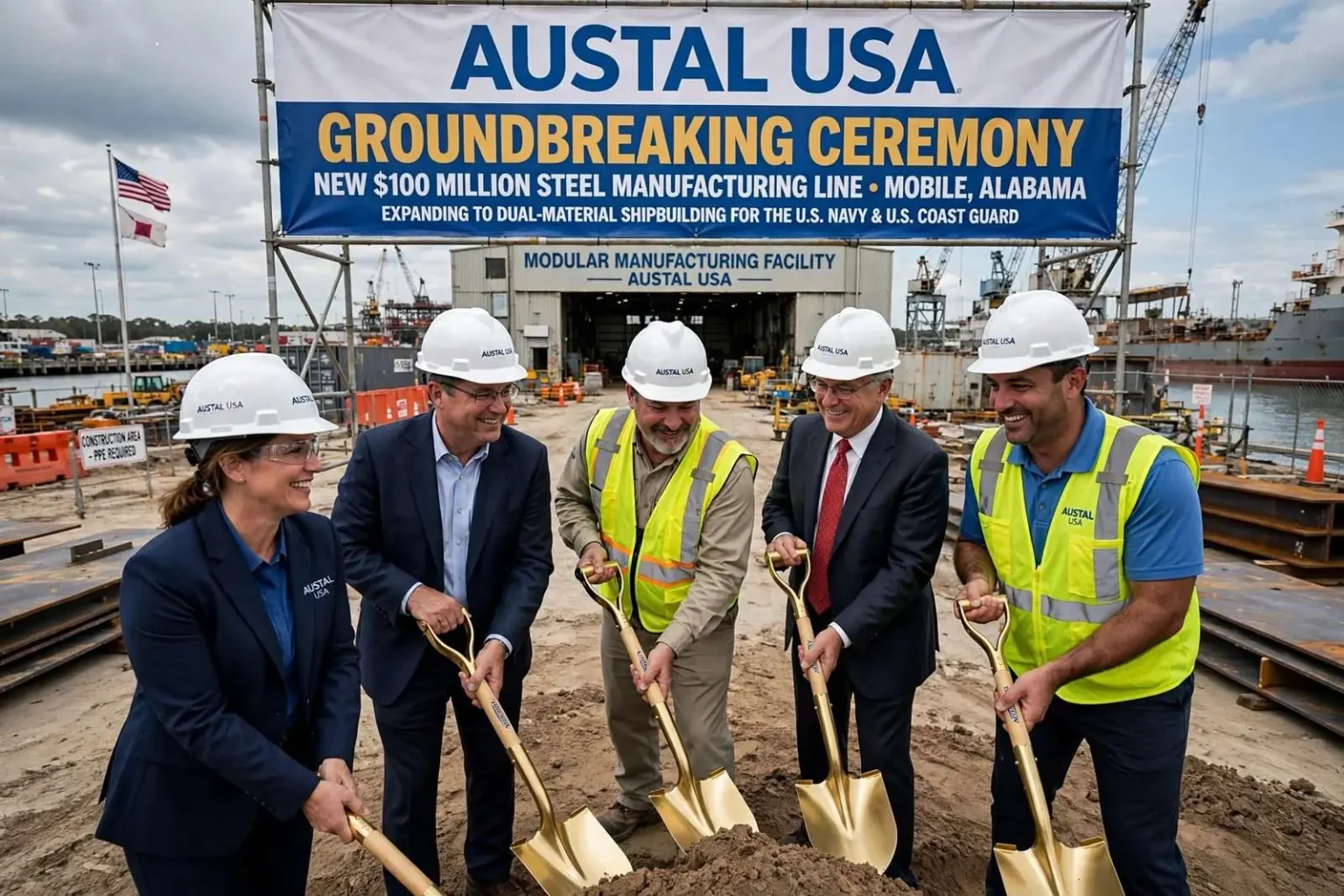
MOBILE, Ala. — Austal USA will break ground Friday on a new steel manufacturing line at its Mobile shipyard, a roughly $100 million expansion that the company says will let it build both aluminum and steel ships. The groundbreaking marks one of the most consequential changes in the Mobile shipyard’s history, transforming a facility that made its name building lightweight aluminum warships into a shipbuilder capable of competing for the full range of Navy and Coast Guard construction programs. For Mobile’s industrial waterfront, the addition represents a bet on the future of shipbuilding on the Gulf Coast — and hundreds of jobs that come with it.
The addition to the modular manufacturing facility is expected to position Austal to meet growing demand from the U.S. Navy and U.S. Coast Guard for steel-hulled vessels. The Navy’s shipbuilding plans have steadily shifted toward larger, more heavily built steel ships, including the next generation of surface combatants and auxiliary vessels, and the Coast Guard’s acquisition programs likewise call for steel hulls. Until now, Austal’s aluminum-only capability had effectively confined it to a slice of that demand; the new line opens the rest of the market to the Mobile yard.
From Aluminum Specialist to Dual-Capability Yard
Austal currently builds the aluminum Littoral Combat Ship and Expeditionary Fast Transport. The LCS program made Austal one of the two primary builders of the fast, agile warship class and turned the company’s Mobile facility into one of the largest aluminum ship production operations in the world, with ships launched, fitted out and delivered to the Navy from the yard on the Mobile River. The Expeditionary Fast Transport, a high-speed aluminum vessel used by the Navy to move troops and equipment quickly, shares the same aluminum construction tradition and has been built alongside the combat ships in the same modular production flow.
Steel is a different craft. It requires different welding processes, different fabrication equipment, different material handling and a workforce trained in techniques that do not transfer directly from aluminum construction. That is why the new manufacturing line is an expansion of the modular facility rather than a retrofit: steel panels and units will be fabricated on dedicated equipment and integrated into the yard’s existing modular production system, where large ship sections are built up under cover and then joined. Company officials have described the dual-material capability as essential to competing for future Navy programs, in which steel construction dominates the large surface fleet.
A Ceremony With the Statehouse and Capitol on the Guest List
Several local and state leaders are scheduled to attend the ceremony, including U.S. Rep. Jerry Carl, Mobile Mayor Sandy Stimpson, Mobile County Commissioner Merceria Ludgood, Gov. Kay Ivey’s Chief of Staff Jo Bonner and Austal interim president Rusty Murdaugh. The roster reflects how many constituencies have a stake in the yard’s growth. Carl represents southwest Alabama in Congress, where defense appropriations and Navy shipbuilding budgets shape Austal’s order book. Stimpson’s administration has made the city’s industrial and maritime sectors a centerpiece of its economic development messaging. Ludgood’s district includes the corridor along the Mobile River where the shipyard sits, and the Mobile County Commission has been a partner in the incentives and infrastructure that support the industrial waterfront.
Bonner’s presence carried its own significance: before serving as Gov. Ivey’s chief of staff, he represented southwest Alabama in Congress for many years and was closely identified with the region’s defense installations and shipbuilding interests. And Murdaugh, leading the company in an interim capacity at the time, was presiding over the most significant physical expansion of the Mobile operation in years. The cost of the expansion is being split between Austal and the U.S. Department of Defense, an arrangement that signals how central the capability is considered to national shipbuilding strategy — the Navy does not typically co-invest in yard infrastructure unless the capacity it buys is one the service expects to rely on.
That federal cost-sharing also situates the Mobile yard within a larger national conversation about shipbuilding capacity. Navy leaders have warned for years that the nation’s shipbuilding industrial base needs more capacity — more yards, more skilled workers, more throughput — to meet fleet goals, and investments like the Mobile steel line are exactly the kind of expansion that strategy envisions. Co-funding the capability reduces the risk to Austal of building for demand that has not yet been contracted, while giving the government a stake in ensuring the capacity exists when programs arrive.
What the Expansion Means for Mobile’s Workforce
A steel manufacturing line means welders, fitters, shipfitters and fabricators trained in steel work joining the yard’s existing aluminum workforce. The Mobile region’s shipbuilding labor market is one of the deepest in the country — fed by Austal, by the other major shipbuilder across the river, by the repair yards and by the training programs at local two-year colleges — but every expansion still tests its depth. Steel and aluminum trades overlap enough that experienced shipbuilders can cross over with additional training, and the company has historically partnered with the regional community college system on pipeline programs that recruit and train workers directly into the yard.
The jobs also matter beyond the yard’s fences. Shipbuilding wages flow through the region’s economy at a scale few other industries match, and each expansion of the industrial workforce supports the suppliers, trades and services that cluster around the Mobile River shipyards. Civic leaders in Mobile have long described the waterfront’s yards as the backbone of the region’s manufacturing economy, and a dual-material Austal strengthens that backbone against the cyclical ups and downs of any single Navy program.
The Yard’s Trajectory
The expansion continues a trajectory that has made Austal one of the defining industrial stories of Mobile over the past two decades. The company arrived in Mobile as an ambitious outsider — an Australian shipbuilder that won the LCS competition and built a yard of its own on the Mobile River — and grew into one of the region’s largest industrial employers, delivering warships at a pace that reshaped expectations of what a Gulf Coast yard could do. Adding steel does not replace that aluminum legacy; it stacks a second capability on top of it, at a moment when the Navy’s needs and the yard’s ambitions are pointing the same direction.
Why the Coast Guard Matters Here Too
The Coast Guard’s presence on the guest list of potential beneficiaries is easy to overlook but significant for a Gulf Coast yard. The service’s multiyear acquisition plans call for new classes of cutters — vessels that are steel-hulled, large and long-lived — and its shipbuilding programs have increasingly looked to the same Gulf Coast industrial base that builds the Navy’s fleet. A Mobile yard capable of steel construction can pursue that work competitively, adding a second federal customer alongside the Navy and further diversifying the yard’s portfolio. For the region, that diversification is the point: yards that depend on one program or one customer are vulnerable to budget cycles in a way that yards serving several are not.
The modular manufacturing facility at the center of the expansion is itself a signature of how modern shipbuilding works. Rather than building a ship stem to stern in place, the yard fabricates standardized modules — complete sections with piping, wiring and equipment installed before joining — which improves quality control and compresses schedules. Adding a steel line to that modular system means steel modules will flow through the same disciplined production process, and the yard’s existing launch and outfitting infrastructure will handle steel-hulled hulls alongside the aluminum ones already moving through it.
Friday’s Ceremony and the Work Ahead
The Friday groundbreaking will draw the officials, the shovels and the photographs, but the measurable milestones will come later: steel fabrication equipment installed, the first steel cut, the first module assembled, the first steel-hulled contract won and executed. Shipyard expansions of this scale unfold over years, and their success is judged by whether the promised capability arrives on schedule and whether the contracts materialize to fill it. Austal’s leadership has framed the investment as positioning, and positioning is exactly what it is — the yard cannot know which future programs it will win, only that it cannot win programs it is not equipped to build.
For Mobile, the groundbreaking is another entry in the city’s long ledger of maritime investment. The Port of Mobile’s expansion, the shipyards on both banks of the Mobile River and the industrial operations along the waterfront together form one of the densest maritime economies on the Gulf of Mexico, and a $100 million dual-material shipbuilding line adds depth to a cluster the city has spent decades cultivating. The leaders gathered for the ceremony — a congressman, a mayor, a county commissioner, the governor’s chief of staff and the company’s interim president — represented the layers of public investment and political support that such expansions require, standing alongside the private capital Austal put up as its half of the cost.
What Friday marked, in the end, was a change in what Mobile can build. The yard that learned to build fast aluminum warships will now learn to build in steel, with the Navy and Coast Guard as its intended customers and the federal government sharing the bill. The ground being broken is the first, unglamorous step in a process that ends, if all goes as planned, with new steel ships sliding down the ways at Mobile for decades to come.


