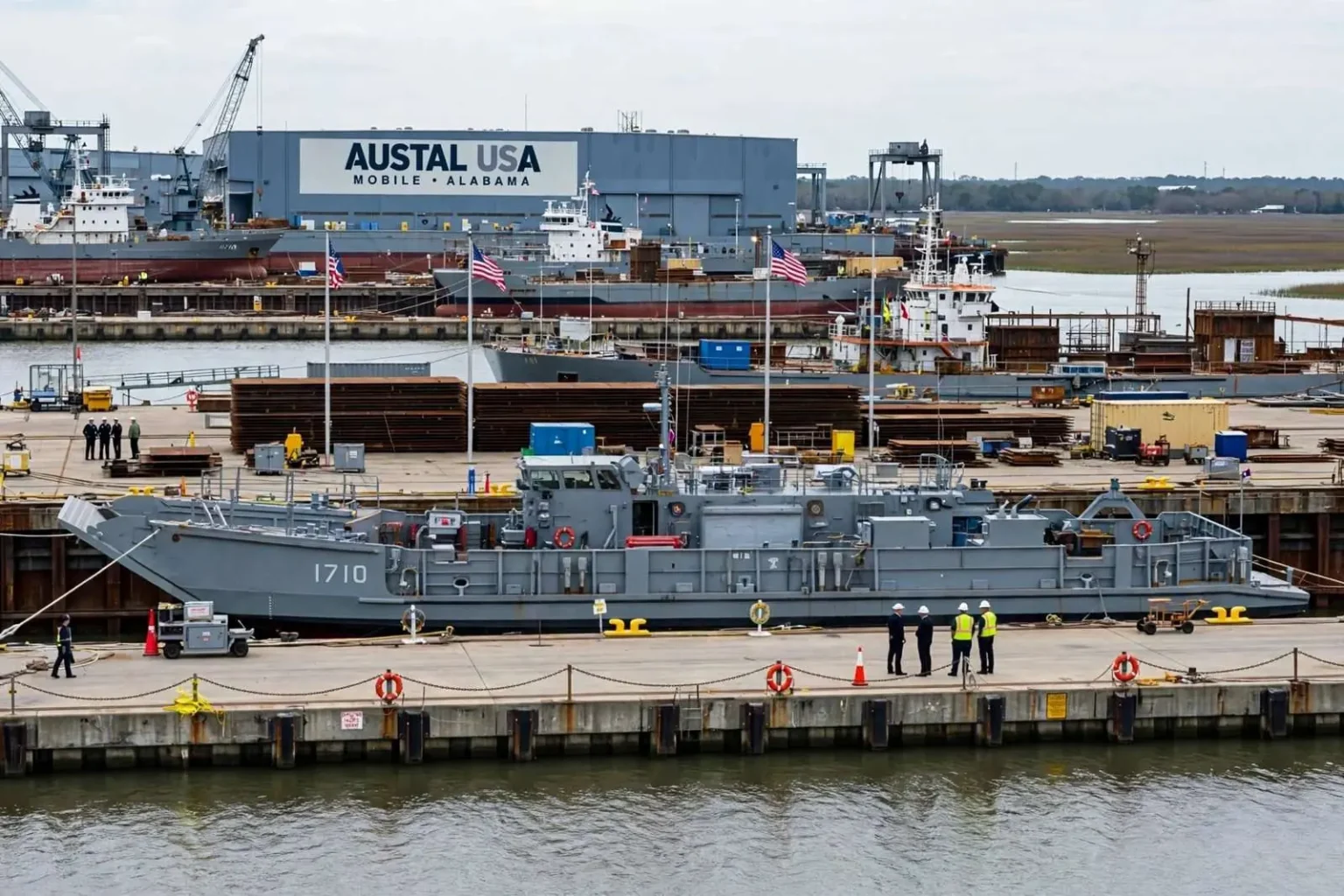
Austal USA has delivered LCU 1710, the first-in-class vessel in the Navy’s new Landing Craft Utility 1700-class program, marking a historic milestone for the Mobile shipbuilder as its first steel ship delivered to the U.S. Navy.
“The delivery of LCU 1710 represents a major achievement for Austal USA and our shipbuilding team,” said Gene Miller, president of Austal USA. “As our first Landing Craft Utility and first steel ship delivered to the U.S. Navy, this accomplishment reflects the dedication and expertise of our workforce and our industry partners. It also demonstrates Austal USA’s ability to skillfully design, build and deliver highly complex steel vessels while continuing to support the Navy’s evolving mission requirements.”
Before delivery, LCU 1710 completed acceptance trials that tested the ship’s major systems and equipment to demonstrate operational performance, reliability and compliance with Navy requirements. The Navy’s Board of Inspection and Survey, known as INSURV, validated the quality of construction and mission readiness throughout the trials.
“The successful completion of these trials reflects exceptional planning, flawless execution, dedication, and the collaboration of our shipbuilding team and Navy counterparts,” said Mike Pruitt, vice president of surface ship programs at Austal USA. The vessel also demonstrated it could get underway without the assistance of tugs or pilots, and it validated its limited crew operating capability, further showcasing the flexibility of the LCU 1700-class design.
LCU 1710 is designed to transport equipment and personnel from ship to shore in support of expeditionary operations, offering improved capability, endurance and survivability compared with legacy landing craft. Austal USA said it continues to expand its portfolio of steel and aluminum shipbuilding programs, with multiple vessels currently under construction and ongoing support for submarine module production and auxiliary ship programs for the Navy and Coast Guard.
How the LCU 1700 Program Began
Austal USA received the contract that kicked off its landmark Landing Craft Utility 1700 program in September 2023, when the U.S. Navy awarded the Mobile shipyard a $91,535,551 agreement to build three LCU 1700-class vessels, with an option for nine more boats. The program ultimately delivered LCU 1710, the first-in-class vessel, to the Navy — marking a historic milestone as the shipbuilder’s first steel ship to enter service.
LCUs are carried aboard amphibious assault ships and used to ferry vehicles, supplies, and personnel from ship to shore. Each LCU carries a payload comparable to that of seven C-17 Globemaster III transport aircraft — a capability critical to Navy and Marine Corps expeditionary operations. The contract also added to an already widening portfolio at the Mobile yard, which was also producing two Navy Towing, Salvage and Rescue Ships and a 90,000-square-foot Auxiliary Floating Dry Dock Medium at the time.
About Austal USA
Austal USA is the American subsidiary of Australian shipbuilder Austal Ltd. Its Mobile shipyard on the Mobile River is best known for building aluminum-hulled vessels for the Navy, including Independence-variant littoral combat ships and Spearhead-class expeditionary fast transports, and the LCU 1700 program is part of the company’s expansion into steel shipbuilding.