
Austal USA Lands $12.8 Million Order for Columbia-Class Submarine Work
Austal USA in Mobile lands its first Columbia-class submarine order — a $12.8 million General Dynamics deal for module fabrication running through 2027.
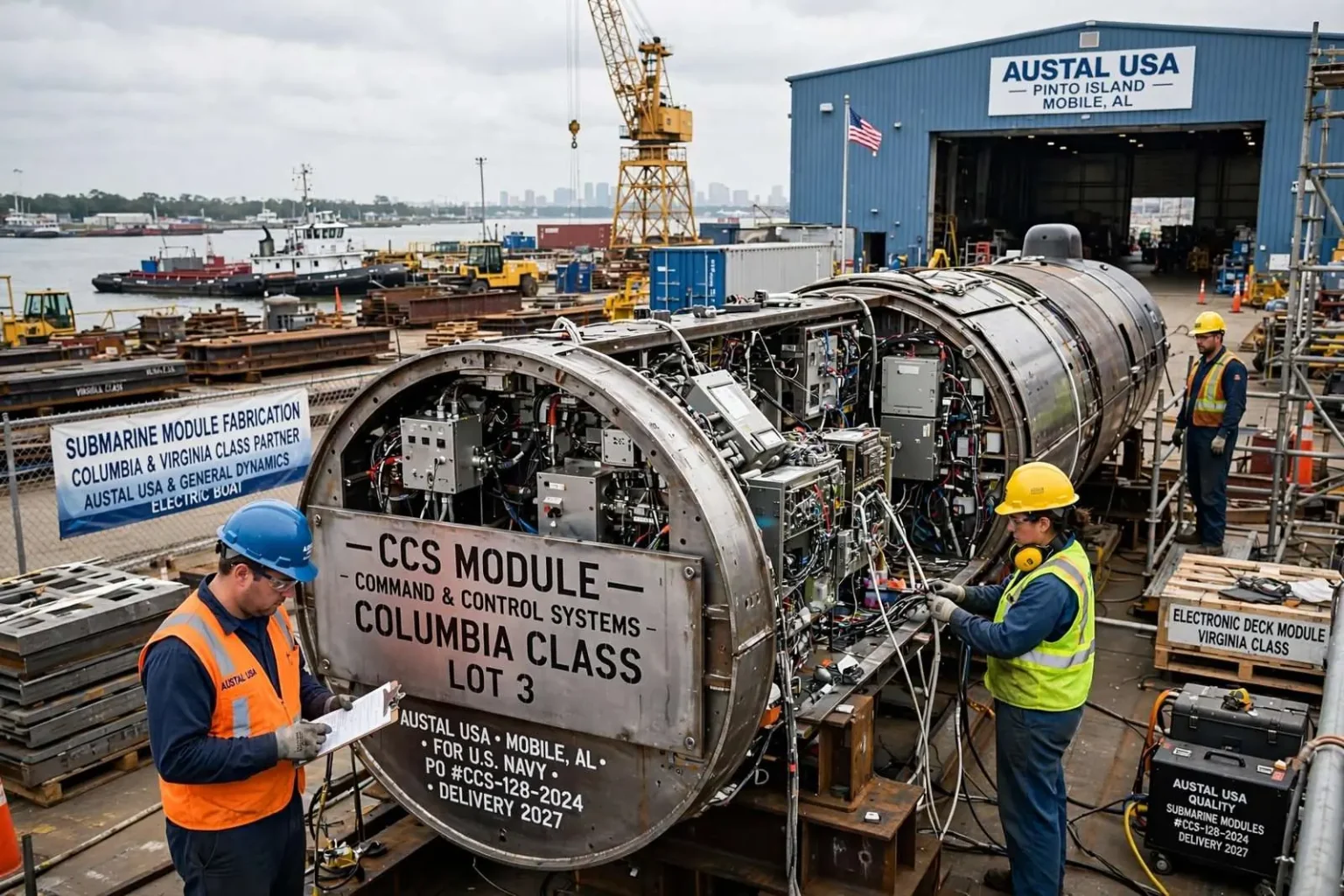
Austal USA has received its first components order for the U.S. Navy’s Columbia-class submarine program, a milestone that deepens the Mobile shipyard’s role in the nation’s submarine industrial base. The purchase order, worth up to $12.8 million, covers fabrication of the Command and Control Systems Module for the third ship in the Columbia class. Prime contractor General Dynamics issued the order, with work scheduled to run from 2024 through 2027.
The award is a notable step for a shipyard that built its reputation on aluminum-hulled surface ships. Austal USA, located on Pinto Island along the Mobile River, has long been known as the builder of the Navy’s Independence-class littoral combat ships and its expeditionary fast transport vessels. Submarine work represents a different discipline altogether, one traditionally dominated by the Electric Boat yards in Connecticut and Rhode Island and by Huntington Ingalls Industries in Newport News, Virginia. Landing a piece of the Columbia-class program places the Mobile yard inside that small and strategically vital circle.
Expanding the Submarine Industrial Base
The arrangement stems from a partnership between Austal USA and Electric Boat, backed by the Navy, aimed at expanding submarine production capacity nationwide. Under the collaboration, Austal builds and outfits Command and Control Systems Modules and Electronic Deck Modules for both the Columbia- and Virginia-class programs. The work grew out of an earlier Electric Boat order for three Virginia-class modules at the Mobile yard.
The Navy’s interest in spreading submarine construction beyond New England is not accidental. The service has warned for years that the submarine industrial base is stretched thin, with backlogs pressing against the capacity of the handful of yards and thousands of suppliers capable of doing the work. Columbia-class construction, in particular, is the Navy’s top acquisition priority, and leaders at the Pentagon and on Capitol Hill have repeatedly said the program cannot afford schedule slips. Adding qualified partners like Austal spreads risk, shortens potential bottlenecks, and brings new workers into a trade where experience takes years to build.
For Mobile, the collaboration arrives at a moment when the region’s maritime workforce is already growing. Austal’s facility has expanded steadily since the company opened its American operation, and the yard’s hiring needs have made it a fixture of local economic development conversations. Submarine module work adds a new skill set to the region’s shipbuilding portfolio, involving outfitting compartments with the electronics, cabling, and control systems that give a nuclear submarine its operational brain.
What the Module Work Involves
The Command and Control Systems Module is a self-contained section of the submarine that houses much of the equipment the crew uses to fight and navigate the ship. Electronic Deck Modules serve a similar purpose as pre-outfitted platforms that carry cabling, racks, and supporting systems into the hull. Building these sections away from the final assembly yard, as fully outfitted modules, allows Electric Boat to manage the enormous pacing demands of Columbia-class construction, where the schedule is governed by the need to deliver boats on the timeline that replaces the aging Ohio-class ballistic missile fleet.
That fleet is central to the nation’s nuclear deterrent, and the Navy has described the Columbia class as its most important program precisely because the Ohio-class boats begin retiring in the next decade with no slack in the replacement schedule. The lead ship, the future USS Columbia, and the boats that follow are being built by General Dynamics Electric Boat with major participation from Huntington Ingalls. Suppliers and module partners across the country feed that effort, which is where Austal’s Mobile work fits into the larger picture.
“This order gives Austal and our employees an opportunity to demonstrate our continued commitment to the submarine industrial base and our partner, Electric Boat,” said Dave Growden, Austal USA’s vice president of new construction programs. “We are proud to be a part of the Electric Boat team and to play a key role in such a critical program for our Nation’s security.”
A Milestone for the Mobile Yard
The Columbia-class order is the first components order Austal has received under the submarine collaboration, which gives the company a chance to prove its performance before larger work packages potentially follow. In shipbuilding, first orders of this kind carry weight well beyond their dollar value. Primes like General Dynamics watch closely how a new partner handles fabrication quality, scheduling, and workforce certification before extending further work, and successful execution typically opens the door to bigger scopes.
The $12.8 million ceiling also underscores the incremental nature of the partnership. Rather than a single sweeping contract, the Navy’s approach to expanding the submarine industrial base has been to qualify additional builders module by module, yard by yard, so that each new participant is demonstrated and trusted on smaller packages first. Austal’s earlier experience with three Virginia-class modules served as that proving ground, and the Columbia-class order extends the relationship into the program where demand is most urgent.
Mobile’s role in national shipbuilding has grown dramatically over the past two decades, first through the littoral combat ship program and then through the expeditionary and auxiliary vessels Austal delivers for the Navy and Military Sealift Command. The yard has also pursued broader ambitions in new classes of support ships, and company leadership has consistently pitched Mobile as a place where the Navy can get more throughput. Submarine modules add a resume line that few non-traditional yards can claim.
What It Means for Local Workers and the Region
The 2024-through-2027 schedule gives the Mobile yard a multi-year run of skilled work. Fabricating and outfitting submarine modules requires welders, electricians, pipefitters, and the specialized trades that install and test electronics packages, all supported by engineers, planners, and quality inspectors. Those jobs tend to pay above the regional manufacturing average and, in an industry where turnover is a constant challenge, a multi-year order gives workers and training programs alike a stable horizon.
Regional institutions have built pipelines to support this kind of work. AIDT, Alabama’s state workforce training agency, has partnered with area shipbuilders for years, and coastal Alabama’s community colleges offer welding, pipefitting, and electrical programs that feed directly into the local yards. The more diverse the work flowing into Mobile’s shipyards, the stronger those pipelines become, because workers can see a career path that spans multiple programs and employers. Steady submarine orders also make it easier to recruit experienced tradespeople from other Gulf Coast yards, deepening the region’s overall bench of submarine-qualified talent.
The broader economic effect radiates through a supply chain that includes hundreds of regional vendors, from metal fabricators and marine suppliers to engineering firms and logistics companies. Defense dollars spent at the shipyard multiply through wages, local purchases, and the secondary businesses that cluster around major maritime employers. City and county officials in Mobile have long treated the shipbuilding sector as an anchor of the regional economy, and submarine work deepens that anchor at a time when the Pentagon is pouring investment into shipbuilding capacity nationwide.
The Road Ahead for the Columbia Class
The Columbia-class program will eventually consist of a dozen boats designed to carry the Navy’s sea-based nuclear deterrent into the second half of the century. The scale of the program is enormous by any measure, involving the largest submarines the Navy has ever built, and the industrial challenge of delivering them on schedule has driven many of the decisions now reshaping the submarine industrial base, including the deliberate expansion of qualified partners to yards like Austal’s in Mobile.
For Austal USA, the order represents both an obligation and an opportunity. The company must now demonstrate that its workforce, processes, and facilities meet the exacting standards that nuclear shipbuilding demands, where quality assurance is unforgiving and documentation requirements dwarf those of conventional surface ships. Success through 2027 would position the Mobile yard for continued participation in a program the Navy has pledged to protect from budget pressure and schedule compression alike.
For the Gulf Coast, the award is further confirmation that the region’s shipbuilding corridor, stretching from Mobile to Pascagoula and beyond, has become an indispensable part of the national defense industrial base. As the Navy works to meet its fleet goals against the pressure of global demands, the expansion of submarine work into Mobile ensures that this region will have a hand in one of the most consequential defense programs of the coming decades, bringing with it years of skilled employment and a permanent elevation of the yard’s standing in the industry.
From Surface Ships to Submarines
Austal’s path into submarine work runs through the fate of the littoral combat ship program. The Independence-class LCS line in Mobile produced a fleet of fast, aluminum-hulled warships for more than a decade, but the Navy capped the program and shifted its shipbuilding priorities toward larger, more survivable combatants. That shift left the Mobile yard with capacity to spare and a workforce eager for new programs, a combination that made the yard a natural candidate when the Navy went looking for ways to relieve pressure on the submarine industrial base.
The yard has since diversified aggressively, taking on auxiliary and support vessel work that includes expeditionary sea bases and other ships that keep the fleet operating far from home ports. Each new program required Austal to master different construction methods and Navy standards, and the discipline learned on those transitions is directly relevant to submarine module work. The company’s leadership has argued that a modern, efficient yard in the Gulf South can deliver naval vessels faster and at lower cost than the legacy yards alone, and the partnership with Electric Boat puts that argument to a demanding test.
The Virginia-class modules that came first gave Austal a foothold in the submarine world under less schedule pressure than Columbia. With those modules, Mobile workers learned the standards for submarine-grade welding, the maze of systems that run through a submarine hull section, and the inspection culture that governs every inch of nuclear-adjacent work. The Command and Control Systems Module order now applies that learning to the newest and most important boat class in the fleet.
A Regional Shipbuilding Corridor Comes Together
Mobile does not carry the region’s defense shipbuilding load alone. Across the state line, Pascagoula hosts Huntington Ingalls’ Ingalls Shipbuilding, the largest employer on the Mississippi Gulf Coast and a builder of destroyers, amphibious ships, and cutters for the Navy and Coast Guard. Together, the two yards anchor a Gulf Coast maritime cluster that includes scores of suppliers, service companies, and training institutions, and competition for skilled workers between the yards has pushed wages up across the region.
The Columbia-class partnership strengthens that cluster in a specific way. Because module fabrication happens in Mobile while final assembly takes place in the Northeast, the work creates a steady flow of completed sections that must be transported, integrated, and tested, knitting the Gulf Coast into the critical path of the nation’s most important submarine program. Local leaders have described this kind of work as exactly what the region needs to future-proof its maritime economy as surface ship programs wind down and new priorities emerge.
Between now and the end of the scheduled work in 2027, Austal will hire, train, and certify workers against submarine standards, deliver module sections for a boat that will patrol the deep oceans for decades, and build a track record in a market it only recently entered. For a company and a city that have bet heavily on shipbuilding as their industrial future, the $12.8 million order is a comparatively small dollar figure attached to a very large strategic foothold, and both the Navy and Mobile will be watching how well the yard turns that foothold into a lasting role.


