Automated License Plate Readers Expand Nationwide, Sparking Privacy Debate in Gulf Shores and Beyond
As automated license plate readers expand nationwide, residents in Gulf Shores and elsewhere are weighing privacy concerns against the technology's use by law enforcement.
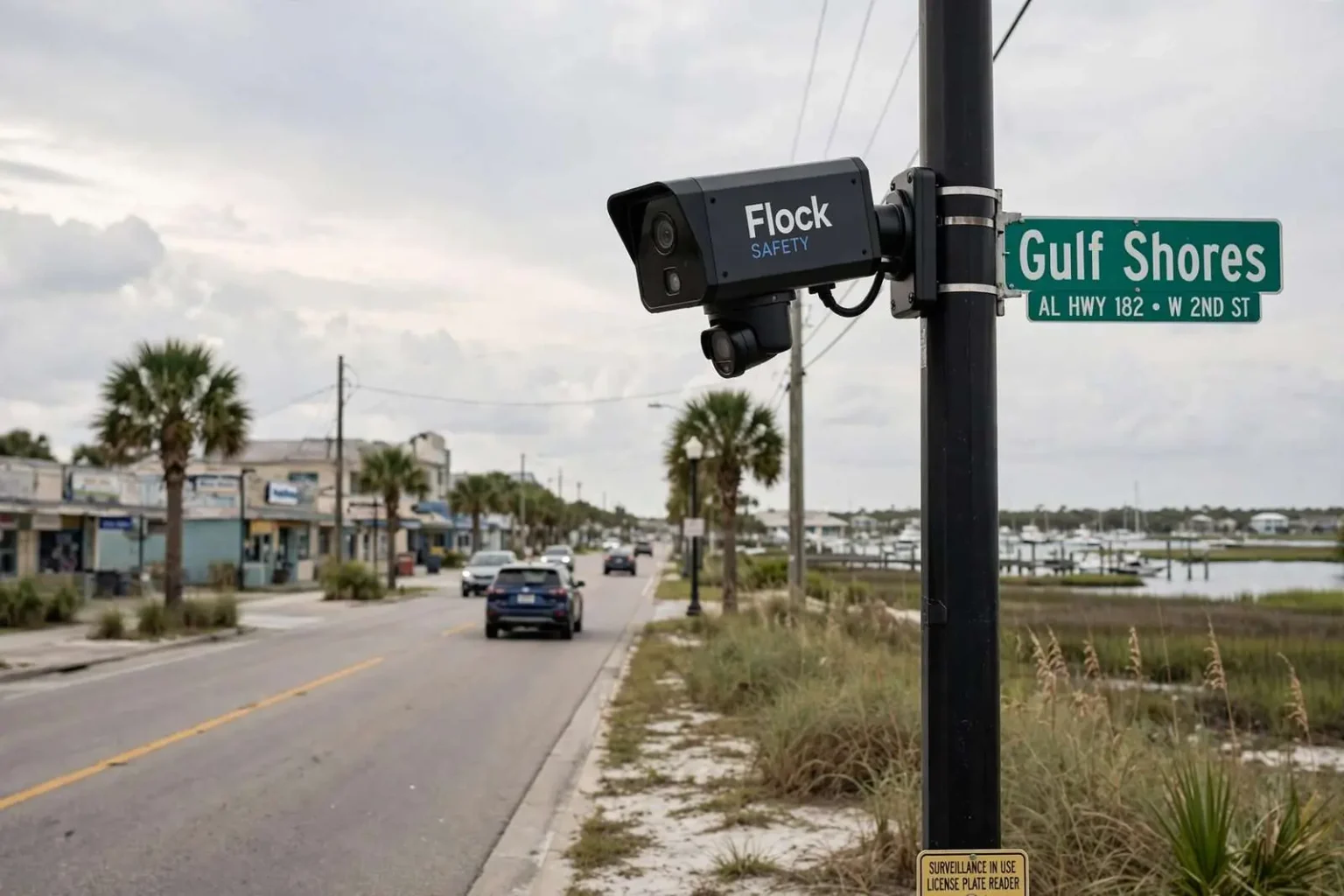
Automated license plate readers (ALPRs) have rapidly expanded across the country in recent years, a growth often referred to as being “Flocked” because of the market prominence of Flock Safety, one of the leading companies behind the technology. A defining feature of the network is that most of these AI-powered cameras are installed on public roads, highways and intersections rather than on private property, allowing them to passively scan, log and catalog the movements of drivers using public roadways.
As awareness of the technology grows, grassroots tools have emerged to help residents understand the scale of local surveillance infrastructure. Drivers can check whether their vehicles have been recorded or searched by visiting the “Have I Been Flocked” website, a third-party tool that is not affiliated with any news outlet or with Flock itself.
License plate reading technology is not new. It was originally developed in 1976 by the Police Scientific Development Branch in the United Kingdom as a tool to combat terrorism, with working prototypes in place by 1979. Over the following decades, advances in machine learning and computer vision transformed the systems from expensive, fixed-base applications into powerful tools capable of recording not just plate numbers but other identifying details such as a vehicle’s make, model, color, roof racks and bumper stickers.
Flock Safety in particular has drawn national headlines amid mounting, bipartisan backlash from civil liberties advocates, residents and lawmakers over data privacy and concerns about misuse. High-profile cases of law enforcement officers misusing the database for personal tracking, along with concerns about data sharing with federal immigration authorities, have brought increased scrutiny to the company. In response, Flock has announced changes to its platform, including shortening its standard data retention window from 30 days to seven days and making search audit tools mandatory for law enforcement users. Even so, a number of communities nationwide have moved to cancel or suspend their contracts with the company.
How the cameras work
License plate reader cameras photograph passing vehicles and use software to convert each plate into searchable text, which is logged with a time and location. The reads are checked against “hot lists” such as records of stolen vehicles, wanted persons and Amber Alerts, and a match can send an alert to officers. Flock Safety was founded in Atlanta in 2017 and sells its cameras to law enforcement agencies, local governments, businesses and neighborhood associations.
The legal questions around the technology remain unsettled. In Carpenter v. United States (2018), the U.S. Supreme Court held that police generally need a warrant to obtain historical cellphone location records, and courts and legislatures have since debated whether large networks of plate readers raise similar privacy concerns.