For the first time in 37 years, the Babe Ruth World Series is back in Mobile — and organizers are racing to line up enough local host families before the first teams touch down in early August.
The tournament, which last came to Mobile in 1982 for a younger age division, now features players ages 16 to 18 from across the globe.
David Todd, host president of the 2019 Babe Ruth World Series, said the series offers Mobile a rare chance to show off the city to visiting athletes and families.
“We’ve always traveled outside to go to the World Series — to actually bring it to Mobile and give an experience with Mobile and show them what Mobile’s about,” Todd said.
The 37-year gap makes this a homecoming for the tournament as much as for the sport. A generation of Mobile families has followed Babe Ruth baseball without ever seeing its premier event played at home — following local teams on the road to regional sites and out-of-state World Series years instead. Bringing the 16-18 division to Mobile reverses that, and puts the city’s own baseball infrastructure, from its ballparks to its hotels to its famously hospitable neighborhoods, on display before a national and international field.
How host families work
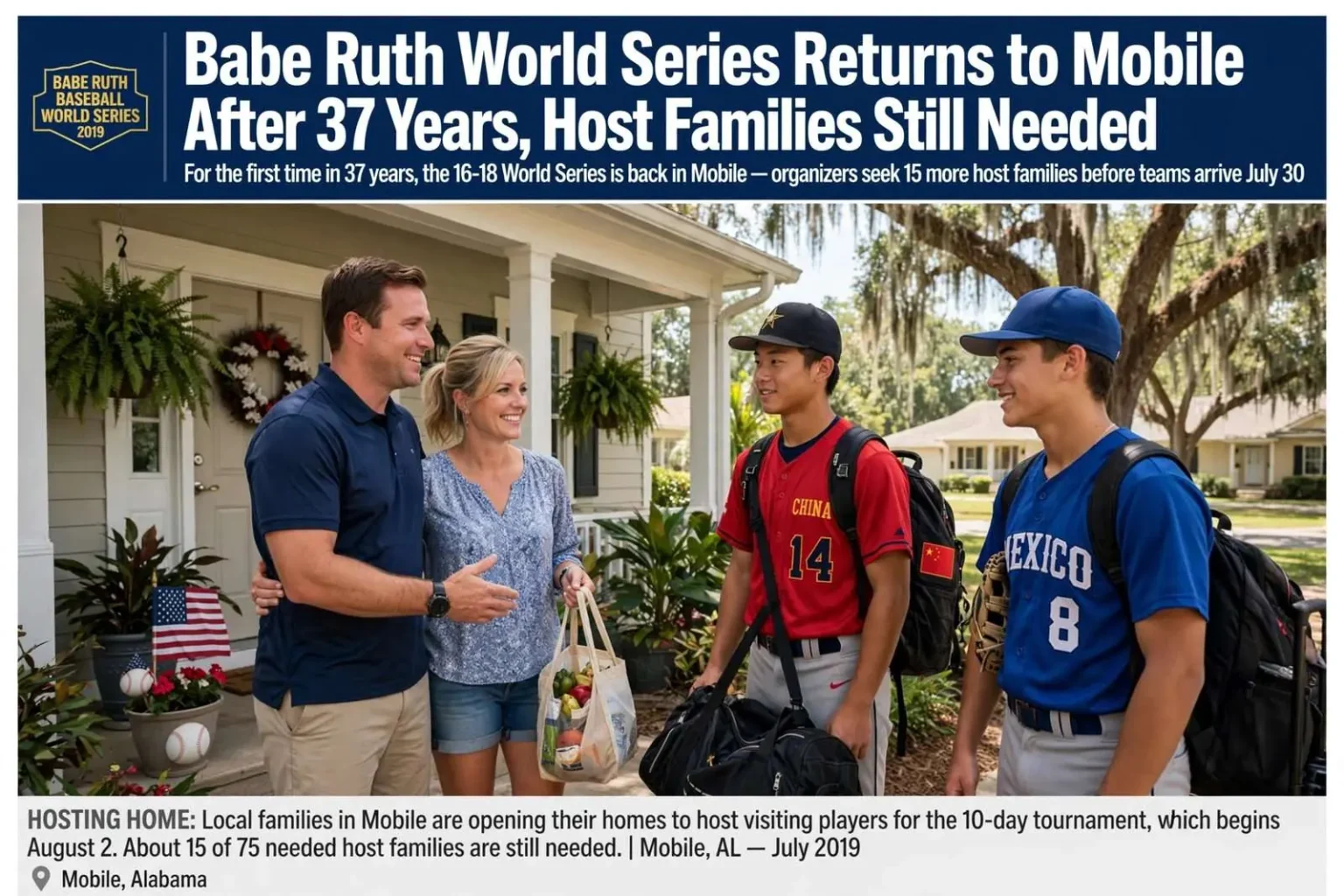
What sets the Babe Ruth organization apart, Todd said, is its host family program. Rather than packing players into hotels, each athlete spends the week living with a local family, sharing meals, routines and day-to-day life in Mobile.
Typically, two players are placed in each home, though some families have taken in three or four.
The program has shaped the tournament’s culture for decades. Players arrive as competitors from different states and countries and leave, in many cases, as members of the families that housed them. Host parents keep team schedules, do loads of uniforms, and shuttle players to the ballpark; players, most of them away from home at this scale for the first time, get a bed, a kitchen table, and a household’s undivided attention for the length of the tournament.
The demands on hosts are real but bounded. Families commit to the tournament’s run — roughly ten days from arrival to the championship — and organizers provide the schedule, contact chains, and support for anything medical or logistical that comes up. Most hosts, in tournament cities across the country, describe the experience as closer to an exchange student’s short visit than to running a boarding house: the players are exhausted from doubleheaders, polite, hungry, and asleep early.
The program has created friendships that last well beyond baseball. Todd said his own family stayed in touch with a visiting team from Ohio for years after hosting.
“We’re still friends today. We travel back and forth to Ohio. They’ve been here for my son’s wedding,” he said.
A former player with the Mobile Rawdogs who once stayed with a host family echoed that sentiment from the other side of the arrangement.
“We felt that we were at home. Always had great home-cooked meals. Always fed us breakfast. Made sure that we were ready to go — I couldn’t thank him enough,” he said.
That reciprocity — Mobile players once hosted as guests elsewhere, now anchoring the tournament at home — illustrates how the Babe Ruth circuit has functioned as a decades-long exchange among baseball towns. The host family model also has a practical economics to it: a ten-team tournament with full rosters would otherwise mean hundreds of hotel room-nights across a week and a half. The families absorb that cost in spare bedrooms, and the tournament’s organizers say the personal bonds that result are the reason the program has never been replaced with lodging blocks.
What’s still needed
The series needs roughly 75 host families. With a few weeks to go until game day, organizers said they were still short about 15 families.
The shortfall is the last logistical hurdle before the tournament begins. Each additional family that signs up takes two or more players off the waiting list, and organizers have been recruiting through churches, schools, booster networks, and word of mouth across Mobile — the standard channels that filled host rosters in other tournament cities. Families who host are not required to have players of their own or any connection to baseball; the requirements are a spare bed or two, meals, and a schedule that can flex around game times for the length of the event.
Teams begin arriving July 30, with games starting August 2.
The arrival window gives host families a day or two with their players before competition starts — time for the grocery run, the house rules, and the tour of the city that organizers hope turns guests into ambassadors for Mobile when they go home. Once play begins, the schedule runs daily, with families managing around day games, night games, and the rain delays that August on the Gulf Coast reliably supplies.
The host team’s shot at history
The Mobile Rawdogs will serve as the host team and are set to face a squad from China in their opening game.
An opening-round date against an international opponent is a marquee draw by any measure — and a reflection of the Babe Ruth organization’s global reach at the 16-18 level, where qualifying teams arrive from Asia, Latin America, and across the United States. For Mobile fans, the opener is a chance to see a style of play and a level of competition that rarely passes through the Gulf Coast outside national tournaments.
Mobile’s program has won nine Babe Ruth national titles over the years, and the Rawdogs are hoping to become the first host team to win a World Series crown on its home field.
The nine championships are the backbone of the city’s claim to being one of America’s great amateur baseball towns — a lineage that runs through the same sandlots and American Legion diamonds that produced major leaguers from Mobile for a century. What the program has never done, despite all those titles, is win the World Series while hosting it, and the Rawdogs’ roster carries that specific piece of history with it into the opener.
The tournament’s return also lands on a city whose baseball calendar has been rebuilding momentum in recent years — youth leagues, high school programs, and college summer teams all feeding the same diamonds the World Series will use. Organizers describe the event as the capstone of that summer: a chance for the area’s younger players to watch a World Series in their own city, the way previous generations of Mobile players once did in 1982.
Playing at home cuts both ways. The host team sleeps in its own beds rather than with host families, avoids travel fatigue, and draws a hometown crowd for every game — but it also carries the pressure of playing before everyone who knows the program’s history, against teams with nothing to lose. Tournament organizers point out that host teams rarely win the event; the Rawdogs’ bid is to be the first to manage it.
What the tournament brings Mobile
Beyond the games, the World Series functions as a two-week showcase for the city: visiting families booking hotel rooms and restaurants, players touring the area between games, and a national amateur audience following scores from a city whose baseball reputation — built on nine titles and a century of major league talent — gets renewed every inning. Organizers say that is precisely the point of the host family model: the visitors leave having lived in Mobile, not merely passed through it.
The economic footprint, while secondary to the baseball, is not trivial. A national tournament fills hotel rooms, spends at local restaurants and attractions, and brings families whose week in the city — extended, in many cases, by deep playoff runs — circulates through the local economy. Tournament cities typically report the visitor impact as a welcome August boost in a season when youth tourism otherwise dips between beach season and school-year schedules.
Todd’s pitch to the remaining families on the fence is the one his own experience backs up: the tournament lasts ten days, but the relationships — the Ohio team at his son’s wedding, the annual trips back and forth — have already lasted decades. For the last 15 households needed, the math is two beds and a couple of weeks of groceries against a summer’s worth of stories from a World Series that will only be in Mobile once in a generation.
The last families signing up in these final weeks are, in that sense, doing more than filling beds. They are completing the roster of the tournament itself — the 75 households that will make an international field of 16-to-18-year-olds feel, for one August, like Mobile is home.