Baldwin County family hands out ‘buddy bags’ to comfort children after Hurricane Sally
A Baldwin County mother and her four children are assembling and delivering "buddy bags" to children affected by Hurricane Sally, with stops planned in Marlow, Spanish Fort and Silverhill.
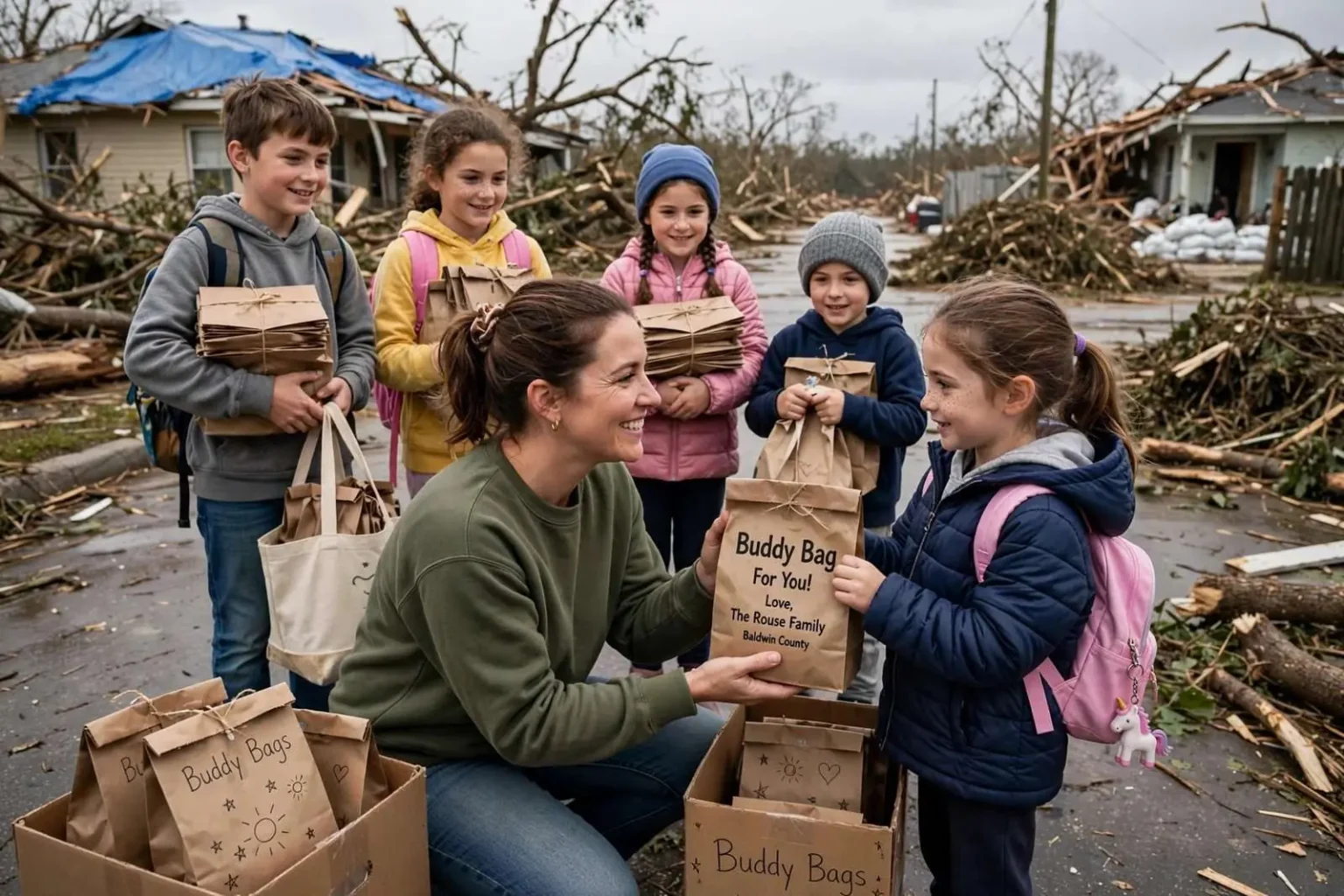
A Baldwin County family has turned the long, slow recovery from Hurricane Sally into a small act of kindness aimed at the community’s youngest residents. Mary Beth Rouse and her four children have begun delivering handmade care packages — known as “buddy bags” — to youngsters whose families were hit hardest by the storm, offering a small measure of comfort during what has been a difficult and drawn-out recovery for households across the county.
The effort began this week, when the Rouse family made its first stop in the Marlow community. In under an hour, the family handed out nearly four dozen bags to children living in some of the areas that saw the worst damage from the storm. Each bag is assembled by the Rouse siblings and their parents and given directly to families with children, rather than dropped off at a collection point, so every delivery comes with a familiar face and a moment of conversation attached.
“All kids in our community went through something really traumatic and they all need a little love right now,” Rouse said of the effort.
The buddy bags are deliberately simple in design. There is no application to fill out and no eligibility paperwork for families to complete. The goal, the family says, is simply to put a small package into the hands of a child — something that belongs to them at a time when so much else in their daily routine has been upended by downed trees, damaged roofs and months of repair work.
For the Rouse children, the project has also become a hands-on lesson in community service. The siblings help assemble the bags together and then take part in the deliveries themselves, meeting other children their own age who are living through the same recovery they have experienced in their own home. The family says that shared experience is part of what makes the visits meaningful, both for the children handing out the bags and for the ones receiving them.
A storm that reshaped daily life
Hurricane Sally made landfall along the Gulf Coast in September, bringing torrential rain, flooding and widespread wind damage across Baldwin County. The storm arrived with a slow, grinding pace that kept damaging winds and bands of heavy rain over the region for hours, toppling trees onto homes and power lines and pushing water into neighborhoods far from the shoreline. Roads across the county were blocked by debris in the days that followed, and thousands of households spent long stretches without electricity while crews worked to restore service.
More than the physical damage, the storm rearranged the rhythms of ordinary life. Schools closed, some for extended periods, and families that evacuated or lost power found themselves camping out with relatives or in hotel rooms.Commutes grew longer as detours around damaged roads became part of daily life, and simple errands turned into complicated ones while stores and businesses repaired their own storm damage.
Months after landfall, many families in Baldwin County are still working through cleanup and repairs. The evidence is visible throughout the hardest-hit communities: patchwork roof repairs, stacked piles of vegetative debris along the curb, and contractors’ signs dotting streets where reconstruction has become a neighborhood-wide project. Insurance claims, repair schedules and supply shortages have stretched recoveries that families once hoped would take weeks into efforts measured in seasons.
Children in particular have had their routines upended by the storm. School closures interrupted classes and separated students from classmates and teachers who anchor their weekly schedules. Property damage forced some families into temporary living arrangements, and many children spent the months after the storm watching their parents navigate insurance calls, repair estimates and the daily grind of recovery — a kind of household stress that even young children absorb.
It is exactly that kind of disruption, the Rouse family says, that the buddy bags are meant to interrupt. A bag handed to a child in front of their own storm-affected home is a reminder that neighbors are paying attention, that the community has not moved on and forgotten, and that some good can be found in the middle of a difficult stretch. The family describes the effort not as a relief program but as a gesture of love, scaled to what children can feel immediately.
Where the buddy bags are headed next
The family plans to keep the deliveries going in the days ahead. A stop is planned in Spanish Fort, and additional visits are scheduled for Silverhill, another Baldwin County community that took damage during the storm. The itinerary also includes a return trip to Marlow, where the family intends to reach families they were not able to see on the first pass through the area.
The routing reflects the geography of the storm’s impact. Sally’s damage was concentrated in communities across southern and central Baldwin County, where wind speeds were strongest and where large numbers of residents spent weeks dealing with debris, outages and repairs. By moving from one neighborhood to the next, the family hopes to cover some of the areas where recovery work is still most visible.
Each round of deliveries follows the same pattern as the first. The bags are assembled at home by the whole family, loaded up, and handed out directly to children in the neighborhoods being visited. There is no formal distribution site and no need for families to sign up — the deliveries come to them, one street at a time.
How the community can help
Community members interested in supporting the effort, or in learning where the next round of buddy bags will be distributed, are encouraged to watch for updates as the family continues making its way through some of Baldwin County’s hardest-hit neighborhoods. The family has said it wants the effort to keep growing to reach as many affected children as possible.
Support for efforts like the Rouse family’s often takes simple forms: donated supplies for future bags, help spreading the word about upcoming stops, or simply showing up to greet the deliveries when they reach a neighborhood. As with the bags themselves, the family has kept the model informal, built around neighbors helping neighbors rather than a formal organization.
The buddy bag project is one of a number of small, grassroots efforts that have taken root across Baldwin County since the storm. While government agencies, utilities and insurance companies handle the large machinery of recovery — debris removal, power restoration, claims processing — it is often neighbors, churches and families who address the quieter needs that fall between the cracks, especially the emotional needs of children whose lives have been disrupted.
Recovery experts and school counselors have long noted that children can be among the most affected members of a community after a natural disaster. Routine is a powerful source of security for young people, and when school schedules, bedrooms and play spaces are all altered at once, the cumulative effect can be significant even for children whose homes escaped major damage. Small, personal gestures — a bag of their own, a visitor their own age, a moment of undivided attention — are simple tools that help restore that sense of normalcy.
A long road still ahead
The Rouse family’s work comes as Baldwin County continues one of the most extensive recovery efforts in its history. Crews have cleared debris from hundreds of miles of roads, and repair work continues on homes, businesses, schools and public buildings across the county. For many households, the daily routine now includes contractor visits, adjuster calls and supply runs that were never part of life before the storm.
Against that backdrop, a handmade bag delivered by a group of kids to another group of kids is a small thing by any measure. But the family says that is the point. The bags are not meant to fix a roof or replace a lost appliance — they are meant to give a child a moment of joy, and a reminder that the community around them is still thinking about them months after the wind died down.
The family says it will continue the buddy bag deliveries as long as there are families who need them, moving from community to community across the areas hit hardest by Sally. Updates on future distribution stops are expected as the effort continues, giving neighbors a chance to follow along, lend a hand, or point the family toward children who have not yet received a bag. In a county still repairing itself street by street, the Rouse family has found a way to repair a little bit of something else — the spirits of the youngest residents along the way.
The effort has also drawn attention to the many ways families can pitch in after a disaster, even without a budget or an organization behind them. A little planning, some supplies and a willingness to drive from neighborhood to neighborhood turned an ordinary family of six into a welcome sight on the doorsteps of dozens of Baldwin County households — and, if the family has its way, dozens more in the weeks to come.