Interest-Only Mortgages and the Baldwin County Boom: A Quiet Argument Over Risk
In December 2004, a private exchange among South Alabama professionals turned into a pointed debate: were interest-only mortgages fueling Baldwin County's housing boom, and what happens if prices stop rising?
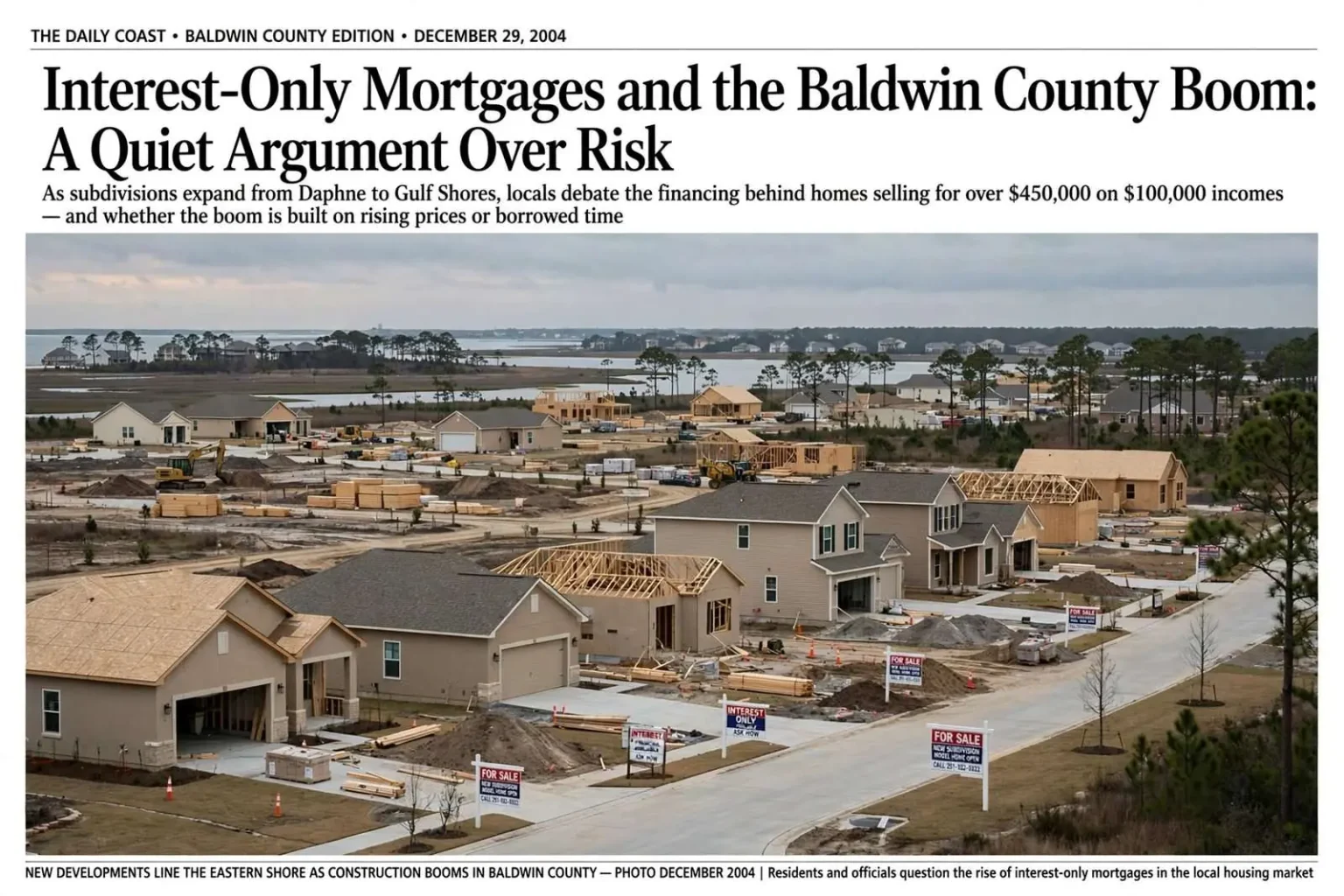
BALDWIN COUNTY — In the last days of 2004, with subdivisions marching east from the bay and For Sale signs turning over faster than anyone could remember, a quiet argument was taking place among South Alabama professionals about how, exactly, so many people were affording so much house. The boom was visible everywhere from Daphne to Gulf Shores — cul-de-sac streets where the model homes had not finished selling before the next phase broke ground — and behind the visible boom sat a question almost no one asked aloud: what income was actually paying for it?
The case that prompted the argument was ordinary enough on its face. A Baldwin County couple with a combined household income of roughly $100,000 — about $65,000 from him, about $35,000 from her — were living in a home appraised at more than $450,000. Their monthly note was about $1,000. The arithmetic did not obviously work. A conventional underwriter would have rejected the pairing of that income with that price; by the rule-of-thumb ratios of the era, the house was simply beyond them. So how did they do it?
The Mechanics of the Deal
The explanation, as the homeowner described it, was a mortgage structured so that he paid interest only for the first eight years of a 15-year term, with principal payments kicking in afterward. For eight years the note covered the loan’s cost of money and nothing else — no equity, no amortization, just the interest — and the payment stayed far below what the same loan would have cost as a conventional amortizing mortgage. The plan was never to reach the point where principal came due. Before then, the couple intended to sell, pocket whatever equity appreciation had accumulated, and roll it into the next house — deducting the interest from their income tax obligation the entire way, since mortgage interest remained one of the last broad deductions available to middle-income households.
His supporting argument was demographic: the average American homeowner moves roughly every five and a half years, so there is always a buyer waiting. Housing turnover, in this view, was as reliable as the seasons — people married, divorced, relocated for jobs, moved up, moved down, and every transition created the next seller’s exit. And, he claimed, a great many of the expensive homes changing hands in Baldwin County were being sold on exactly those terms: interest-only structures, short horizons, appreciation as the exit strategy.
If that were true, one participant in the discussion observed, then the residential real estate market in Baldwin County was functioning as a giant pyramid scheme — one in which buyers could live far beyond their means, on the cheap, for as long as prices kept climbing. The structure depended not on income supporting the asset but on the next participant arriving to refinance the last one. The label was deliberately harsh, and it was meant to be: a pyramid does not collapse from fraud but from arithmetic, when the pool of new entrants runs short.
The Bull Case
The counterargument was not that the structure was sound in principle, but that the risk was remote in practice. As long as the Gulf Coast market kept appreciating — and in late 2004 it was appreciating briskly, with Baldwin County among the fastest-growing counties in Alabama — the borrower would find his buyer and walk away with a profit. Appreciation was doing the work that equity should have done, and as long as it continued, the monthly payment was a kind of rent with a tax advantage attached.
The only real exposure, on this view, was a market that tumbled and left him unable to sell above what he owed. In the conditions of the moment, that looked to some like a minimal risk. Coastal Alabama had absorbed hurricanes and recessions before and kept growing; the Eastern Shore and the beach corridor were drawing retirees, telecommuters and transplants from higher-cost states who arrived with equity from houses sold elsewhere — buyers whose budgets made local prices look cheap. It was, in its way, an ingenious piece of financial engineering: leverage dressed up as prudence, made respectable by a rising tide.
The Bear Case
The skeptical view was that no such thing as a sure thing exists in investments, and that the scheme had a mathematical end point. If enough buyers across Baldwin County were financing homes this way, then sooner or later somebody would have to produce principal — and the whole chain depended on the next buyer being willing and able to step in. Chains like that do not fail in the first years, which is what makes them seductive; they fail when the market’s turnover slows, when rates rise, or when the pool of buyers who can qualify at the next price level thins out.
The doubt was also social. Who, in South Alabama, actually had that kind of money? There were not, the skeptic argued, many jobs in Baldwin County that paid enough to carry a $400,000 house honestly. The county’s economy — construction, tourism, retail, schools, small professional practices — generated comfortable livings, but the wage structure of the region sat far below the price structure of its newest subdivisions. Even successful professionals hesitated at that number.
The reply came back that this reflected a cloistered view of the times. The 1990s had produced a remarkable accumulation of wealth, and on both sides of Mobile Bay there were plenty of people for whom a $400,000 home was a mere cottage — executives with stock and bonus income, early retirees with investment portfolios, business owners whose profits never appeared in a salary. The county’s new buyers, on this account, included more genuine wealth than a local paycheck survey could see.
The piper, if he was to be paid at all, would be paid later. But even the optimist conceded a vulnerability: a sharp surge in interest rates would wipe the smiles off a good many faces in Baldwin County — and not only in Baldwin County. Rising rates would raise the cost of the next buyer’s mortgage, which meant the next seller’s price; a chain financed by refinancing and turnover could be broken from the top down by a move in the bond market that no local participant controlled.
Why It Mattered
The exchange is worth recording because it captures, in real time and without hindsight, a debate that most of the country would not have publicly for another two or three years. Interest-only and other nontraditional mortgage products were expanding rapidly in coastal markets in 2004, marketed as flexibility for households whose incomes were rising or whose assets sat in other forms. Regulators had not yet issued the guidance that would later flag them, and underwriting standards still assumed, in many cases, that appreciation itself was a form of collateral. The national conversation still treated home price appreciation as a near-certainty.
In South Alabama, the stakes were concrete. Baldwin County’s population and construction boom depended on a steady stream of buyers moving in from elsewhere or trading up from within, and each of those buyers had to be financed. If the financing stock of the market was skewed toward products that deferred principal, then the county’s growth was not just a demographic trend but a leveraged one — more sensitive to rates, to credit tightening, and to the first serious break in appreciation than a market of conventional 30-year loans would have been.
Coastal Alabama had spent the previous decade building on the assumption that the line on the chart pointed in one direction. The county’s roads, school construction and water systems — not to mention its municipal budgets, which leaned on sales taxes and permit fees generated by the boom — all assumed the next subdivision, the next shopping center, the next wave of new households. A financing structure that deferred its costs was invisible to all of that planning until the day it stopped working.
The people arguing about it that December were not economists. They were a lawyer and a newspaperman trading letters at the end of a year, one of them convinced he was watching a Ponzi scheme in slow motion and the other inclined to think the risk was manageable. Neither claimed certainty. What they agreed on was the shape of the question: whether the Baldwin County housing market was being carried forward by genuine income and demand, or by a financing structure that worked beautifully right up until the moment it did not.
History would soon supply its own version of the answer, though neither correspondent could have predicted the form it would take. Within a few years, interest-only and adjustable products would be at the center of a national credit crisis, Baldwin County’s inventory of unsold homes would swell, and the arithmetic that looked contrived in 2004 — a $100,000 income carrying a $450,000 house on a $1,000 note — would reappear in foreclosure filings across the county as principal came due on loans whose owners had counted on selling first.
What the correspondence preserved was the moment before: a regional market operating on a financing theory that its own participants could articulate clearly and disagree about completely. The bull case — that turnover, in-migration and wealth transfer would keep the chain moving — and the bear case — that a chain of deferred principal is a chain by definition — were both coherent, and both were local. Neither required a Wall Street vocabulary to state. It was, as one of them put it, an interesting question — and the answer would not arrive for some years.
The episode also anticipated the policy argument that followed. If a county’s housing market can be leveraged into fragility by the design of its mortgage products, then the fragility is not the homeowner’s alone: it reaches the lender’s balance sheet, the county’s tax base and the construction economy that the boom fed. The Baldwin County debate of late 2004 was, in miniature, the argument the country would hold in 2008 — conducted early, conducted locally, and conducted by two men who knew the cul-de-sacs in question by sight.