Baldwin County trespassing increases as property owners voice concerns
Baldwin County residents have shared doorbell videos and complaints about trespassers this year, but Alabama law often requires signs, fences or prior warnings before charges can be filed.
BALDWIN COUNTY, Ala. — Baldwin County trespassing complaints have been piling up this year, with residents taking to social media to share doorbell-camera clips and frustration over strangers wandering onto their land. The concerns come as a recent statewide poll found Alabamians to be strong supporters of private property rights.
Throughout the summer, posts on several social media platforms described people cutting across yards, walking onto rural acreage and driving onto private parcels. Some property owners went beyond describing the encounters and posted videos showing the trespassers and the vehicles they arrived in.
A doorbell camera and a call to police
One of the more widely discussed accounts came in June from a resident who identified herself as Madeline. In her post, she said her doorbell camera had recorded two different people coming onto her property and into her barn. One of them, she said, stood on her porch and peered through her windows.
Madeline said she contacted law enforcement, but the responding officer declined to take a report because, she was told, no crime had been committed.
That answer frustrated her and many who read the post. Under Alabama law, however, the officer’s assessment was correct.
Why many trespassing cases go nowhere
Prosecution for trespassing in Alabama is rare when a property is not posted with “No Trespassing” signs, is not protected by a secured fence, and the person who came onto it had not previously been warned to stay away.
That outcome reflects how the state’s criminal code is written. Alabama law treats a person’s presence on someone else’s property as unlawful only when that person lacks permission, or “license or privilege,” to be there. For land that is not fenced or otherwise enclosed to keep people out, the code generally presumes a visitor has that privilege unless the owner, or someone acting for the owner, has told the person to stay off, or has posted notice in a conspicuous way. In practical terms, signs, fences and direct warnings are what turn an uninvited visit into an offense an officer can act on.
Alabama divides criminal trespass into three degrees. The least serious, third-degree trespass, involves unlawfully entering or remaining on premises and is classified as a violation rather than a crime. Second-degree trespass covers unlawfully entering a building or land that is fenced or enclosed in a way designed to exclude intruders and is a misdemeanor. First-degree trespass, the most serious level, involves unlawfully entering or remaining in a dwelling and is also a misdemeanor, carrying stiffer potential penalties.
When trespassing becomes burglary
The circumstances can change quickly when locks are involved. Had the visitor in Madeline’s case gone through a locked gate or into a locked building, the matter could have escalated from trespassing to burglary, a felony.
Under state law, burglary generally requires that a person knowingly enter or remain unlawfully in a building with the intent to commit a crime inside. Because it is a felony, a burglary conviction carries far more serious consequences than a trespassing citation, including the possibility of prison time.
Vehicles on private property
Alabama’s trespassing rules extend to vehicles as well as people. A driver who leaves a vehicle parked on someone else’s property, including a business’s lot, risks more than a tow. The vehicle’s owner could also receive a misdemeanor citation for trespassing.
That provision may surprise some motorists who assume that parking in an unattended commercial lot after hours is harmless, or that the worst outcome is a towing bill.
Growth brings neighbors closer together
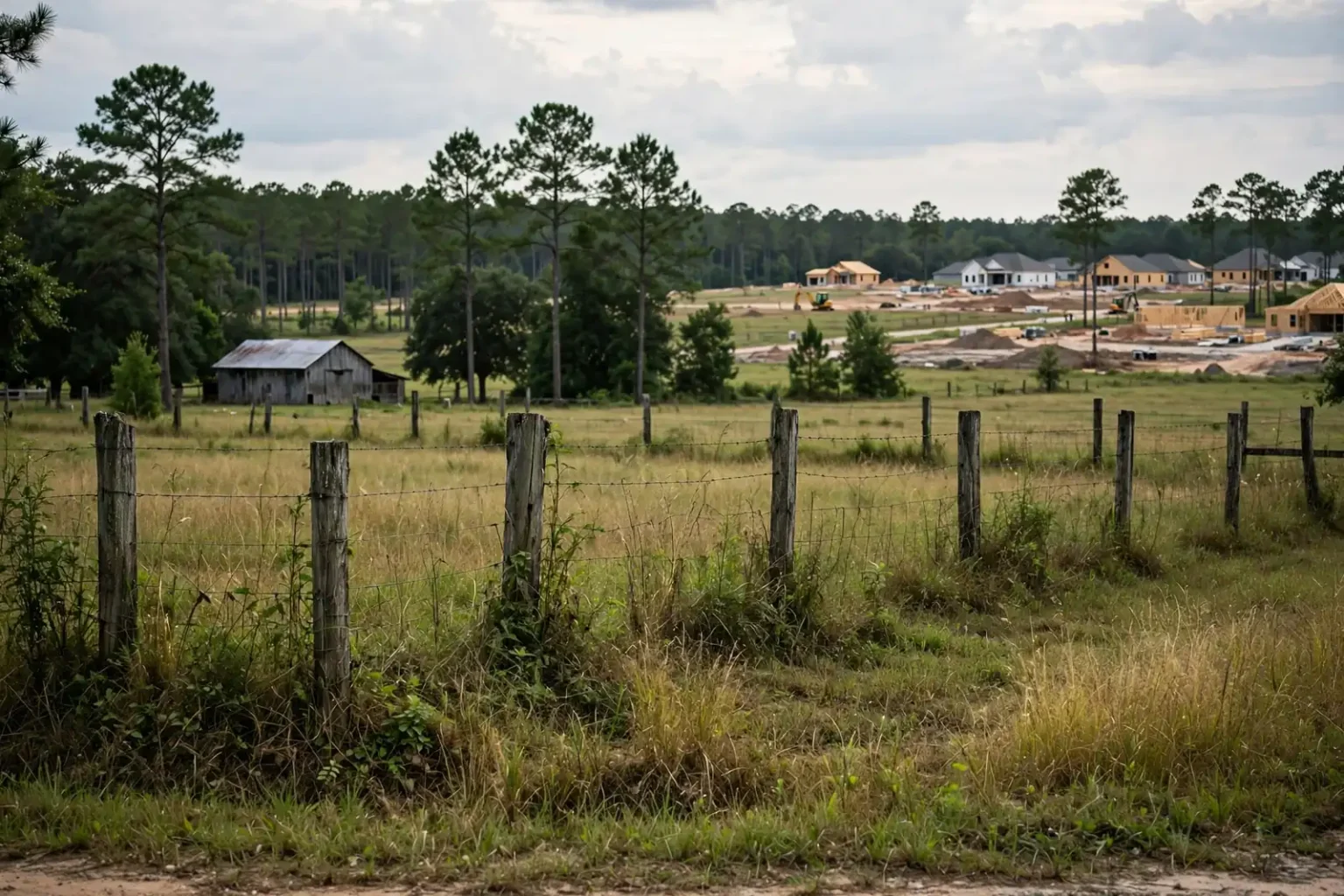
Baldwin County has for years ranked among the fastest-growing counties in Alabama, according to U.S. Census Bureau estimates, and the pace of new subdivisions and home construction has brought more people into areas that were once largely rural. As residents move in and build closer to one another, trespassing is expected to keep rising.
Trespassing, along with other property crimes, is listed among the fastest-growing categories of crime in Alabama.
For longtime landowners, the shift can mean that pastures, woods and outbuildings that once sat far from neighbors now border new streets and homes. For newcomers, the boundaries of nearby private land may not always be obvious, particularly where fences and signs are absent.
What property owners can do
Because the law places much of the burden on owners to make their wishes clear, the steps that matter most are ones that establish notice before a problem occurs. Based on how Alabama’s trespass laws are structured, property owners concerned about unwanted visitors may want to consider:
- Posting signs. Clearly visible “No Trespassing” signs give notice that entry is not permitted.
- Fencing and securing property. Fences, gates and locks designed to keep people out can raise the level of any offense and, where locked structures are entered, may open the door to more serious charges.
- Warning repeat visitors directly. A person who has been told to stay away and returns is in a different legal position than a first-time visitor.
- Keeping recordings. Doorbell and security camera footage, like the videos residents shared this summer, can help document who entered a property and when.
- Calling law enforcement. Reporting incidents creates a record, even when officers determine that no charge can be filed at that time.
Residents with questions about whether a specific situation rises to the level of a crime can contact the Baldwin County Sheriff’s Office or their local police department. For emergencies or crimes in progress, residents should call 911.