Six Charged in Mobile Tax Refund Fraud Case Prosecutors Say Sought $177 Million, Got $81 Million
Federal prosecutors say a Mobile tax preparation business and five of its preparers filed more than 9,000 false returns seeking $177 million in refunds; about $81 million was paid. All six are presumed innocent.
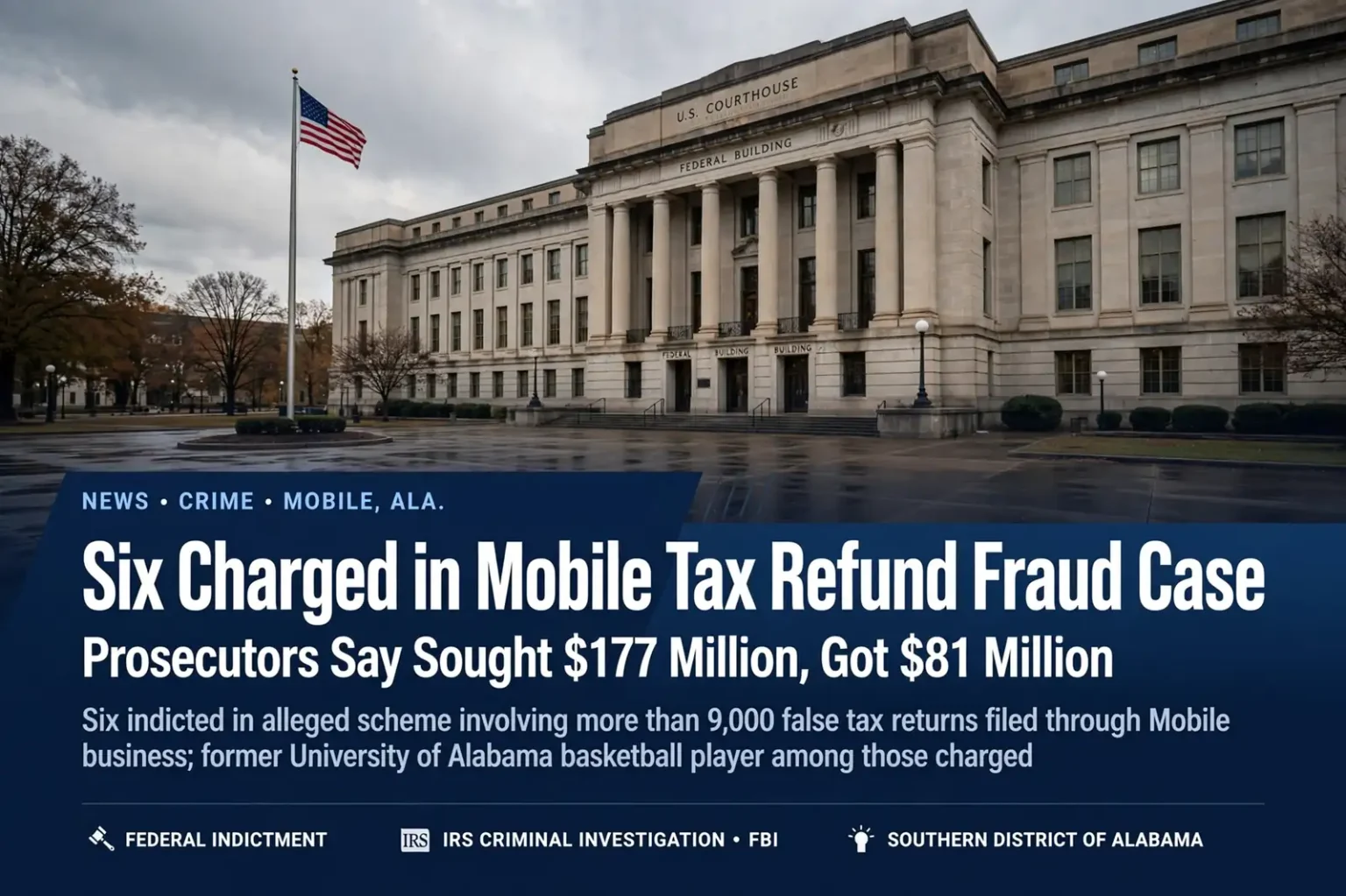
MOBILE, Ala. — Six people tied to a Mobile tax preparation business, including a former University of Alabama basketball player, have been indicted in what federal prosecutors describe as a Mobile tax refund fraud scheme that sought more than $177 million in federal tax refunds through more than 9,000 allegedly false returns. The IRS issued about $81 million of those refunds, according to the indictment, which was unsealed Wednesday, Oct. 28.
The U.S. Attorney’s Office for the Southern District of Alabama announced the charges, saying the case is part of ongoing enforcement work led by the Justice Department’s National Fraud Enforcement Division, the Internal Revenue Service and IRS Criminal Investigation, working with the FBI. Federal officials described the announcement as coinciding with coordinated arrests.
An indictment is an accusation, not a finding of guilt. All six defendants are presumed innocent unless and until they are proven guilty beyond a reasonable doubt in court.
Who is charged
According to the indictment, Jennifer Beverly, 47, of Mobile owned and operated JB Accounting Tax Service LLC, a tax preparation business on Broad Street that prepared returns in Mobile from about 2022 through 2024. Prosecutors say the other five defendants worked for Beverly as tax preparers:
- Jadasha Bowman, 28
- Kennedy Lawrence Stovall Winston, 42
- Solida Lucille Green, 36
- Paris Lovett, also known as Paris Johnson, 30
- Shermeka Benjamin, 38
Winston is a former Blount High School standout who went on to play basketball at the University of Alabama. He is also charged in a separate, unrelated federal case involving stolen Treasury checks. He is presumed innocent in both cases.
What the Mobile tax refund fraud indictment alleges
Prosecutors allege that from about 2021 through 2024, the defendants took part in a scheme to prepare and submit false and fraudulent federal income tax returns to the IRS. The returns allegedly included false entries on a range of forms and schedules, including:
- Schedule C statements, which report profit or loss from a business
- COVID-19-related credits
- Fuel tax credits
- Credit repayments
- Estimated tax payments
- Schedule A statements, which list itemized deductions
- Schedule 3 statements, which report additional credits and payments
- Education credits
According to the indictment, some of the returns reported businesses that the clients did not actually own or operate, and claimed credits for work interruptions that the clients allegedly never experienced.
In all, prosecutors say, the scheme involved more than 9,000 allegedly fraudulent returns seeking more than $177 million in refunds. Approximately $81 million in refunds was paid out. Those totals describe the alleged scheme as a whole and are not attributed to any single defendant.
How the alleged false claims work
Several of the items named in the indictment are ones the IRS has repeatedly warned taxpayers about.
Business losses reported on Schedule C reduce a filer’s taxable income, so inventing a business, or inventing expenses for a real one, can shrink a tax bill or generate a refund. Credits are even more powerful, because they reduce the tax owed dollar for dollar, and some can produce a refund larger than the tax a person actually paid.
The federal fuel tax credit is designed for people who buy fuel for certain nontaxable uses, such as running farm equipment or other off-highway business machinery. Because few ordinary wage earners qualify, the IRS has for years listed improper fuel tax credit claims among its annual “Dirty Dozen” warnings about common tax scams. The pandemic also brought a series of temporary credits, including credits for self-employed people whose work was disrupted by COVID-19, that the IRS later said were targeted by fraudulent claims.
Tax preparers sign returns they prepare for clients and are required to use reasonable care to make sure the information is accurate. Prosecutors in this case allege the defendants did the opposite.
Charges against each defendant
All six defendants are charged with conspiracy to commit wire fraud. Each also faces individual counts of wire fraud, tied to specific returns:
- Jennifer Beverly: 63 counts of wire fraud
- Jadasha Bowman: 11 counts
- Solida Lucille Green: 11 counts
- Paris Lovett: 11 counts
- Kennedy Lawrence Stovall Winston: five counts
- Shermeka Benjamin: four counts
The five returns cited in the counts against Winston allegedly claimed false fuel tax credits and together sought about $101,896 in refunds, according to the indictment. Prosecutors do not allege that Winston personally received the $81 million paid out across the full scheme.
Wire fraud is charged when someone allegedly uses interstate wire communications, which include electronically filed tax returns, to carry out a scheme to obtain money through false or fraudulent pretenses. If convicted, each defendant faces a maximum of 20 years in prison per count, along with possible supervised release, fines, special assessments and restitution. Actual sentences in federal cases are set by a judge after considering federal sentencing guidelines and other factors, and are often well below the statutory maximum.
Federal officials call it a ‘staggering abuse’
Maisha Horton, acting special agent in charge of IRS Criminal Investigation’s Atlanta Field Office, said the size of the alleged scheme was remarkable.
“The allegations in this case reveal a staggering abuse of the federal tax system, involving more than 9,000 allegedly fraudulent tax returns, over $177 million in refund claims, and approximately $81 million in refunds issued,” Horton said. “Tax return preparers are entrusted with sensitive financial information and have a responsibility to uphold the integrity of our nation’s tax system, not exploit it for personal financial gain.”
“Those who seek to enrich themselves by manipulating tax credits and defrauding the American taxpayer should understand that IRS Criminal Investigation, along with the FBI and the U.S. Attorney’s Office, is committed to uncovering these schemes, following the money, and holding those responsible accountable,” she said. “This indictment underscores our unwavering commitment to protecting taxpayer dollars and preserving public trust in the integrity of our tax system.”
Christopher R. Flowers, special agent in charge of the FBI’s Mobile Field Office, pointed to cooperation between the two agencies.
“Today’s coordinated arrests highlight the strong partnership between the FBI and IRS Criminal Investigation,” Flowers said. “These allegations involve a serious breach of trust, and our agencies worked closely to identify the extent of the fraudulent activity and ensure accountability. Rebuilding public trust is one of the FBI’s core priorities, and we will continue to pursue anyone who exploits our financial and tax systems for personal gain. We remain committed to working alongside our federal partners to protect the public and uphold the integrity of the institutions they rely on.”
Prosecutors seek 12 properties
The indictment includes a forfeiture notice, which signals that prosecutors will ask the court to take certain assets if the defendants are convicted. It seeks a money judgment against each defendant equal to the proceeds that person allegedly obtained, and it identifies 12 real properties belonging to one or more of the defendants.
Mobile County property records attached to the case show a combined 2026 appraised value of $3,183,500 for the 12 properties. That figure is the county’s appraisal total for tax purposes. It is not a court finding about what the properties would sell for, and it does not represent the amount of money any defendant allegedly received.
Criminal forfeiture happens only after a conviction. If a defendant is acquitted, the forfeiture allegations against that defendant fall away.
What happens next
A court date has not yet been set. In federal court, defendants are typically brought before a magistrate judge for an initial appearance and arraignment, where they are advised of the charges and enter pleas. The case will then move through discovery and pretrial motions, and it may be resolved by trial or by plea agreements.
The case is being handled in the U.S. District Court for the Southern District of Alabama in Mobile.
Protecting yourself at tax time
Cases like this one are a reminder that taxpayers remain legally responsible for what appears on their own returns, even when someone else prepares them. The IRS offers several basic precautions for choosing a preparer:
- Make sure the preparer has a valid Preparer Tax Identification Number, or PTIN, and signs the return.
- Be wary of anyone who promises an unusually large refund or bases the fee on the size of the refund.
- Never sign a blank return, and review every line before signing.
- Make sure any refund goes directly to your own bank account, not the preparer’s.
- Ask questions about any business, credit or deduction on the return that you do not recognize.
Clients whose returns contained false information can face consequences of their own. The IRS can audit a return, disallow improper credits or deductions, and require repayment of a refund that should not have been issued, along with interest and, in some cases, penalties. Taxpayers who are concerned about a return a preparer filed on their behalf can request a transcript of their account from the IRS to see exactly what was reported, and can file an amended return to correct errors.
Taxpayers who suspect a preparer of filing false returns can report it to the IRS using Form 14157, Return Preparer Complaint.