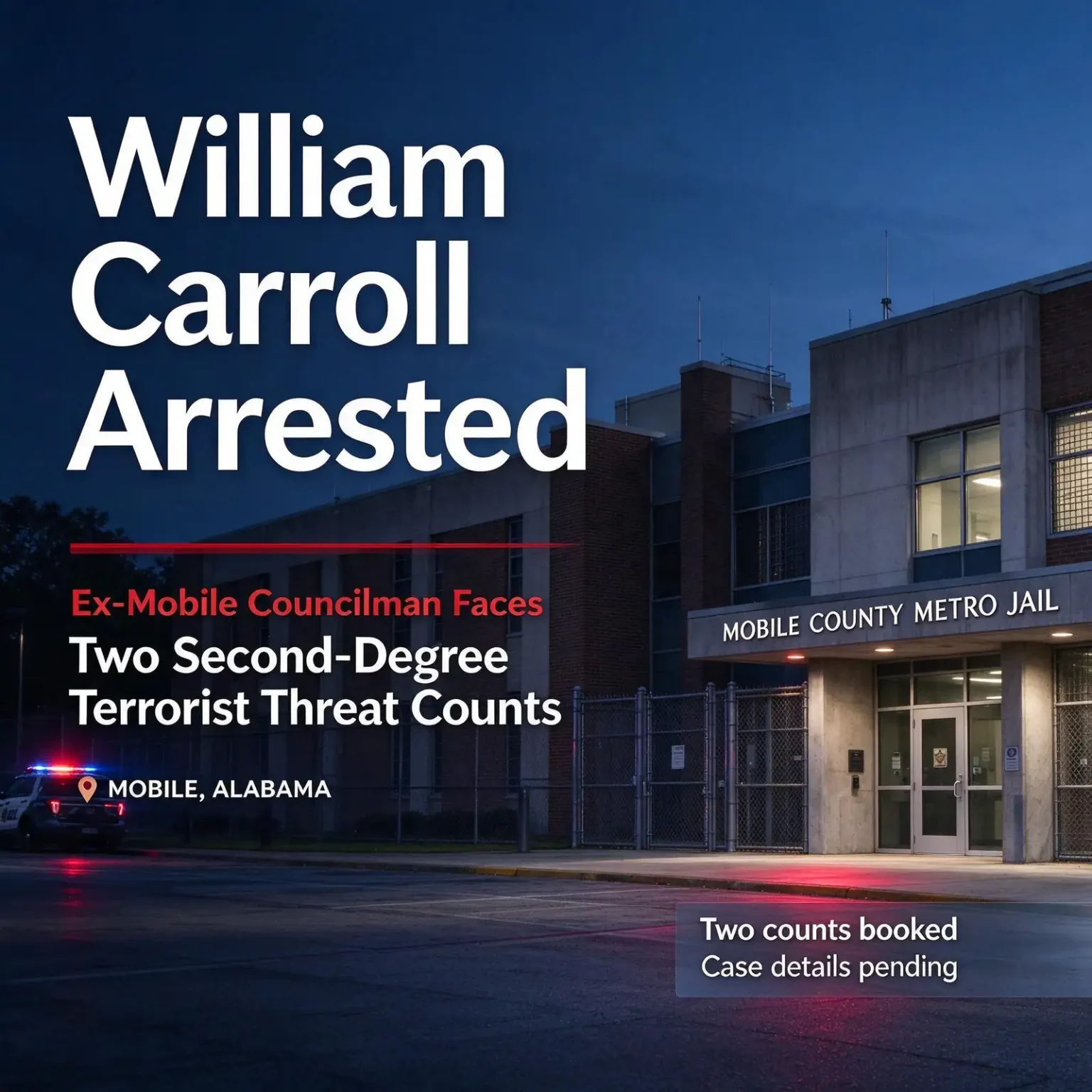
MOBILE, Ala. — William Carroll arrested: The former Mobile City Council member who represented District 2 for more than a decade was taken into custody Wednesday evening, Oct. 28, and charged with two counts of making a terrorist threat in the second degree, according to the Mobile County Sheriff’s Office and Mobile County Metro Jail records.
Deputies with the sheriff’s office served an arrest warrant on Carroll, and he was booked into Metro Jail at about 7:52 p.m. Jail records show each of the two charges carries a $3,000 bond. Carroll was released shortly after 9 p.m., and a bond hearing is scheduled for Friday, Oct. 30, according to jail records.
The charges are accusations only. Carroll has not been convicted of any crime and is presumed innocent unless and until he is proven guilty in court.
What is known about the William Carroll arrest
Although sheriff’s deputies made the arrest, officials said the case belongs to the Mobile Police Department, which conducted the investigation that led to the warrant.
Mobile County Sheriff Paul Burch confirmed the arrest Wednesday night but said he did not have details about the alleged threats or the circumstances behind the charges. A Mobile Police Department spokesperson said additional information would be released Thursday, Oct. 29.
As of Wednesday night, authorities had not said what Carroll is accused of saying or doing, when the alleged threats were made, or whether any particular person or location was targeted.
Here is a summary of the details officials and jail records have released so far:
- Charges: Two counts of making a terrorist threat in the second degree
- Arresting agency: Mobile County Sheriff’s Office, serving a warrant
- Investigating agency: Mobile Police Department
- Booked: Mobile County Metro Jail, about 7:52 p.m. Wednesday, Oct. 28
- Bond: $3,000 on each count
- Released: Shortly after 9 p.m. Wednesday
- Next court date: Bond hearing set for Friday, Oct. 30, according to jail records
Spokesperson: ‘A heated disagreement’
Carroll’s spokesperson, Kimberly Rossler, released a brief statement after his release that described the incident behind the charges as an argument and signaled that Carroll intends to fight them.
“He is out and at home after he had a heated disagreement with someone. We know how passionate William can be, but he will be taking further action over this dramatic charge.”
The statement did not identify the other person involved or say what form the “further action” might take.
What a second-degree terrorist threat charge means in Alabama
Despite its name, the charge Carroll faces is not a terrorism charge in the federal sense and, at the second-degree level, is not a felony. Alabama lawmakers rewrote the state’s terrorist threat law in 2023, splitting the offense into first- and second-degree crimes. The bill was enacted in June 2023.
Under that law, a person commits the offense when, based on an objective evaluation, he or she credibly threatens to commit a crime of violence against a person, or to damage property, using a bomb, explosive, weapon of mass destruction, firearm, deadly weapon or other mechanism.
The statute defines “threaten” narrowly. To qualify, a statement must be made intentionally and knowingly, communicated to another person, and be credible and imminent, and it must cause the person to reasonably be in sustained fear.
The difference between the two degrees turns on what the threat causes:
- First degree applies when the threat also causes the evacuation of a building or other real property, disrupts a school, church or government activity, or is made to retaliate against someone for taking part in a legal proceeding or giving information to law enforcement. It is a Class C felony.
- Second degree, the charge Carroll faces on both counts, covers the same kind of credible threat without those added circumstances. It is a Class A misdemeanor.
A Class A misdemeanor is the most serious level of misdemeanor in Alabama. Under state sentencing law, it is punishable by up to one year in jail and a fine of up to $6,000. Misdemeanor cases in Alabama generally begin in district court.
Whether the statements at the center of Carroll’s case meet the law’s definition of a credible, imminent threat would ultimately be for prosecutors to prove and a court to decide.
Carroll’s long tenure on the Mobile City Council
Carroll is one of the more familiar names in Mobile city politics. He represented District 2 on the seven-member Mobile City Council from 2005 to 2013, then returned to the seat in 2021 and served until 2025.
He lost his bid for re-election in the August 2025 municipal election to Samantha Ingram, a former Mobile County Public School System administrator who now holds the District 2 seat.
After the election, Carroll went to court to challenge the result. He argued that Ingram should be removed because she did not meet the city’s residency requirement, pointing to the fact that she had been living in Georgia in 2024 and voted there in that year’s presidential election.
The dispute turned on whether a candidate for a Mobile council district must live there for one year, as Carroll’s attorney argued under the 1985 Zoghby Act that set up Mobile’s current form of government, or for 90 days, as a newer statewide law provides. Ingram took the oath of office in early November 2025 while the challenge was still pending.
On Nov. 20, 2025, Mobile County Circuit Judge Brandy Hambright dismissed the challenge, ruling that the more recent statewide law took precedence and that Ingram was a qualified candidate. In her ruling, Hambright wrote that rejecting all post-1985 laws on district council residency “is neither practical nor consistent with rules of statutory construction.”
Ingram has remained in office since. Earlier this month she scheduled a community safety forum at the Rickarby Center for District 2 residents, and during the council’s Oct. 27 meeting she joined District 1 Councilman Cory Penn in calling for the administration to keep the council informed about fraud attempts against the city.
Authorities have not said whether Wednesday’s charges have any connection to Carroll’s time in office, the 2025 election or anyone currently serving in city government.
What happens next
The next scheduled step is Friday’s bond hearing. Police have said they expect to release more information about the case on Thursday, which may answer questions about what Carroll is alleged to have said, when and to whom.
Carroll’s spokesperson has indicated he will contest the charges. As with any criminal case, the burden is on the state to prove each element of the offense beyond a reasonable doubt, and Carroll is entitled to a defense and to his day in court.
South Alabama News will update this story as police and court officials release additional details.