West Alabama Highway Picks Up Speed North of Thomasville as Key Intersection Closes Nov. 2
Construction on the 70- to 75-mile West Alabama Highway is moving quickly from Thomasville north toward Moundville, with the Linden bypass complete and a Thomasville intersection closing Nov. 2 for about two months.
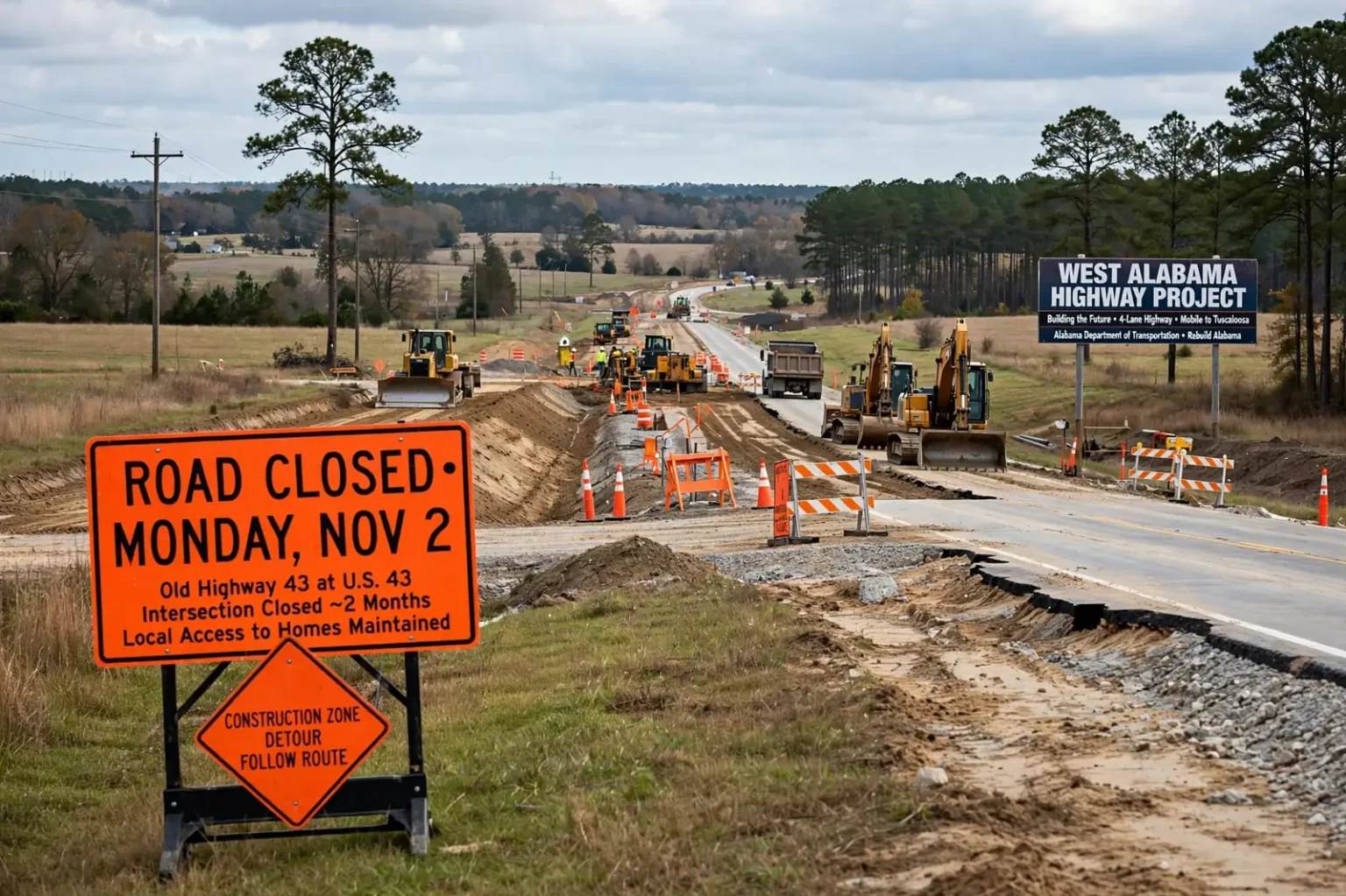
THOMASVILLE, Ala. — Bulldozers, earthmovers and road crews are moving quickly along the U.S. Highway 43 and Alabama Highway 69 corridor north of Thomasville, where the West Alabama Highway is taking shape as one of the largest highway construction projects the state has undertaken in recent memory.
The project will turn a largely two-lane route through the rural heart of west Alabama into a modern four-lane highway, giving drivers a continuous divided highway between Mobile and Tuscaloosa. Much of the visible work right now is concentrated along a 45-mile stretch running north from Thomasville through Dixons Mills and Linden to Gallion.
For Clarke County drivers, the project will soon be more than a distant construction zone. Beginning Monday, Nov. 2, a key intersection in Thomasville will close for about two months to make way for the new road.
Thomasville intersection to close Nov. 2
The intersection of Old Highway 43 and U.S. 43, just north of O’Bryant Funeral Home in Thomasville, will close starting Nov. 2 because of construction. The closure is expected to last about two months.
Residents who live along the old highway will still be able to reach their homes, according to project information. Drivers who normally use that intersection to get on or off U.S. 43 should plan for a different route and allow a little extra time while the work is underway.
- Location: Old Highway 43 at U.S. 43, just north of O’Bryant Funeral Home, Thomasville
- Closure begins: Monday, Nov. 2
- Expected duration: about two months
- Local access: residents along Old Highway 43 will keep access to their properties
Where West Alabama Highway work stands
Progress is uneven along the corridor, with the southern end well ahead of the northern sections.
The bypass around Linden, the Marengo County seat, is complete. Bypasses around Dixons Mills and Gallion are moving forward. Those bypasses are designed to carry through traffic around the small towns rather than down their main streets, which improves safety and keeps heavy trucks out of town centers.
Farther north, from Gallion through Greensboro and on to Moundville, the cleared right of way for the new highway can be seen from the road, but construction there is not as far along as it is to the south.
Just north of Moundville, the new highway will tie into the existing four-lane section of Alabama 69, which already carries traffic on to Tuscaloosa. All told, the project covers roughly 70 to 75 miles.
To the south, the route already connects to an existing four-lane highway. U.S. 43 is four lanes from Thomasville all the way to Mobile, so once the West Alabama Highway is finished, drivers will be able to travel between the Port City and Tuscaloosa on a four-lane route the entire way.
A long-sought link for the Black Belt
The project’s price tag is estimated at $750 million to $1 billion. Gov. Kay Ivey announced it in 2019, describing a safer and faster north-south highway for west Alabama that could help spur economic development in the Black Belt.
That same year, the Legislature passed the Rebuild Alabama Act, which raised the state’s gasoline tax to pay for road and bridge improvements. The West Alabama Highway is part of the Rebuild Alabama program, which is funded by those state fuel taxes.
The Rebuild Alabama Act raised the state fuel tax by 10 cents a gallon, phased in over three years beginning in 2019, and was the first increase in Alabama’s gas tax in decades. The law also indexed the tax to construction costs going forward and set aside money for city and county roads in addition to state highway projects. Large corridor projects such as the West Alabama Highway are among the most visible uses of that revenue.
For the communities along U.S. 43 and Alabama 69, the investment represents a change many have sought for years. The two-lane route has been a lifeline for residents, school buses, log trucks and farm equipment, but it was never designed for the volume and speed of modern traffic.
The Black Belt, named for its dark, fertile soil, stretches across the middle and western parts of the state and includes some of Alabama’s most rural and economically challenged counties. Community leaders have long argued that the lack of a modern four-lane highway has made it harder to attract industry and jobs to the region.
When the state outlined the project in Demopolis in April 2025, local leaders made that case directly. Demopolis Mayor Woody Collins said “West Alabama has been ignored for so many years” and said the highway would “open up more trade.” State Sen. Bobby Singleton said, “We needed new bridges, we need a new highway.”
Demopolis officials said at the time that a former grocery store on U.S. Highway 80 would serve as the project’s headquarters, and that they expected about 700 jobs at the peak of construction.
Why the work is moving so fast
Much of the credit for the accelerated pace goes to the way the project is being delivered. The Alabama Department of Transportation is using a method called progressive design-build, the first time the approach has been used on a state highway project in Alabama.
Under a traditional highway project, the state typically finishes the design, then puts the job out for bids and hires a contractor to build it. Each step generally waits on the one before it.
With progressive design-build, the state brings a combined design and construction team on board early and works with it as the design develops. Engineering, environmental permitting, right-of-way acquisition and utility relocation are coordinated together rather than handled one after another. That overlap allows crews to start building some sections while others are still being designed or permitted, which can shave considerable time off a large project.
The approach is especially useful on a long corridor like this one, where different segments can be at different stages at the same time. That is exactly what drivers can see along the route today: a completed bypass at Linden, active construction at Dixons Mills and Gallion, and cleared right of way waiting farther north.
Engineering firm Neel-Schaffer, which is part of the design team, has described the West Alabama Highway as the first progressive design-build project for ALDOT, with work that includes roadway, structural and hydraulic design and the design of several bridges along the corridor.
The towns along the route
The corridor links a string of small communities that have long depended on the two-lane highway as their main connection to the rest of the state.
- Thomasville: The Clarke County city sits at the northern end of the existing four-lane U.S. 43 from Mobile and marks the southern starting point of the new construction.
- Dixons Mills: A small Marengo County community where a bypass is under construction.
- Linden: The seat of Marengo County, where the new bypass is complete.
- Gallion: A small community in Hale County where a bypass is progressing.
- Greensboro: The Hale County seat, along the northern section where right of way has been cleared.
- Moundville: Home to the Moundville Archaeological Park, where the new highway will connect to the existing four-lane Alabama 69 leading to Tuscaloosa.
What it means for south Alabama
Although most of the construction is north of Clarke County, the finished highway is expected to matter to the Mobile area as well. A continuous four-lane route would give travelers, freight haulers and businesses a more direct and safer path between Mobile and Tuscaloosa, and beyond that to the Birmingham area and points north.
Two-lane highways with heavy truck traffic carry a higher risk of head-on and passing crashes. Divided four-lane highways separate opposing traffic and give drivers room to pass safely, which is one of the main reasons state leaders cited safety as a key goal of the project.
The route also connects the Port of Mobile with the timber, agriculture and manufacturing economies of west Alabama, where logging trucks and freight are a constant presence on U.S. 43.
A longer vision: to the Tennessee line
The current project is only part of a larger plan. Officials eventually hope to extend the West Alabama Highway all the way to the Tennessee state line, creating a four-lane corridor that runs the length of western Alabama.
No timeline has been announced for that longer extension. For now, the focus remains on finishing the Thomasville-to-Moundville stretch that will close the remaining two-lane gap between Mobile and Tuscaloosa.
What drivers should know
With construction active across dozens of miles, drivers on U.S. 43 and Alabama 69 should expect work zones, equipment entering and leaving the roadway, lane shifts and occasional detours. Slowing down and following posted signs in work zones helps protect both drivers and the crews building the road.
In Thomasville, the most immediate change is the Nov. 2 closure of the Old Highway 43 intersection. Drivers who use it regularly should plan alternate routes for the next two months, while residents along the old highway will continue to have access to their homes.