New 9th Avenue Pedestrian Path Will Link Foley High, Highway 59 Sidewalks and South Foley Neighborhoods
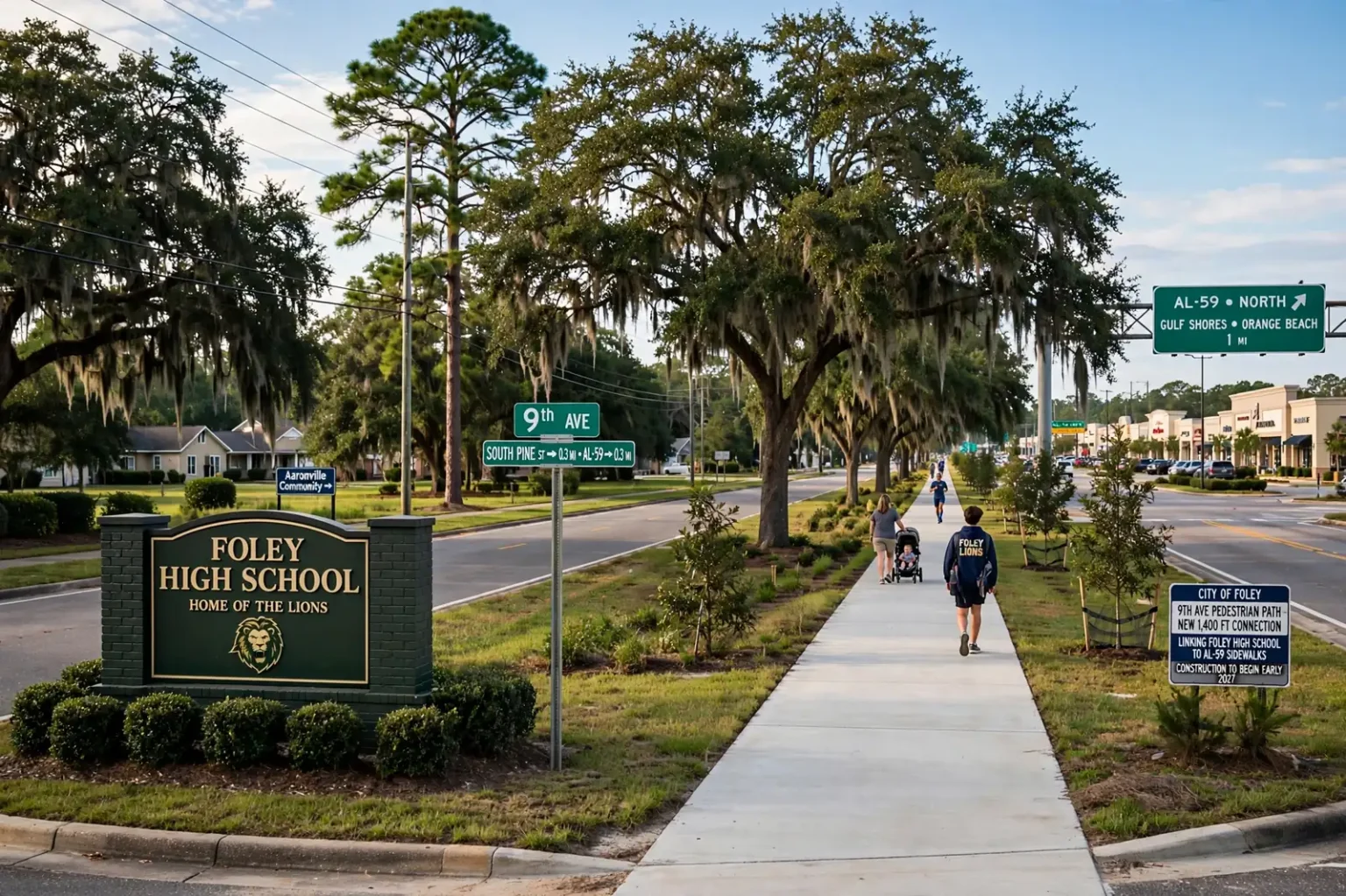
Foley has approved design work for a 1,400-foot 9th Avenue pedestrian path connecting Alabama 59 sidewalks with Foley High School, the Aaronville community and Florence B. Mathis Elementary. Construction is expected in early 2027.
FOLEY, Ala. — Walkers, runners and students in south Foley will soon have a safer way to get between neighborhoods, schools and the city’s main highway corridor, as the city moves ahead with a 9th Avenue pedestrian path designed to tie together two existing sidewalk networks.
The Foley City Council approved a professional services proposal to design the path along 9th Avenue from South Pine Street to Alabama 59. Construction is expected to begin in early 2027.
The new walkway will stretch about 1,400 feet, running from Alabama 59 to the northeast corner of the Foley High School campus. Along the way, it will close a gap between sidewalks the city has already built, creating a continuous route for people on foot between the highway and the neighborhoods and schools to the west.
Closing the gap between two sidewalk systems
Foley City Engineer Taylor Davis said the project will connect walkways the city previously built with money from the federal Transportation Alternatives Program, commonly known as TAP.
“We completed the TAP grant sidewalk in front of the high school on 9th Avenue two or three years ago, and we’re just now completing the TAP grant on 59. So this would connect over there to it,” Davis said.
In other words, the city already has a sidewalk along 9th Avenue in front of Foley High School and is finishing another along Alabama 59. What has been missing is the stretch in between. The new path fills that hole, so a pedestrian will be able to travel from the high school area to the highway without having to walk along the edge of the road.
Four miles of sidewalk along Alabama 59
The 9th Avenue project is one piece of a larger effort to make Foley’s busiest corridor more walkable.
The city is nearing completion of a sidewalk on Alabama 59 between Pride Drive and Azalea Avenue. That section is the last link in a plan to provide about four miles of pedestrian walkways along the highway, from Miflin Road, also known as Baldwin County 20, south of Tanger Outlets, north to Peachtree Avenue.
Alabama 59 is the main north-south artery through Foley and one of the primary routes for beach traffic heading to Gulf Shores and Orange Beach. The corridor is lined with shopping centers, restaurants, offices and the Tanger Outlets, and it carries heavy traffic year-round, with even more during the summer tourist season. Continuous sidewalks give people who walk to work, shop or catch a ride a safer place to travel away from that traffic.
How the 9th Avenue pedestrian path links schools and neighborhoods
Once complete, the 9th Avenue path will tie the new highway sidewalks into walkways that already serve several important destinations in south Foley:
- Foley High School, where the path will end at the northeast corner of the campus
- The Aaronville community, one of Foley’s established neighborhoods
- Florence B. Mathis Elementary School
- The Cedar Street sidewalk system, which runs about three miles north from 9th Avenue to West Peachtree Avenue
Connections near schools are a particular focus for many cities. Students who walk or bike to class, as well as parents walking younger children, benefit from sidewalks that keep them separated from passing cars. Continuous routes also make it easier for families to reach after-school activities, parks and nearby businesses on foot.
Cedar Street sidewalk extension
The 9th Avenue work will also strengthen links to the Cedar Street sidewalk system, which already stretches roughly three miles from 9th Avenue north to West Peachtree Avenue.
The City Council recently approved additional work to extend that system north to Village Square Boulevard. The council approved a memorandum of understanding with a developer to help pay for the new section of sidewalk along North Cedar Street, which will run from West Peachtree Avenue to Village Square Boulevard.
Taken together, the projects are building a network rather than a collection of isolated sidewalk segments. A pedestrian starting near Foley High School will eventually be able to head east on 9th Avenue to Alabama 59 and follow the highway sidewalks, or head north on Cedar Street toward the center of town and beyond.
What the Transportation Alternatives Program pays for
The Transportation Alternatives Program is a federal program administered by the Federal Highway Administration that sets aside a portion of federal highway money for smaller projects aimed at people who are not traveling by car. Eligible projects include sidewalks, bicycle lanes, trails, safe routes to school, pedestrian crossings and similar improvements.
In Alabama, the program is managed by the Alabama Department of Transportation, which accepts applications from cities, counties and other local agencies and awards funding on a competitive basis. Federal TAP grants generally cover a large share of a project’s cost, while the local government provides a matching contribution.
Foley has used TAP funding for both the sidewalk in front of Foley High School on 9th Avenue and the sidewalk along Alabama 59. The new 9th Avenue path is designed to make those earlier investments more useful by linking them together.
Part of a broader push for walkability
Foley has grown rapidly in recent years, with new subdivisions, shopping centers and tourist attractions drawing residents and visitors to the city. That growth has added traffic to local streets and increased demand for safe places to walk.
The city has responded with a series of pedestrian projects. Earlier this month, the council’s agenda also included new crosswalks along Highway 98, and the Cedar Street and Alabama 59 sidewalk projects are steadily filling in gaps across the city.
Sidewalk networks are generally most useful when they are continuous. A sidewalk that ends abruptly forces walkers into the street or onto grassy shoulders, which can be especially difficult for people pushing strollers, using wheelchairs or walking with small children. By focusing on connections like the 9th Avenue path, the city is aiming to turn existing segments into routes that people can use from end to end.
What happens next
With the design contract approved, engineers will now prepare plans for the 9th Avenue path between South Pine Street and Alabama 59. Construction is expected to start in early 2027.
The city had not announced a cost estimate or a specific completion date for the project. Meanwhile, work continues on the final section of sidewalk along Alabama 59 between Pride Drive and Azalea Avenue, and on plans to carry the Cedar Street sidewalk north to Village Square Boulevard.
- Project: 9th Avenue pedestrian path
- Route: 9th Avenue from Alabama 59 to the northeast corner of the Foley High School campus, with design covering South Pine Street to Alabama 59
- Length: about 1,400 feet
- Status: design contract approved by the Foley City Council
- Construction: expected to begin in early 2027
- Connects to: Alabama 59 sidewalks, Foley High School, the Aaronville community, Florence B. Mathis Elementary School and the Cedar Street sidewalk system
When finished, the short stretch of path along 9th Avenue is expected to have an outsized effect, linking miles of sidewalk that until now have stopped short of one another and giving south Foley residents a safer way to get where they are going on foot.