Baldwin County’s Spay and Neuter Voucher Program Has Quietly Reached Thousands of Pets in Two Years
The Baldwin County Animal Shelter’s voucher program pays participating clinics $100 for dogs and $50 for cats toward spay and neuter surgeries, with $20 and $10 procedures available to low-income households.
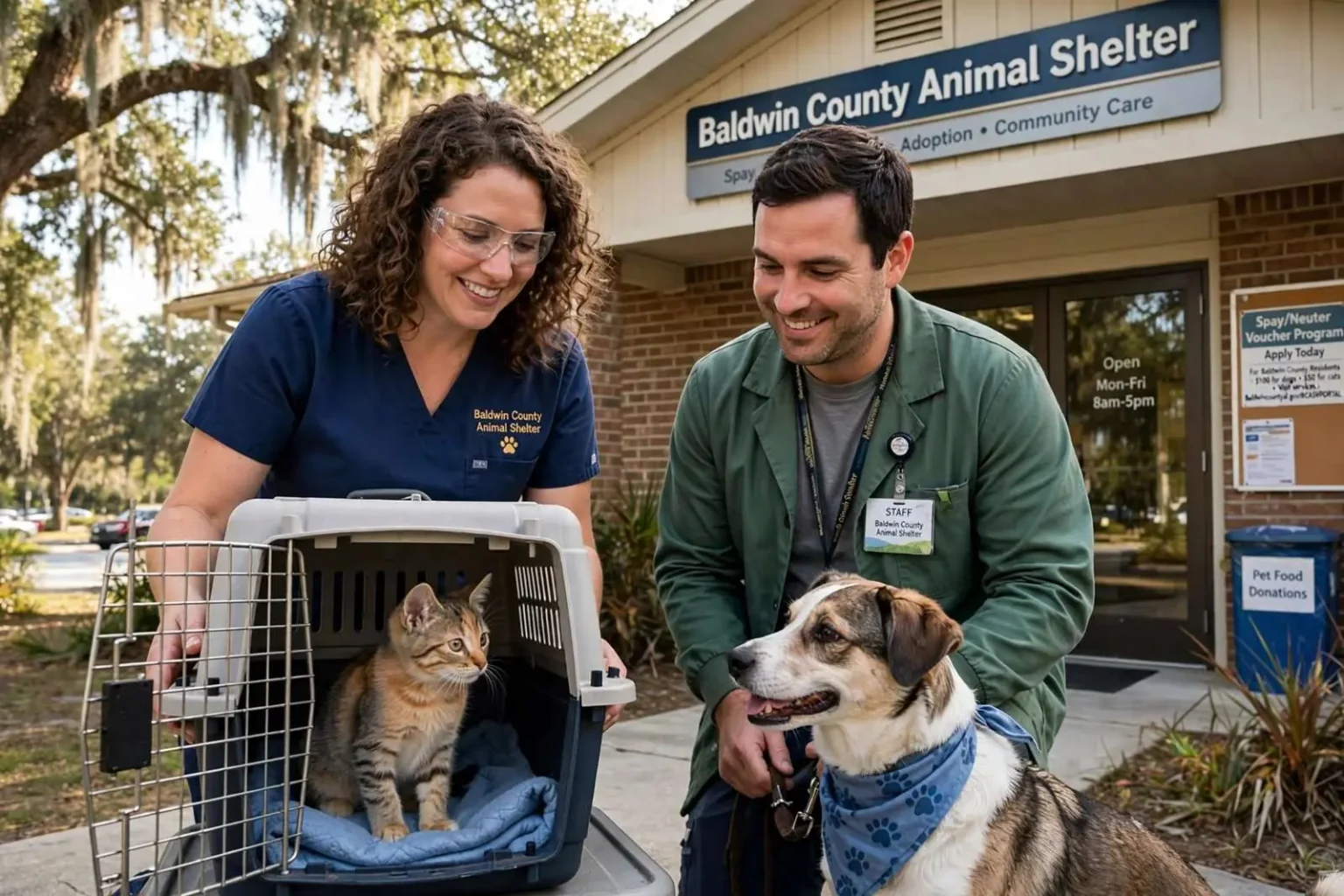
Animal shelters spend most of their public attention on the animals already inside them. The Baldwin County Animal Shelter has spent the last two years working on the arithmetic that determines how many arrive in the first place.
The shelter’s discount voucher program helps county residents cover the cost of spaying or neutering their animals. It has operated for nearly two years, continues to grow in reach, and shelter officials say the goal is straightforward: stop pet overpopulation at its source by making the surgeries affordable.
How the Voucher Works
The mechanism is deliberately simple. The Baldwin County Animal Shelter pays participating veterinary clinics directly — $100 for dogs and $50 for cats — to apply toward the cost of the spay or neuter procedure. Pet owners are responsible for the remaining balance.
Participating clinics include:
- Bay Minette Animal Clinic
- Central Baldwin Vet Hospital
- Happy Acres Vet Clinic
- Advanced Animal Care
- Robertsdale Animal Clinic
Paying the clinic directly rather than reimbursing the owner removes the single biggest barrier in most subsidy programs: the requirement that someone front the full cost and wait for money back. For a household where the surgery is already a stretch, a reimbursement model is functionally the same as no program at all.
A Deeper Discount for Low-Income Households
Low-income residents may also qualify for services at The Surgery Center at Safe Harbor Animal Coalition, a private nonprofit spay-and-neuter clinic in Foley.
Safe Harbor provides low-cost services to rescue organizations, shelters and low-income pet owners in Baldwin County. It is not open to the general public outside those categories.
Eligibility is based on receipt of government assistance — Medicaid, WIC, EBT or Social Security Disability — or on a household income below the Baldwin County median.
For qualifying households, the procedure costs $20 for dogs and $10 for cats, including a rabies vaccination if needed. That is roughly a tenth of typical private-practice pricing, and the included rabies vaccination folds a second public health requirement into the same visit.
Safe Harbor is listed as a participating clinic for low-income households only. Pet owners interested in that option are encouraged to contact the clinic directly about costs and requirements before scheduling.
The Math That Makes This Work
Shelter advocates describe each procedure as preventing not one animal but a lineage, and the underlying reproductive numbers explain why.
A single unaltered female cat or dog can produce dozens of offspring in a short period, and those numbers grow quickly without intervention. Cats in particular reach sexual maturity young, can have multiple litters in a year, and in the Gulf Coast’s mild climate breed close to year-round rather than seasonally. Because the offspring themselves reach breeding age within months, an unaltered population does not grow in a straight line — it compounds.
The practical consequence is that intake pressure at a shelter is not primarily determined by how many animals are surrendered. It is determined by how many are born. A program that prevents litters upstream reduces intake for years afterward, while a program that only handles animals already in the building never catches up.
That is why prevention spending is generally the most cost-effective money in animal welfare. A $100 voucher is a fraction of what it costs to house, feed, vaccinate and place even one animal — let alone the descendants that animal would otherwise produce.
Trap-Neuter-Return
Shelter officials say the program has also supported ongoing trap-neuter-return efforts for stray cat populations, work that might otherwise have gone unfunded.
TNR involves humanely trapping free-roaming cats, sterilizing and vaccinating them, and returning them to their original territory. The approach recognizes something practitioners learned the hard way: removing cats from a colony site does not eliminate the colony, because the resources that supported it remain and draw new arrivals. A sterilized colony, by contrast, holds its territory without reproducing and declines gradually through natural attrition.
TNR is chronically underfunded because it does not produce the visible outcome — an adoption — that drives most animal welfare donations. Folding it into a voucher program gives it a funding stream it usually lacks.
Why This Matters in Baldwin County
Baldwin County is one of Alabama’s fastest-growing counties and one of its largest by land area, spanning dense coastal municipalities, established towns like Bay Minette and Robertsdale, and substantial rural territory in between.
That geography creates specific challenges. Rural households may be a considerable drive from the nearest participating clinic. Growth brings new residents with pets into areas where veterinary capacity has not expanded proportionally. Coastal tourism communities deal with seasonal abandonment. And a mild climate means minimal natural check on year-round breeding.
Spreading participating clinics from Bay Minette in the north through central Baldwin and down to Foley and Robertsdale is a direct response to the distance problem — the program is only usable if a resident can reach a participating clinic.
How to Apply
Officials are urging Baldwin County residents to support the shelter’s efforts to keep the voucher program running.
Pet owners who want to apply for a voucher or learn more can use:
- The Baldwin County government services portal at services.baldwincountyal.gov/BCASVPORTAL
- safeharboranimalcoalition.org for Safe Harbor appointments
Applicants are reminded to check spam or junk folders after submitting a request — automated responses from government portals are frequently filtered, and a missed reply is one of the most common reasons an application stalls.
Two years in, the program’s value is best measured in animals that never entered the shelter system at all — a category that does not photograph well but determines nearly everything else about how a county shelter operates.