Baldwin Health Adds an OB-GYN With a Nursing Background to Its Medical Staff
Dr. Mehgan Lazenby, who practiced as an ICU and acute care nurse before earning her medical degree, has joined Baldwin Health’s medical staff in obstetrics and gynecology.
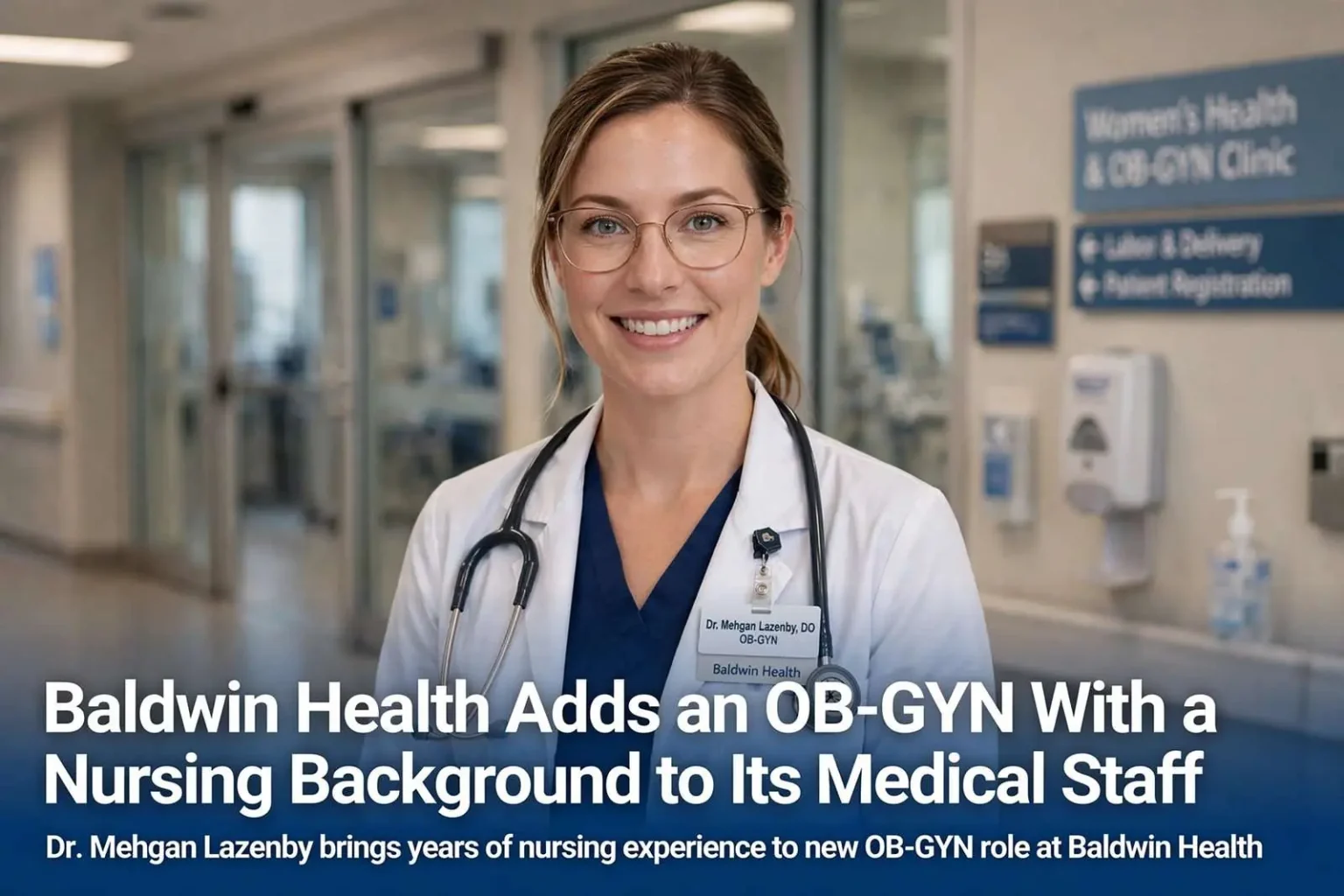
Baldwin Health has added an obstetrics and gynecology provider to its medical staff, announcing that Dr. Mehgan Lazenby has joined the hospital’s clinical team.
Lazenby provides care for women across all stages of life, with a practice that spans routine wellness exams, prenatal and pregnancy care, and complex gynecological treatments — the full breadth of a specialty that is unusual in medicine for combining a surgical discipline, a primary care relationship and the management of a healthy physiological process in the same job description.
A Career That Started at the Bedside
What distinguishes Lazenby’s path is that she practiced for years as a nurse before she practiced as a physician.
She holds a bachelor of science in nursing from Auburn University Montgomery and a master of science in nursing as an acute care nurse practitioner from the University of Alabama at Birmingham. Her clinical background includes work as a medical intensive care unit nurse at Baptist Medical Center South, service as a certified registered nurse practitioner in hospitalist and pulmonary care, and a role as a clinical faculty member at the Auburn University School of Nursing.
Each of those roles carries a distinct kind of experience. Medical ICU nursing is continuous assessment of unstable patients — recognizing deterioration early, managing ventilated and critically ill patients, and functioning inside a team where communication failures have immediate consequences. Hospitalist and pulmonary work as a nurse practitioner involves independent clinical judgment, admitting and managing inpatients, and coordinating care across specialties. Clinical faculty work means teaching that judgment to students, which generally requires being able to explain reasoning rather than simply act on it.
Physicians who come to medicine from nursing are still a minority, and the background tends to show up in specific ways: familiarity with what the nursing staff on a unit actually needs from a physician’s orders, comfort with the operational side of a hospital, and a patient-communication style shaped by having spent long shifts at the bedside rather than short encounters in an exam room.
Medical Training and Residency
Lazenby earned her Doctor of Osteopathic Medicine from the Edward Via College of Osteopathic Medicine. She completed her residency training in obstetrics and gynecology at the University of Louisville.
Osteopathic physicians — those holding a DO rather than an MD — are fully licensed physicians in all 50 states with the same practice rights, prescribing authority and surgical privileges as their allopathic colleagues. The two training paths cover the same medical science and, since the 2020 completion of a single accreditation system for graduate medical education, DO and MD graduates now compete for and train in the same residency programs. Osteopathic medical schools add training in osteopathic manipulative medicine and have historically emphasized primary care and practice in underserved and rural areas.
Residency in obstetrics and gynecology is a four-year program that trains physicians simultaneously as surgeons and as primary care providers for women. Residents learn obstetric care from prenatal management through delivery and postpartum care, including operative deliveries and the management of high-risk pregnancies and obstetric emergencies. They also train in gynecologic surgery — abdominal, vaginal, laparoscopic and increasingly robotic approaches — and in office gynecology, including contraception, abnormal bleeding, menopause management and cancer screening.
Professional Memberships and Publications
Lazenby is a member of the American College of Obstetricians and Gynecologists and the American College of Osteopathic Obstetricians and Gynecologists.
ACOG is the specialty’s principal professional organization in the United States and the body whose practice bulletins and committee opinions function as the working standard of care for much of obstetric and gynecologic practice — the guidance that shapes decisions on screening intervals, labor management and the treatment of common conditions.
She has also contributed to clinical research published in a peer-reviewed obstetrics and gynecology journal, and she authored “Quick Pharm for Med Students,” a pharmacology reference aimed at medical trainees — a project consistent with her earlier work as nursing faculty.
Why New OB-GYNs Matter in a Coastal County
The addition of an obstetrics and gynecology provider is a routine hospital announcement, but it lands against a national backdrop that makes it less routine than it sounds.
Obstetric care has been contracting outside major metropolitan areas across the United States. Hospitals in smaller communities have closed labor and delivery units over the past two decades, citing the combination of low delivery volumes, the cost of maintaining round-the-clock obstetric and anesthesia coverage, malpractice insurance costs and difficulty recruiting. The result, documented extensively in health services research, is that a substantial share of U.S. counties have no hospital obstetric services and no obstetric provider at all — a pattern researchers describe as maternity care deserts.
Distance to obstetric care is not a neutral inconvenience. Longer travel is associated with more out-of-hospital and unplanned births, less prenatal care and worse outcomes for both mothers and infants. That makes the presence of a practicing OB-GYN a genuine measure of a community’s health infrastructure rather than a matter of convenience.
Baldwin County is one of Alabama’s fastest-growing counties, a growth pattern that steadily increases demand for exactly the services an obstetrics and gynecology practice provides — prenatal care for new families moving in, and routine and specialty gynecologic care for a population that is also aging.
What the Practice Covers
The description Baldwin Health provided — routine wellness exams, prenatal and pregnancy care, and complex gynecological treatments — covers three fairly different modes of practice.
Routine wellness care is preventive: cervical cancer screening, breast health, contraceptive counseling, screening for sexually transmitted infections, and the ongoing relationship that makes it possible for a patient to raise a problem early. For many women, an OB-GYN functions as the primary point of contact with the health system for years at a time.
Prenatal and pregnancy care is longitudinal management of a healthy process with periodic risk assessment built in — monitoring fetal growth, screening for conditions such as gestational diabetes and preeclampsia, and preparing for delivery, along with postpartum care that includes screening for postpartum depression.
Complex gynecologic treatment covers conditions including endometriosis, fibroids, abnormal uterine bleeding, pelvic pain, ovarian cysts and pelvic floor disorders, managed medically or surgically depending on the case.
Patients seeking information about scheduling or about whether a particular insurance plan is accepted should contact Baldwin Health directly.