Baldwin Judge Charles Partin Calls Retirement Rumors Premature
Baldwin County Circuit Judge Charles Partin, a 25-year veteran of the bench who recently presided over the Steve Nodine murder trial, said talk of his imminent retirement was at least premature.
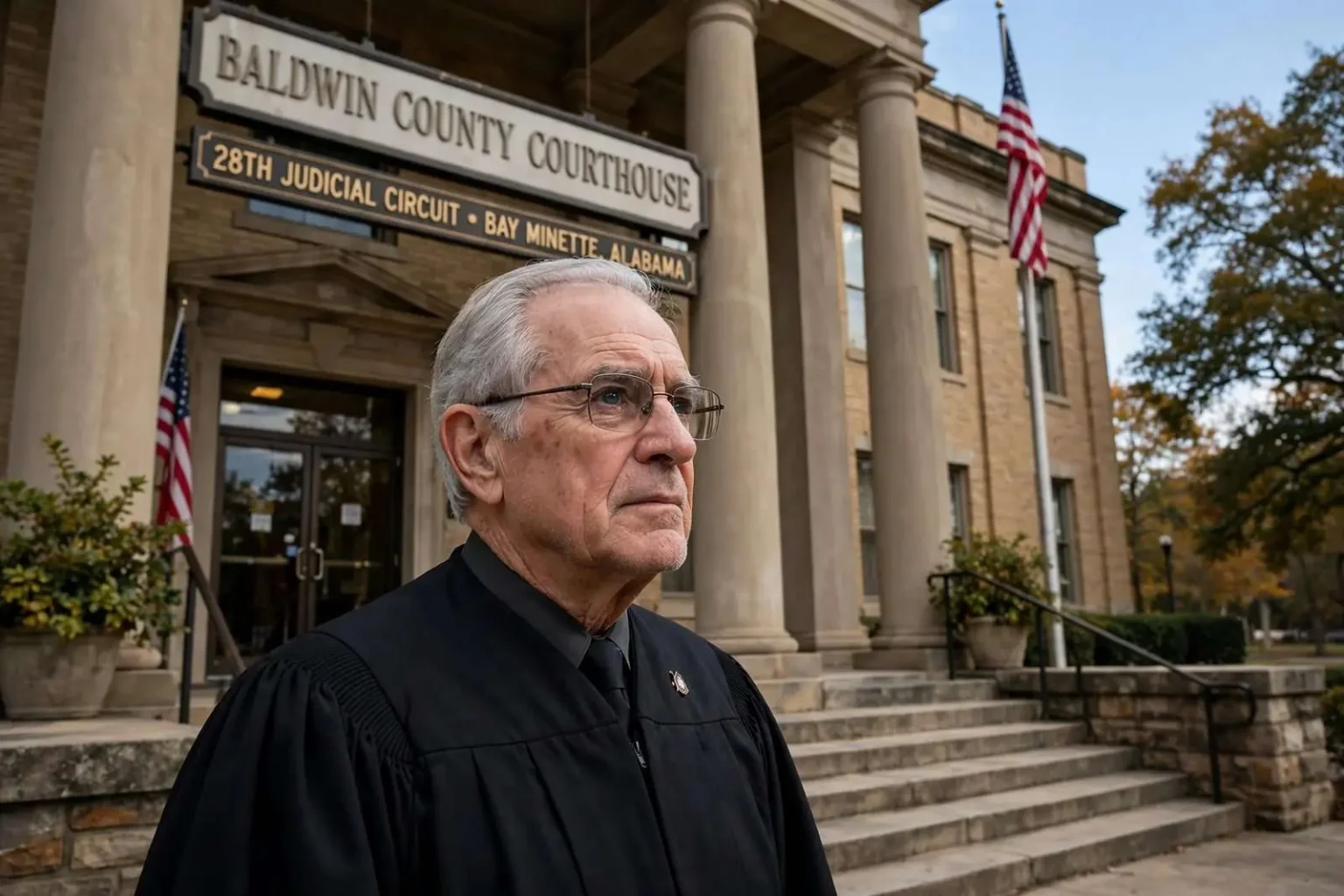
Continuing rumors of Baldwin County Circuit Judge Charles Partin’s pending retirement were, at the very least, premature, according to the 25-year veteran of the bench himself.
Setting the Record Straight
Partin said he planned to serve out his term, which would expire in two years, but did not intend to run for re-election in the 2012 election cycle. That distinction, staying on the bench for the balance of his current term while declining to seek another, appeared to be the source of the confusion that had fed the speculation.
Circuit judgeships in Alabama carry six-year terms, and a decision not to seek re-election — unlike a resignation — leaves the judge in place for years, with the seat only opening when the term actually ends. Anyone hearing secondhand that a judge would “not be on the ballot in 2012” could easily conclude an early exit was coming, and in Baldwin County’s tight legal community the conclusion traveled fast.
A courthouse, Partin agreed, can serve as a hot-house for rumors. He suggested that health issues, now resolved, along with his purchase of a house on the Bon Secour River in south Baldwin County, had prompted talk of an earlier departure. Neither, he indicated, signaled an imminent exit from the bench.
The two threads made for plausible-sounding gossip, which is precisely why they spread. A move to a quiet river house in the county’s southern end reads, to a certain kind of courthouse observer, like a man preparing to slow down; a health scare does the rest. Partin’s point was that both readings were wrong — the house was a home, the health matter was settled, and neither had anything to do with the docket.
A High-Profile Docket
Partin’s name carried added weight because of a case he had recently overseen. He presided over the trial of former Mobile County Commissioner Steve Nodine, who was accused of murder in the shooting death of his paramour, Angel Downs. That proceeding had drawn intense regional attention, keeping the judge and his courtroom in the public eye.
The Nodine case was the kind that turns a trial judge into a familiar name. The shooting of Downs, a Gulf Shores real estate agent, outside her home in May had been covered daily across Mobile Bay’s television stations and newspapers, and every pretrial ruling out of Partin’s courtroom — on venue, evidence and scheduling — was itself news. Presiding over such a case places unusual demands on a judge: every decision is second-guessed by partisans on both sides, and the courtroom fills with reporters on days when the calendar would otherwise be routine.
The trial itself unfolded with all the complications such cases attract: a fight over where and how the case would be tried, disputes over evidence gathered from the victim’s phone and the defendant’s records, and defense arguments about the circumstances of the shooting that kept the jury’s deliberations in the headlines. The proceeding stretched across weeks of testimony, watched closely across both sides of Mobile Bay, and its twists kept Partin’s courtroom calendar — ordinarily the least newsworthy document in the courthouse — a matter of daily public interest. For a judge whose rulings had rarely drawn notice outside the legal community, the case changed the scale of public attention overnight.
Set to turn 64 on Sunday, Jan. 9, Partin had served as a circuit judge in Baldwin County since 1985. Over a quarter century on the bench, he had become a fixture of the county’s judicial system, and his plans naturally became a subject of interest among lawyers, litigants and courthouse observers alike.
A quarter century also means an entire generation of Baldwin County lawyers has never practiced in front of anyone else. Judges who serve that long shape the local bar in ways that outlast any single case — through sentencing patterns, trial management, the standards they enforce in discovery, and the examples they set for younger attorneys watching how a courtroom should be run. Partin’s courtroom had been a constant through Baldwin County’s transformation from a rural farming county into one of the fastest-growing in Alabama, with the caseload growth to prove it.
The circuit court itself sits within Alabama’s 28th Judicial Circuit, which covers Baldwin County alone — the county is populous enough to constitute its own circuit, unlike the sparser counties paired together elsewhere in the state. Based in Bay Minette, the seat of county government and home to the Baldwin County Courthouse, the circuit’s judges handle the full range of felony cases, major civil litigation, and family matters from across a county that stretches from Mobile Bay to the Florida line.
What Comes After a Long Bench
Looking ahead, Partin’s decision not to seek re-election in 2012 meant that, in due course, the seat would open, prompting the kind of competition that accompanies any vacancy on the circuit bench. In practice, that means an open seat attracts interest years in advance: practicing attorneys gauge the field, party committees take soundings, and the eventual race — a circuit judgeship in one of the state’s largest counties is a sought-after post — draws candidates long before the qualifying deadline.
Alabama elects its judges in partisan contests, which adds a layer to any open-seat math. A vacancy on the Baldwin circuit would be contested in a primary before it ever reached the general election, and the county’s shifting political balance made the timing a topic of its own speculation. For the moment, however, Partin made clear that he intended to remain in place through the end of his current term.
The episode illustrated how readily rumors can take hold in a legal community attuned to any hint of change on the bench. A judge’s move to a new home, a resolved health matter, or a stray comment can quickly harden into assumptions about retirement. Partin’s response, measured and specific, aimed to separate fact from conjecture.
The growth of the county’s docket made the question of who sits on the bench more than administrative trivia. Baldwin County’s population boom had filled the circuit with subdivisions, schools and businesses, and with them the full range of modern litigation — contract fights from the construction economy, family court calendars stretched by growth, and criminal dockets fed by the county’s corridors of Interstate 10 and U.S. 98. Each retiring judge represented thousands of pending files that would pass to a successor, and each successor election drew candidates who understood exactly how much that caseload was worth in experience.
The judge’s account tied the chatter to ordinary life events rather than any professional dissatisfaction, and his willingness to address it directly reflected an effort to keep the focus on the work of the court rather than on speculation about his future. Judges rarely issue statements about their own plans, precisely because anything said becomes courthouse currency; the decision to speak at all signaled that the rumors had reached a volume worth correcting.
For Baldwin County, the practical takeaway was continuity in the near term and a known transition point down the road. With Partin committing to finish his term while ruling out another campaign, the county could anticipate an eventual contest for the seat in the 2012 cycle, even as the veteran jurist continued to preside over the cases before him, including the high-profile matters that had recently defined his docket.
The timeline mattered for more than courthouse gossip. Defendants awaiting trial, civil litigants scheduling complex cases, and attorneys managing calendars all plan around who will be sitting on the bench; a long-tenured judge’s reassignment or retirement reshuffles dockets and forces adjournments. Certainty about two more years — with a defined end after that — was worth more to the bar than the rumor it replaced.
It also mattered to the high-profile Nodine case and others like it, where continuity on the bench is not a small thing. High-visibility prosecutions gather layers of rulings — on motions, evidence and procedure — that a new judge would have to absorb from scratch. Keeping Partin in place through the term kept those cases on the rails they had been traveling.
By the time the speculation had run its course, the record stood plainly: the rumors were premature, the term would be served, and 2012 would bring an open seat in its own good time. In a county growing as quickly as Baldwin, even the courthouse could not stay out of the churn — but for two more years, at least, one courtroom on the second floor in Bay Minette would keep operating exactly as it had for a quarter century.
Rumors of this kind are a fixture of any elected judiciary. Because judges cannot campaign openly on pending matters and rarely speak to the press about themselves, the information vacuum around a judge’s plans fills quickly with whatever the legal community is already murmuring — and Baldwin County’s bench, serving a county of nearly 200,000 at the time, was large enough that any change rippled through dozens of courtrooms and hundreds of law practices. A judge’s simple act of buying a house across the county was, in that environment, enough to start a story that took a direct statement to stop.