LOXLEY, Ala. — Baldwin Preparatory Academy is opening the school year with an expanded slate of career programs, new industry credentials and an incoming class of 233 tenth-grade students. The most substantial additions land in health science, a field that has become one of the strongest drivers of hiring across Baldwin County and the wider Gulf Coast.
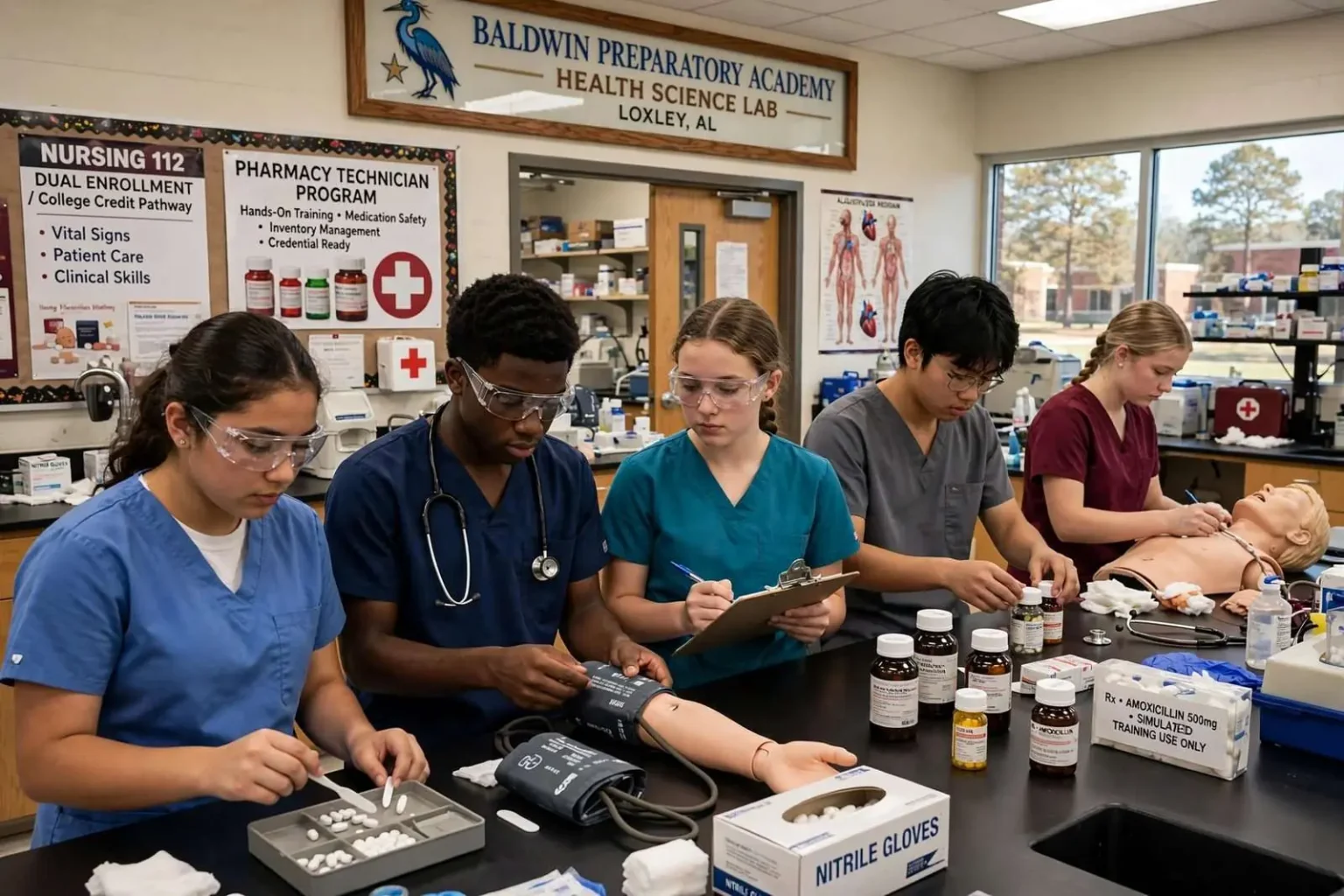
Students at the Loxley campus can now enroll in Nursing 112, a dual-enrollment course that carries college credit, and can participate in a pharmacy technician program that pairs classroom instruction with hands-on training. Both additions are aimed at students who want to leave high school with something concrete in hand — transcripted college coursework, an industry credential, or a head start on a license — rather than a general diploma alone.
What dual enrollment actually delivers
Dual enrollment allows high school students to earn college credit while still in secondary school. The mechanics are straightforward: a student takes a college-level course, often taught by a college-approved instructor or delivered through a partner institution, and the credit counts on both the high school and the college transcript. In a nursing pathway, that matters more than it might in a general elective.
Nursing programs are competitive and sequential — prerequisite courses gate entry, and completing one before graduation can move a student meaningfully forward in a pipeline that otherwise takes years to navigate. A student who finishes Nursing 112 in high school arrives at a college nursing program with a required course already completed, which can shorten the time to admission and reduce the total cost of a degree. For families in Baldwin County, where tuition and fees at public institutions remain a real budget item, that head start has practical value.
The pharmacy technician program operates on a different logic. Pharmacy technicians can enter the workforce with a credential rather than a degree, which means a student who completes the program can be employed in a healthcare setting shortly after graduation while deciding whether to pursue further education. Classroom instruction covers the knowledge base — medications, terminology, safety and recordkeeping — while the hands-on training component gives students practice with the tasks they would perform in a pharmacy environment, from preparing and labeling under supervision to managing inventory and working with patients at the counter.
The academy’s model deliberately puts career coursework on the same footing as academic coursework. Rather than treating career and technical education as a separate track, Baldwin Preparatory Academy builds its schedule around programs that lead somewhere specific — a credential, a license pathway, a stackable set of college credits — and health science has quickly become one of the areas where that design is most visible. The new industry credentials the school is adding this year are intended to give students documentation that employers can verify, an expectation that has grown steadily in healthcare hiring across the region.
For the 233 sophomores arriving this fall, the timing is deliberate. Tenth grade is the point where the academy’s pathways begin in earnest, giving students two full years — and in many cases additional summer terms — to move through a program before graduation. Starting in the sophomore year also leaves room to adjust: a student who discovers pharmacy technology is not the right fit can redirect toward another pathway without losing ground toward a diploma.
Meeting a regional need
Baldwin County’s healthcare sector has grown alongside its population, and staffing shortages in nursing and pharmacy support roles have been persistent across the Gulf Coast. The county has added residents faster than nearly any other in Alabama over the past two decades, and that growth has pulled hospitals, outpatient clinics, physician practices, long-term care facilities and retail pharmacies into communities from Fairhope and Daphne to Foley, Gulf Shores and Bay Minette. Each of those employers needs credentialed support staff, and each has struggled at times to find enough of them.
Programs that produce credentialed graduates locally address that gap more directly than recruitment from outside the region. Workers who train where they live tend to stay where they live, and a student who completes a pharmacy technician program in Loxley is a plausible employee for a pharmacy in Robertsdale or Spanish Fort a few years later. That local loop — train here, work here — is precisely what workforce developers in Baldwin County have tried to build as the county’s economy has shifted from a largely agricultural and tourism base toward a broader mix that includes healthcare, aerospace and light manufacturing.
The regional shortage is not unique to Baldwin County. Communities across the Gulf Coast have wrestled for years with a mismatch between the number of nursing and allied-health positions available and the number of qualified candidates to fill them, a problem that has intensified as the population ages and as healthcare delivery shifts toward outpatient and clinic settings. Support roles such as pharmacy technician form the entry tier of that workforce, and they are often the point where shortages bite first, because turnover is high and the credential requirements, while real, are attainable in months rather than years.
School-based programs are one of the responses that has drawn the widest agreement across otherwise-divergent views on healthcare workforce policy. Introducing students to health science careers while they are still in high school expands the pool of candidates who consider the field at all, and pairing that exposure with actual credentials means a graduate can go to work immediately, then decide whether to climb further — toward licensed practical nursing, registered nursing, or a pharmacy degree — with income coming in and employer experience accumulating along the way.
A growing sophomore class
The arrival of 233 incoming tenth graders reflects continued demand for the academy’s model. Enrollment at career academies tends to move with the perceived value of what they offer, and a class of that size arriving together indicates that families across Baldwin County see the programs as worth choosing. It also gives the school a cohort to build around: sophomores who begin a pathway together in the fall can progress through sequenced courses as a group, which simplifies scheduling and gives instructors classes that move at a similar pace.
Career and technical education has shifted considerably in public perception over the past decade, from a track once regarded as an alternative to college toward one increasingly seen as a parallel path — or, in the case of dual enrollment, a head start on the same path. That reframing has been national in scope, but it has particular resonance in a fast-growing county like Baldwin, where employers in healthcare, construction, aviation and marine trades have all voiced difficulty filling skilled positions. A high school graduate with a credential in hand no longer reads as someone who opted out of higher education; increasingly, it reads as someone who started early.
The dual-enrollment structure captures that shift most clearly. A student in Nursing 112 is simultaneously a high school student and a college student, and the credit earned counts in both directions. Under that framing, the old either-or choice — college or career training — dissolves, and the practical question becomes which sequence of courses and credentials gets a particular student to a particular goal fastest and at the lowest cost.
The year ahead in Loxley
The school year is underway in Loxley. The addition of nursing and pharmacy technology programs reflects growing demand for healthcare professionals in the region, and the academy’s health science students will be watched closely by school officials, college partners and employers alike to see how the first cohorts move through the new courses. Nursing 112 is sequenced to fit within the academic year, and the pharmacy technician program is structured so that classroom instruction and hands-on training reinforce one another rather than running on separate tracks.
Preparatory academies serve an important role in preparing students for careers in critical fields. By concentrating equipment, instructors and employer partnerships in a single program rather than spreading them across a comprehensive high school’s elective catalog, an academy can offer depth that individual schools cannot — simulation and lab work for health science students, for example, or industry-standard tools in skilled trades programs. That concentration is also what makes credential attainment realistic: students get enough hours in the discipline to reach a certification standard, not merely an introduction.
The arrival of 233 sophomores indicates sustained interest in these programs, and the year that is just beginning will show whether the expanded health science offerings convert that interest into completed credentials. For the students themselves, the near-term measure is simpler: passing a college-level nursing course, finishing pharmacy technician training, and walking out of high school with a credential that means something to an employer. For the school, the measure is whether the model continues to attract families at a time when Baldwin County’s public school system is among the fastest-growing in the state.
A piece of a larger regional picture
The events described in this report connect to broader patterns across the Gulf Coast region, where communities continue to navigate growth, infrastructure needs, and the challenges of maintaining quality of life. Local institutions, government agencies, and community organizations all play roles in addressing these issues, and school systems — which must anticipate the workforce their graduates will enter a decade out — are among the most consequential of those institutions. A county that cannot staff its clinics and pharmacies feels the gap in appointment wait times, in overextended nurses, and in the cost of recruiting workers from outside the region.
The outcomes of these efforts will shape the region’s future development and resilience. Every student who completes a nursing prerequisite or a pharmacy technician credential in Loxley represents a small piece of the answer to a question Baldwin County will be asking for years: whether the local pipeline of healthcare workers can keep pace with the population the county keeps adding. The health science pathways added this year are a modest but concrete piece of that larger work, and the sophomores now beginning them are the first full test of the design.